
Search All Items
- Filters:
- Language
- English 1212
- Spanish 11
- ENGLISH 1
- English 1
- census_013 1
- Type
- Image 1098
- Text 63
- Still Image 39
- Text 22
- Textual 1
Search Results 1221 to 1230 of 1232
-
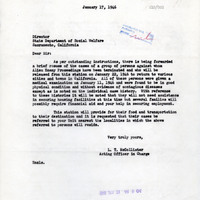
Correspondence from L. T. McCollister to Director of State Department of Social Welfare regarding individuals released from incarceration camps
Date: January 17, 1946
-
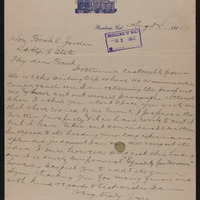
Charles W. Bell’s argument for Senate Constitutional Amendment No. 8 was the official argument in favor of the women's suffrage amendment that appeared in California's voter information pamphlet before the October 10, 1911 special election. Its purpose was to persuade California's male voters to approve Proposition 4, which would amend the California Constitution to grant women the right to vote. Senator Charles W. Bell was an ardent supporter of women’s suffrage who had spent years campaigning for the cause. In the 15-page argument, Bell explains that women deserve the right to vote because they are educated, civic-minded citizens whose participation will strengthen government. He urges voters to approve the amendment, asserting that equal suffrage would make California's democracy more representative and effective.
Date: August 2, 1911
-
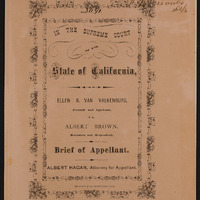
A Brief of Appellant is filed in the appellate court by the party who lost in the previous trial and argues in favor of appealing a lower court’s decision. Ellen Van Valkenburg began an important legal battle for women’s enfranchisement in California on July 21, 1871, when she requested that Santa Cruz County Clerk Albert Brown enter her name in the Great Register of voters. After Brown (a willing accomplice in helping her bring the case to court) refused to register her, Van Valkenburg and her lawyer, Santa Cruz Judge Albert Hagan, began legal proceedings by requesting a writ of mandamus, a judicial remedy used to compel agencies to perform ministerial acts, such as registering voters. Van Valkenburg and Hagan argued her case by citing the 14th Amendment of the U.S. Constitution. The new amendment, ratified 3 years earlier in 1868, defined all persons born or naturalized in the U.S. as citizens protected by civil rights. Van Valkenburg and Hagan asserted that American women were considered citizens under this amendment, and that citizenship automatically granted absolute rights, including the right to vote. The case first went to California’s Third District Court. Many of America’s most prominent suffragists, including Elizabeth Cady Stanton and Susan B. Anthony, were with Van Valkenburg in Santa Cruz when the lower court ruled against her on August 16, 1871. Van Valkenburg and Hagan swiftly appealed this decision through the Supreme Court of California. In the end, the Supreme Court of California upheld the lower court’s verdict under the reasoning that as a white American woman, Van Valkenburg already had citizenship and civil rights prior to the passage of the 14th amendment, and that the 14th amendment did not provide her with any additional political rights, such as the right to vote. While Van Valkenburg lost her case, and subsequent lawsuits failed to secure women's suffrage nationwide, the case stands as a critical early example of legal advocacy for women's political rights in California.
Date: September 29, 1871
-
Discussion from Helen Van Gulpen Harris to Mr. Harrison regarding rights of aliens to hold property
Date: June 26, 1942
-
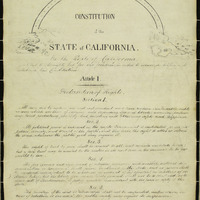
California’s first Constitutional Convention was held in Monterey in 1849. The original constitution, published in both English and Spanish the same year, was written by 48 delegates on nineteen pages of parchment. Article II, The Right to Suffrage stipulates that only white males have the right to suffrage.
Date: 1849
-
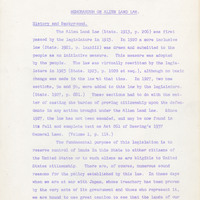
Summary of the history of the Alien Land Laws including deciding court cases; Sections: History and Background, Provisions of Existing Law; Persons Affected by this Law, Property Affected by the Law
Date: Undated
-
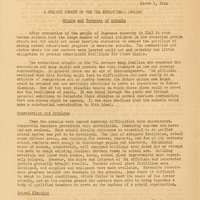
Summarative report on the WRA Educational Program including scope, employees, cost, and future goals
Date: March 1, 1944
-
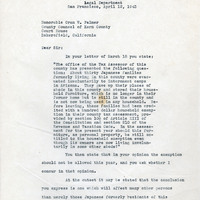
Correspondence from Robert W. Kenny (by H. H. Linney) to Oran W. Palmer regarding taxation of Japanese families during incarceration
Date: April 12, 1943