
Search All Items
- Filters:
- Language
- English 6219
- Spanish 19
- ENGLISH 2
- English 1
- contra_costa_schedule_1_volume_1 1
- Type
- Image 3871
- Still Image 1869
- Text 440
- Text 54
- Textual 2
- Image of the California Census from the records of the office of the California Secretary of State 1
Search Results 1231 to 1240 of 6312
-
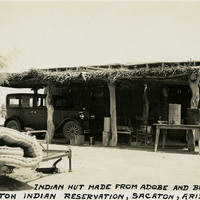
Caption: "Indian Hut Made From Adobe and Bush Branches, Sacaton Indian Reservation, Sacaton, Arizona, May, 24, 1934." View of a small adobe building with a porch area across the length of the façade. The porch is sheltered by a low roof supported by tree trunks or thick tree branches and thatched with grass or sticks. Located south of Phoenix and including the town of Sacaton, the Gila River Indian Reservation is home to members of the Akimel O’odham (Pima) and the Pee-Posh (Maricopa) tribes. The reservation was established in 1859. Eighty years later, in 1939, Congress provided for the self-governance of the reservation via the Gila River Indian Community.
Date: 5/24/1934
-
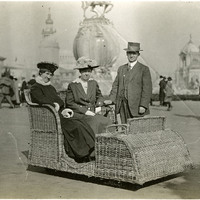
No Caption: Grace McCarthy (left) and friend sitting in the Electric Motor Chair, also known as the Osborn Electriquette, with William McCarthy standing by, at the Panama-Pacific International Exposition.
Date: 1915
-
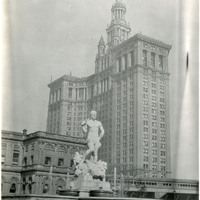
Caption: "Municipal Bldg. N.Y." c. 1925. The statue Civic Virtue Triumphant Over Unrighteousness (Frederick William MacMonnies, sculptor) stands in the foreground of this photograph. The statue, unveiled in 1922, now stands in Brooklyn's Green-Wood Cemetery. New York City's Municipal Building rises above the statue in the background. Built between 1907-1914 and designed by architect William M. Kendall, the Municipal Building was constructed in order to consolidate several different municipal agencies under one roof and thereby save the city rent for multiple buildings. In 2015, it was renamed the David N. Dinkins Municipal Building, after a former New York City mayor.
Date: 1925
-
Opinion of Attorney General Edmund G. Brown regarding application for restoration of liquor licenses
Date: November 30, 1951
-
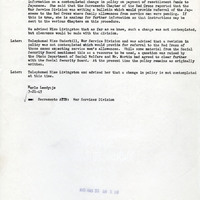
Summary of communication with the Pacific Area American Red Cross and the War Services Division regarding the Red Cross's role in resettlement
Date: March 19, 1945
-
The Census of 1852 collection includes enumerations of California's 32 counties, arranged into 126 volumes. Schedule I enumerated the county's inhabitants, while schedule II enurmerated economic production. Many pages of this volume are damaged.
Date: 1852
-
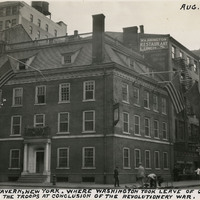
Caption: "Frances [sic] Tavern, New York. Where Washington Took Leave of Offices and Disbanded the Troops at Conclusion of the Revolutionary [sic] War. Aug. 5, 1934." Built as a family home for Etienne "Stephen" DeLancey in 1719, this building was converted to use as a tavern in 1762. It served many important functions before, during, and after the Revolutionary War, but several fires in the nineteenth century erased the building's original appearance. The Sons of the Revolution purchased the property in 1904 and embarked upon extensive restoration plans in 1907, supervised by William Mersereau. The building is now used as a museum and art gallery.
Date: 8/5/1934
-
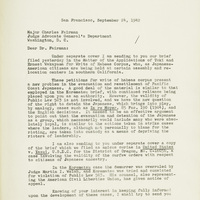
Correspondence from Herbert E. Wenig to Major Charles Fairman relating to court briefs pertaining to incarceration and other restrictions on Japanese
Date: September 24, 1942
-
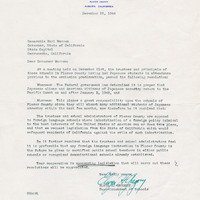
Correspondence from Elwyn H. Gregory to Earl Warren regarding resolution passed by the trustees and principals of schools in Placer County on foreign language schools
Date: December 26, 1944
-
The Census of 1852 collection includes enumerations of California's 32 counties, arranged into 126 volumes. Schedule I enumerated the county's inhabitants, while schedule II enurmerated economic production. Many pages of this volume are damaged.
Date: 1852