Search All Items
- Filters:
- Language
- English 6853
- Spanish 18
- ENGLISH 3
- English 2
- census_013 1
- contra_costa_schedule_1_volume_1 1
- Type
- Image 3886
- Still Image 2484
- Text 441
- Text 54
- Textual 2
- Image of the California Census from the records of the office of the California Secretary of State 1
Search Results 1231 to 1240 of 6969
-
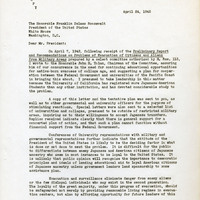
Correspondence from Robert G. Sproul to Franklin Delano Roosevelt regarding a plan for Japanese college and university students during the evacuation; See "Proposal for the Continued Collegiate Training…" (F3729_145_003a-F3729_145_003b)
Date: April 24, 1942
-
Label in photograph album for photographs 172 and 173: "City Hall Tower Before and after the Quake."
Date: Undated
-
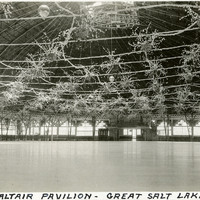
Caption: "Saltair Pavilion - Great Salt Lake," c.1923. Interior of the Saltair Pavilion on Utah's Great Salt Lake. Constructed in 1893 and designed by Richard K.A. Kletting, the Saltair resort set out to be the Western counterpart of Coney Island. The resort was a popular spot for Mormon families, only fifteen miles from Salt Lake City and overseen by Church leaders. The Church sold the building in 1906. It was later destroyed by fire in 1925, but a second pavilion was quickly built.
Date: 1923
-
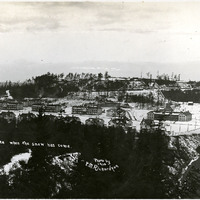
Caption: "Fort Worden when the snow has come. Greetings from Port Townsend - Wash." and "Photo by P.M. Richardson, 1910." This postcard shows an overview of Fort Worden in Port Townsend, Washington, on Admiralty Inlet of Puget Sound. Construction began on the fort in 1898, and by 1902 it was serving as an active U.S. Army base. Fort Worden was part of the "triangle of fire," three coastal defense fortifications (Fort Casey, Fort Worden, and Fort Flagler) guarding the entrance to Puget Sound. The U.S. sold the property to the state of Washington in 1957. In 1973, the fort and surrounding area opened as Fort Worden State Park.
Date: 1910