
Search All Items
Search Results 1301 to 1310 of 6229
-
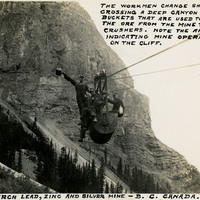
Caption: "The Monarch Lead, Zinc, and Silver Mine - B.C. Canada. The workmen change shifts by crossing a deep canyon in the buckets that are used to transport the ore from the mine to the rock crushers. Note the arrows indicating mine operations on the cliff," c. 1935.
Date: 1935
-
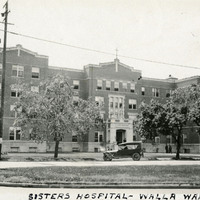
Caption: "Sisters Hospital -- Walla Walla.," ca. 1920. Five-story brick and stone building. This building is the second hospital built on the site. The first, built in the 1880s by the Sisters of Providence, burned in a 1915 fire. This second building (seen here), constructed in 1916, served as the main hospital building until a new facility was constructed in 1976. The resulting new complex of buildings is now called the Providence St. Mary Medical Center.
Date: 1920
-
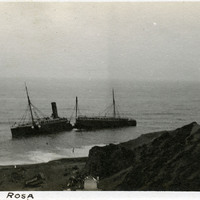
Caption: "S.S. Santa Rosa." Wreck of the S.S. Santa Rosa off Point Arguello in Santa Barbara County. The steamship ran aground on July 6, 1911. Unable to break free, the turbulent waters eventually cracked the ship in half. All two hundred passengers got to shore alive, the only fatalities coming when four sailors were accidentally thrown out of a lifeboat by rough seas while attempting to establish a land line to stabilize the wreck.
Date: 1911
-
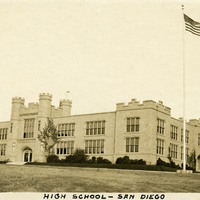
Caption: "High School -- San Diego," c. 1910. By 1902 San Diego's schools had become overcrowded enough to warrant the construction of a new high school building. Completed in 1907 and designed by F.S. Allen, the new building was quickly nicknamed the "Grey Castle on the Hill" in reference to its castle-like parapets and towers. The Grey Castle was torn down in 1975 to make way for a facility in compliance with new earthquake safety laws.
Date: 1910
-
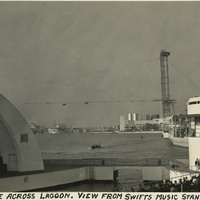
Caption: "Sky Ride Across Lagoon. View from Swifts Music Stand. Chicago Fair, Sept. 18, 1934." One of the 628-foot towers making up the Sky Ride, an aerial tramway which carried fair goers in small gondolas or trams (visible in the center of the photograph) over the harbor around which the Century of Progress Exposition was held. Over 4.5 million passengers enjoyed the views from the Sky Ride before it was demolished after the conclusion of the exposition in 1934. The Exposition, a world fair attended by thirty-nine million people, celebrated Chicago's one-hundred year anniversary of incorporation. Originally planned to only run from May to November in 1933, it was such a success that its organizers decided to keep it running for a second season from May through October the following year. The central theme of the Exposition was technological innovation, with a motto of "Science Finds, Industry Applies, Man Conforms."
Date: 9/18/1934
-
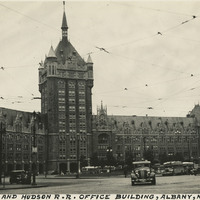
Caption: "Delaware and Hudson R.R. Office Building, Albany, N.Y., Sept. 7, 1934." View of the enormous Gothic building constructed by and for the Delaware and Hudson Railroad Company between 1914-1918. It also housed the offices of the Albany Evening Journal. A small city park sits in front of the building's central tower, surrounded on all sides by a looped street originally intended for trolley cars. The building was gradually abandoned by the businesses within, until purchased in 1973 by the State University of New York (SUNY). SUNY renovated the building for use as its administrative offices, a purpose which it still serves today.
Date: 9/7/1934
-
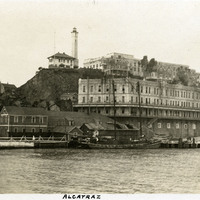
Caption: "Alcatraz," c. 1920. Image of lighthouse, main prison building (at top of hill), residences, and wharf facilities at Alcatraz Island prior to its designation as a federal penitentiary in 1934. Built in 1859 by the U.S. Army for coastal defense purposes, the fort at Alcatraz began serving as a prison in 1861. It ceased function as a defense fortification and became the Pacific Branch of the U.S. Military Prison in 1907. Over the next two decades the facilities on the island were modified and modernized.
Date: 1920
-
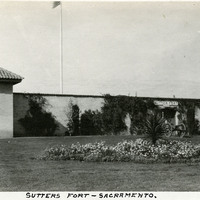
Caption: "Sutters [sic] Fort - Sacramento," c. 1920, shows a gun tower at Sutter's Fort, and a gate bracketed by two cannons. John Sutter established the fort in 1839, calling it New Helvetia. After the discovery of gold at one of Sutter's mills (at Coloma, on the American River), almost all of the fort's inhabitants left for the gold fields in the foothills. The fort deteriorated until being restored from 1891-1893. The Native Sons of the Golden West were influential in the restoration. The fort is now the site of a State Historic Park. See also 96-07-08-alb05-117 and 118.
Date: 1920
-
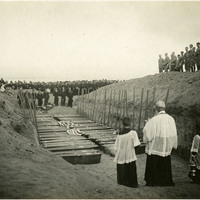
No Caption: See also 96-07-08-alb08-217 with caption: "Last Rites," shows a grave site with dozens of caskets ready for burial. A priest and two altar boys stand at one side of the caskets, while a large group of US Navy sailors looks on from the other side. While sailing from port in San Diego on the morning of July 21, 1905, the boiler of the USS Bennington exploded, killing sixty-six of her crew. The victims were laid to rest in the cemetery at Fort Rosecrans.
Date: 1905
-
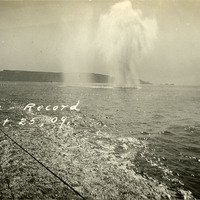
Caption: "#4 -- Record Oct 25, 09." This postcard shows plume of seawater thrown up by a mortar shell during target practice at Fort Point. The facilities at Fort Point were part of an effort by the U.S. government to protect the Golden Gate, entrance to the San Francisco Bay. Built between 1853-1861, the fort included emplacements for 141 guns but never fired a weapon in defense of the Bay. Its name was officially changed in 1882 to Fort Winfield Scott, but in 1886 the fort was officially downgraded to a sub-post of the San Francisco Presidio and the name discontinued. It was resurrected in 1912, with the establishment of a coastal artillery fortification at the Presidio, called, once again, Fort Winfield Scott.
Date: 10/25/1909