Search All Items
- Filters:
- Language
- English 4770
- Spanish 11
- ENGLISH 2
- English 1
- census_013 1
- contra_costa_schedule_1_volume_1 1
- Type
- Image 3784
- Still Image 594
- Text 377
- Text 22
- Textual 2
- Image of the California Census from the records of the office of the California Secretary of State 1
Search Results 1301 to 1310 of 4833
-
Caption: "Maguey, a most useful plant from which is made paper, rope, twine, cloth, vinegar, molases [sic], medicine and native drinks, pulque, mezcal & tequila."
Date: 1938
-
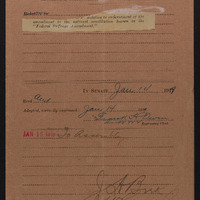
In addition to granting women the right to vote, the 1911 women’s suffrage amendment also paved the way for women to hold political office in California. In 1918, Esto B. Broughton, Elizabeth Hughes, Anna L. Saylor, and Grace S. Dorris became the first four women elected to the California State Assembly. Though fifteen states had already granted women full voting rights, a federal amendment was required to secure nationwide suffrage. To push for this national change, two almost identical resolutions were introduced on January 9, 1919 to urge the U.S. Congress to move forward with “the amendment to the National Constitution known as ‘The Federal Suffrage Amendment.’". On just her third day in office, newly elected Assemblywoman Grace S. Dorris introduced Assembly Joint Resolution No. 1. Simultaneously, Senate Joint Resolution No. 3 was introduced by Senator Burnett, a male colleague in the State Senate. While Dorris's historic Assembly bill ultimately died in committee, its twin Senate resolution successfully advanced, passing both chambers on January 17, 1919.
Date: January 1919
-
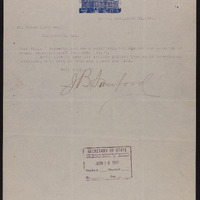
J. B. Sanford was a California State Senator representing the 4th Senate District and served as Chairman of the Democratic Caucus during the 1911 legislative session. He was one of the most prominent legislative opponents of women's suffrage in California. Sanford authored the official ballot argument against Senate Constitutional Amendment No. 8 (Proposition 4). In it, Sanford argues that women should not be granted the right to vote because suffrage is a privilege rather than an inherent right. He asserts that political involvement would distract women from their primary domestic duties, disrupt traditional gender roles, and ultimately harm the family structure. Furthermore, he claims that men already adequately protected women's interests in government and that granting women the vote would lead to increased social instability.
Date: June 24, 1911
-
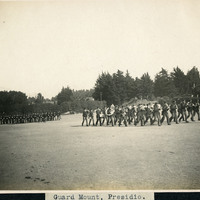
Caption: "Guard Mount. Presidio," c. 1906, shows two groups of men in formation on the Presidio grounds. One group of men is playing musical instruments, while the other group is carrying firearms. Established in 1776 by Spanish explorers, the Presidio is a fortified location overlooking the Golden Gate, the entrance into San Francisco Bay. It was closed as a military structure in 1995, and is now a park within the Golden Gate National Recreation Area.
Date: 1906
-
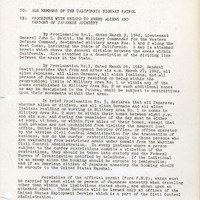
Bulletin from E. Raymond Cato to All Members of the California Highway Patrol regarding procedures pertaining to curfews, permits, and prohibited articles
Date: April 14, 1942
-
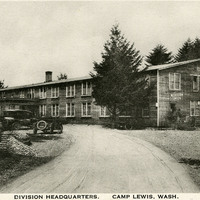
Caption: "Division Headquarters. Camp Lewis, Wash.," c. 1918. Shows the two-story building that served as Division Headquarters for Camp Lewis in Washington. The Camp was established by the U.S. Army in 1917, as part of the U.S.'s preparations for eventual entry into World War I. Rapid construction had the camp ready to house 60,000 men within a few months. The site is still in use as a military facility, under the name Fort Lewis.
Date: 1918
-
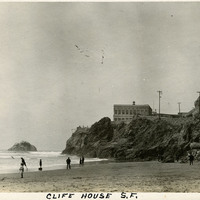
Caption: "Clife [sic] House S.F.," c. 1908-1912. View of San Francisco's Cliff House overlooking Ocean Beach. The building shown here is the fourth iteration of the Cliff House, a neo-classical design built after a fire destroyed the Victorian structure previously at the site in 1907. Reconstruction of the iconic restaurant began in 1908, and a new Cliff House opened in 1909 (the building in this photograph). This neo-classical building was extensively remodeled in the 1930s.
Date: 1908
-
Caption: "Palofax [sic] St. Pensacola, Florida, June 21, 34." Street scene on Palafox Street in Pensacola. In the foreground the street is lined with trees, while a city center is visible in the distance.
Date: 6/21/1934
-
Correspondence from Charles F. Miller to Charles M. Wollenberg regarding denial of resettlement aid in Tulare County; Attached is a memo on same subject
Date: November 16, 1945