
Search All Items
Search Results 1311 to 1320 of 6229
-
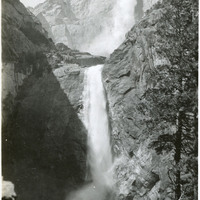
Caption: "Yosemite Falls," c. 1917. Both Upper and Lower Yosemite Falls can be seen in this photograph, taken at a location near the base of Lower Yosemite Fall. The highest waterfall in Yosemite National Park, it is made up of two successive cascades falling a total of 2,425 feet from the top of the Upper Fall to the base of the Lower Fall. The Upper Fall alone is 1,430 feet high, and is one of the top twenty highest waterfalls in the world.
Date: 1917
-
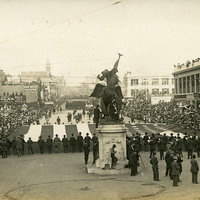
No Caption: A view of the large crowds surrounding an enormous United States flag and the Spanish-American War Memorial (Douglas Tildon, sculptor) at the Portola Festival of 1909. The Portola Festival was a grand celebration devised to commemorate the discovery of San Francisco Bay by Gaspar De Portola, and for the public to celebrate the future of the rebuilt city after the 1906 earthquake and fires.
Date: 1909
-
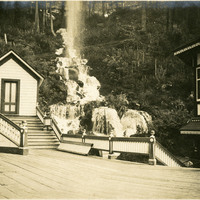
No Caption: See also 96-07-08-alb03-070 with caption: "Shasta Springs." Waterfall, hillside, and buildings at Shasta Springs, c. 1910. Shasta Springs, just north of Dunsmuir, California, in the Trinity Mountains, was a resort area in the late nineteenth and early twentieth centuries. It centered around natural springs, which became a featured stop on the Southern Pacific Railroad's Shasta Route. The resort operated until the 1950s, when it was purchased by private interests.
Date: 1910
-
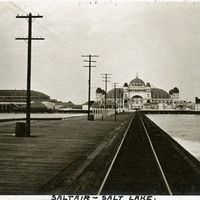
Caption: "Saltair -- Salt Lake." View of the first Saltair resort pavilion and surrounding buildings. Constructed in 1893 and designed by Richard K.A. Kletting, the pavilion hovered above the Great Salt Lake on more than 2,000 posts and pilings. The resort was a popular spot for Mormon families, only fifteen miles from Salt Lake City and overseen by Church leaders. The Church sold the building in 1906. It was later destroyed by fire in 1925, but a second pavilion was quickly built.
Date: 1916
-
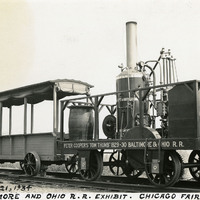
Caption: "Sept. 21, 1934, Baltimore and Ohio R.R. Exhibit. Chicago Fair." Shows a replica of the Tom Thumb, an early steam locomotive built by Peter Cooper in 1830 for the Baltimore and Ohio Railroad. This replica was displayed at the Century of Progress Exposition in Chicago, a world's fair celebrating the city's one-hundred year anniversary of incorporation. This photograph was loose in the box with Album 11.
Date: 9/21/1934
-
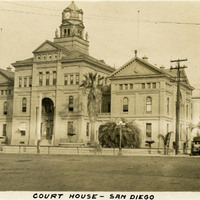
Caption: "Court House -- San Diego," c. 1910. View of the second courthouse built by San Diego County, completed in 1889. Designed by architectural firm Cornstock & Trotsche of San Francisco, this elaborate building featured a bell and clock tower, statues of four presidents, and 42 stained-glass windows honoring each state in the Union at the time of installation. The tower was removed in 1939. Twenty years later, the entire building was demolished in favor of a newer facility.
Date: 1910
-
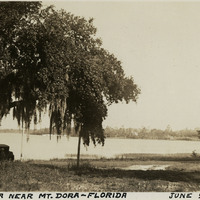
Caption: "Lake Dora near Mt. Dora -- Florida, June 26, 1934." View of Lake Dora, near the town of Mount Dora in Florida. Grace McCarthy can be seen standing next to an automobile in the lower left-hand corner of the photograph. Mount Dora, settled in 1874, is thus named because the town sits on a low plateau approximately 184 feet above sea level, an unusual feature in a state whose mean elevation above sea level is 100 feet.
Date: 6/26/1934
-
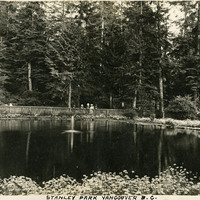
Caption: "Stanley Park Vancouver B.C.," c. 1908-1912. Shows a pond with central fountain, surrounded by lush vegetation including evergreen trees. A group of people stands at the pond's edge in the distance. The City of Vancouver opened Stanley Park in 1888. The 405-hectare park is even now thickly forested, and remains Vancouver's largest park. It is located on the northern edge of the city, surrounded on three sides by Vancouver Harbor and English Bay.
Date: 1908
-
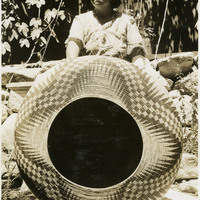
No Caption: Pictured is Yosemite master basket weaver, Lucy Parker Telles, a Mono Lake Paiute, who lived at Yosemite and Mono Lake. Telles was one of a group of Mono-Paiute women renowned for the artistry of their stunning baskets, many of which they sold to Yosemite visitors. Here, Telles poses with her beautiful 36" basket, which took her four years to complete, and which captured first prize at the 1933 World's Fair in Chicago. 1935.
Date: 1935
-
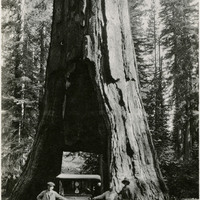
Caption: "California - Living Giant - Mariposa Grove," c. 1917. William and Grace McCarthy, with an unidentified friend, pose with their vehicle in the tunnel through the California Tree, a Giant Sequoia in the Mariposa Grove of Yosemite National Park. The tunnel was cut through the tree in 1895 to facilitate travel on the road into the grove, and also as a tourist attraction. It is now the only living Giant Sequoia with a tunnel cut through it (so-called "tunnel trees"), the others having all fallen.
Date: 1917