
Search All Items
- Filters:
- Language
- English 6219
- Spanish 19
- ENGLISH 2
- English 1
- contra_costa_schedule_1_volume_1 1
- Type
- Image 3871
- Still Image 1869
- Text 440
- Text 54
- Textual 2
- Image of the California Census from the records of the office of the California Secretary of State 1
Search Results 1321 to 1330 of 6312
-
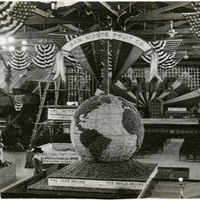
No caption. Grace McCarthy standing next to an exhibit by the San Monte Fruit Company at the 1912 "Big Week" in Salinas (Monterey County), an event still celebrated today as the Salinas Rodeo. The exhibit consists of a globe made of apples and apple slices. See also 96-07-08-alb05-062.
Date: 1912
-
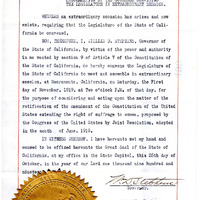
The 19th Amendment to the U.S. Constitution was passed by the U.S. House of Representatives on May 21, 1919 and the U.S. Senate on June 4, 1919 in a special congressional session. The amendment was then sent to the states for ratification. On October 25, 1919, Governor William D. Stephens issued a proclamation calling the California Legislature into a special session to consider ratification. When lawmakers convened on November 1, 1919, California ratified the amendment, becoming the 18th state to do so. The 19th Amendment received the required approval of 36 states on August 18, 1920, establishing that voting rights could not be denied on account of sex nationwide. Finally, on August 26, 1920, the 19th Amendment was added to the U.S. Constitution, granting women in the United States the right to vote on the federal level. This day is still commemorated and known today as Women’s Equality Day.
Date: October 25, 1919
-
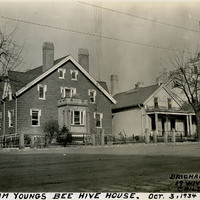
Caption: "Brigham Youngs [sic] Bee Hive House. Brigham Young had 19 Wives and 52 Children. Oct. 3, 1934." Street scene in Salt Lake City, Utah. Brigham Young, founder of the Church of Jesus Christ of Latter Day Saints built the so-called "Beehive House" in 1854 to house himself and several of his wives (Young practiced polygamy). The Beehive House is visible in the photograph at the far right, with a widow's walk featured on its roofline. Designed by Salt Lake Temple architect Truman O. Angell, the Beehive House has since been used as a residence for several dignitaries of the Mormon Church, as well as a boarding home for young Mormon women. The house was restored in the late 1950s and is now a museum. See also 96-07-08-alb11-301.
Date: 10/3/1934
-
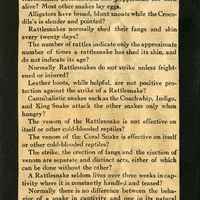
One side of a flier handed out by the San Antonio Reptile Garden in the mid-1930s entitled "Reptile Facts." The Reptile Garden opened in the 1930s as a fundraising facility for the Witte Museum. The Garden featured turtle races, snake handling demonstrations, fried rattlesnake meat, and rattlesnake dinner fund raisers. It also became a research center for the use of antivenom. The Garden closed in the early 1940s, its live snakes donated to the San Antonio Zoo.
Date: 1934
-
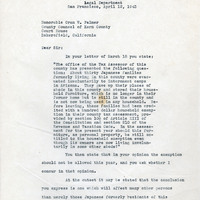
Correspondence from Robert W. Kenny (by H. H. Linney) to Oran W. Palmer regarding taxation of Japanese families during incarceration
Date: April 12, 1943
-
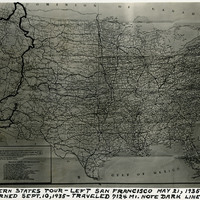
Caption: "Western States Tour - Left San Francisco May 21, 1935, Returned Sept. 10, 1935 - Traveled 7,124 Mi. Note Dark Line." The California State Automobile Association map of the U.S. shows the route that William and Grace McCarthy took during their 1935 tour of the western states, including national parks.
Date: 1935
-
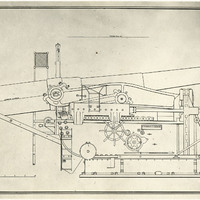
Caption: "U.S. 10" Disappearing Gun & Carriage, Model 1896, Wm McCarthy, July 20, 1905."
Date: 1905
-
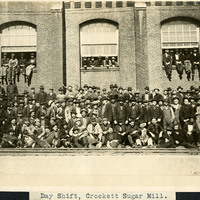
Caption: "Day Shift, Crockett Sugar Mill," c. 1906. A large group photo of Crockett Sugar Mill employees. William McCarthy is seen seated in the front row (seventh from right, wearing light clothing).
Date: 1906
-
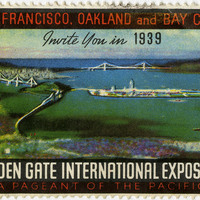
No caption. Commemorative stamp celebrating the upcoming Golden Gate International Exposition, c. 1938. The Exposition, which ran from February through October in 1939 and May to September in 1940, celebrated the completion of the San Francisco-Oakland Bay Bridge (1936) and the Golden Gate Bridge (1937). More than ten million people attended in 1939, while an additional five million visited in 1940. The Exposition was held on an artificial island created by dredging more than 19 million cubic yards of material from the bottom of the bay. The federal government completed this dredging and fill, intending for the site, called Treasure Island, to become a municipal airport after the exposition. However, the advent of World War II resulted in the U.S. Navy taking over the site, holding it until for military purposes until 1997.
Date: 1938