
Search All Items
Search Results 1321 to 1330 of 6229
-
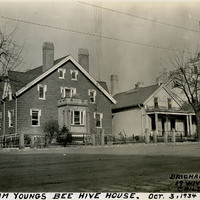
Caption: "Brigham Youngs [sic] Bee Hive House. Brigham Young had 19 Wives and 52 Children. Oct. 3, 1934." Street scene in Salt Lake City, Utah. Brigham Young, founder of the Church of Jesus Christ of Latter Day Saints built the so-called "Beehive House" in 1854 to house himself and several of his wives (Young practiced polygamy). The Beehive House is visible in the photograph at the far right, with a widow's walk featured on its roofline. Designed by Salt Lake Temple architect Truman O. Angell, the Beehive House has since been used as a residence for several dignitaries of the Mormon Church, as well as a boarding home for young Mormon women. The house was restored in the late 1950s and is now a museum. See also 96-07-08-alb11-301.
Date: 10/3/1934
-
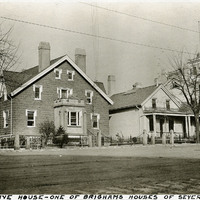
Caption: "The Bee Hive House -- One of Brighams Houses of Several Wives." Street scene in Salt Lake City, Utah. Brigham Young, founder of the Church of Jesus Christ of Latter Day Saints (the followers of which are known as Mormons) built the so-called "Beehive House" in 1854 to house himself and several of his wives (Young practiced polygamy). The Beehive House is visible in the photograph at the far right, with a widow's walk featured on its roofline. Designed by Salt Lake Temple architect Truman O. Angell, the Beehive House has since been used as a residence for several dignitaries of the Mormon Church, as well as a boarding home for young Mormon women. The house was restored in the late 1950s and now operates as a museum. See also 96-07-08-alb11-301.
Date: 1934-10-03
-
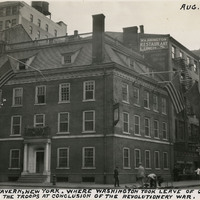
Caption: "Frances [sic] Tavern, New York. Where Washington Took Leave of Offices and Disbanded the Troops at Conclusion of the Revolutionary [sic] War. Aug. 5, 1934." Built as a family home for Etienne "Stephen" DeLancey in 1719, this building was converted to use as a tavern in 1762. It served many important functions before, during, and after the Revolutionary War, but several fires in the nineteenth century erased the building's original appearance. The Sons of the Revolution purchased the property in 1904 and embarked upon extensive restoration plans in 1907, supervised by William Mersereau. The building is now used as a museum and art gallery.
Date: 8/5/1934
-
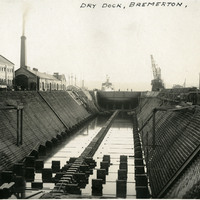
Caption: "Dry Dock, Bremerton." Bremerton, Washington, c. 1908-1912. See also 96-07-08-alb08-085. View of a dry dock at the Puget Sound Naval Shipyard in Bremerton, Washington. Established in 1891 as a naval station, it became Naval Yard Puget Sound in 1901. During World War I the shipyard constructed hundreds of ships to support the war effort, while in World War II, the shipyard was dedicated primarily to repairing damaged ships. Today, it contains a portion of the U.S. Navy's mothball fleet (ships retired but retained in case of future need), as well as building, repairing, and maintaining sea-going vessels of all kinds.
Date: 1908
-
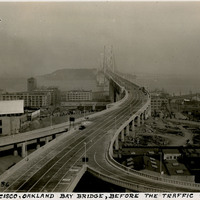
Caption: "Opening Day, Nov. 12, 1936, San Francisco, Oakland Bay Bridge, Before the Traffic Started." View of the San Francisco terminus of the San Francisco-Oakland Bay Bridge. Built between May 1933 and its opening on November 12, 1936, the Bay Bridge's design combined three different types of bridge-building technology over the five miles it covers between San Francisco and Oakland: a suspension span, a cantilevered span, and a tunnel. At the time of its completion the bridge was the longest steel structure on the globe. It also featured the deepest bridge pier ever built, and the world's largest bore tunnel.
Date: 11/12/1936
-
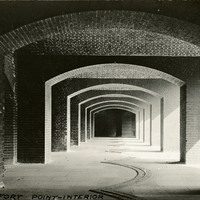
Caption: "Fort Point -- Interior," c. 1910. Postcard showing a view of an interior hall or walkway featuring several arches at Fort Point. The facilities at Fort Point were part of an effort by the U.S. government to protect the Golden Gate, entrance to the San Francisco Bay. Built between 1853-1861, the fort included emplacements for 141 guns but never fired a weapon in defense of the Bay. Its name was officially changed in 1882 to Fort Winfield Scott, but in 1886 the fort was officially downgraded to a sub-post of the San Francisco Presidio and the name discontinued. It was resurrected in 1912, with the establishment of a coastal artillery fortification at the Presidio, called, once again, Fort Winfield Scott.
Date: 1910
-
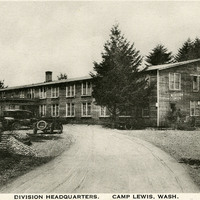
Caption: "Division Headquarters. Camp Lewis, Wash.," c. 1918. Shows the two-story building that served as Division Headquarters for Camp Lewis in Washington. The Camp was established by the U.S. Army in 1917, as part of the U.S.'s preparations for eventual entry into World War I. Rapid construction had the camp ready to house 60,000 men within a few months. The site is still in use as a military facility, under the name Fort Lewis.
Date: 1918
-
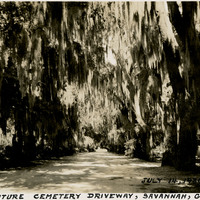
Caption: "Bonaventure Cemetery Driveway, Savannah, Georgia, July 14, 1934." Road stretching into the distance, flanked by trees dripping with Spanish moss. The Bonaventure Cemetery in Savannah originated in a private cemetery on a plantation. The plantation was sold in 1846. Major William H. Wiltberger, son of the new owner, formed the Evergreen Cemetery Company in 1868. The City of Savannah purchased the company and cemetery in 1907, and changed its name to Bonaventure Cemetery.
Date: 7/14/1934
-
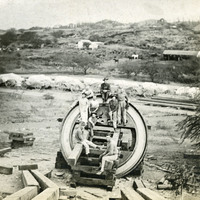
No caption, c. 1909-1915. Group of unidentified men gathered around a part of what appears to be a 12-inch mortar at Fort Ruger, Hawaii. Farm buildings and rolling hills appear in the distance. Fort Ruger was established on the Island of O'ahu by the U.S. in 1906 as the Diamond Head Reservation. Its name was changed to Fort Ruger in 1909. See also 96-07-08-alb05-098 and 099.
Date: 1915
-
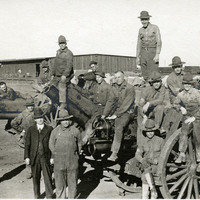
No caption, c. 1917. Group of men posing on 6" Howitzers at Camp Kearney. William McCarthy is standing in a dark suit just beneath the barrel of the middle gun. Camp Kearney was established by the U.S. Army in 1917 just north of San Diego. The post was largely abandoned by the government in 1920, used as a military and civilian airfield. It did not see increased military service again until the 1930s.
Date: 1917