Search All Items
- Filters:
- Language
- English 4772
- Spanish 11
- ENGLISH 2
- English 1
- census_013 1
- contra_costa_schedule_1_volume_1 1
- Type
- Image 3784
- Still Image 595
- Text 378
- Text 22
- Textual 2
- Image of the California Census from the records of the office of the California Secretary of State 1
Search Results 1331 to 1340 of 4835
-
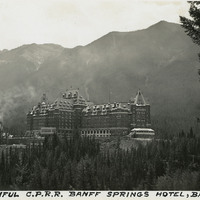
Caption: "The Beautiful C.P.R.R. Banff Springs Hotel, Banff, CA.," c. 1935. Built by the Canadian Pacific Railway at the instigation of its president, William Cornelius Van Horne, the luxury Banff Springs Hotel originally opened in 1888 to welcome visitors travelling on the railway. The hotel was renovated and expanded through the years and today is a National Historic Site of Canada, located in Banff National Park, Canada's first National Park.
Date: 1935
-
Caption: "Crockett Mandolin Club," c. 1906. William McCarthy is seen strumming the mandolin, second from left.
Date: 1906
-
Caption: "Byron Springs," c. 1915-1920. Grounds and entrance to the Byron Hot Springs resort hotel, built in 1913 (the third hotel on the site). See also 96-07-08-alb04-155.
Date: 1920
-
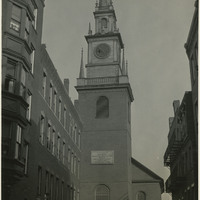
Caption: "Historic North Church, Boston. Where Signal was Hung for Paul Revere, Sept. 5, 1934." View of the clock tower and steeple of the Old North Church, built in 1723. The church is said to be the site where Paul Revere, after his famous midnight ride, caused two lanterns to be hung as the signal that British troops were advancing into the area by sea rather than by land.
Date: 9/5/1934
-
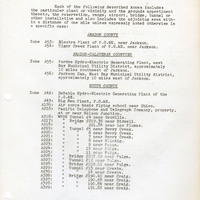
List of key locations in each prohibited zone by county
Date: April 6, 1942
-
Caption: "Maguey, a most useful plant from which is made paper, rope, twine, cloth, vinegar, molases [sic], medicine and native drinks, pulque, mezcal & tequila."
Date: 1938
-
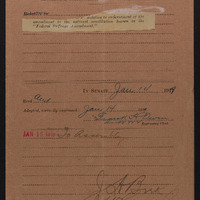
In addition to granting women the right to vote, the 1911 women’s suffrage amendment also paved the way for women to hold political office in California. In 1918, Esto B. Broughton, Elizabeth Hughes, Anna L. Saylor, and Grace S. Dorris became the first four women elected to the California State Assembly. Though fifteen states had already granted women full voting rights, a federal amendment was required to secure nationwide suffrage. To push for this national change, two almost identical resolutions were introduced on January 9, 1919 to urge the U.S. Congress to move forward with “the amendment to the National Constitution known as ‘The Federal Suffrage Amendment.’". On just her third day in office, newly elected Assemblywoman Grace S. Dorris introduced Assembly Joint Resolution No. 1. Simultaneously, Senate Joint Resolution No. 3 was introduced by Senator Burnett, a male colleague in the State Senate. While Dorris's historic Assembly bill ultimately died in committee, its twin Senate resolution successfully advanced, passing both chambers on January 17, 1919.
Date: January 1919
-
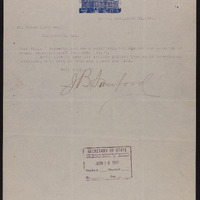
J. B. Sanford was a California State Senator representing the 4th Senate District and served as Chairman of the Democratic Caucus during the 1911 legislative session. He was one of the most prominent legislative opponents of women's suffrage in California. Sanford authored the official ballot argument against Senate Constitutional Amendment No. 8 (Proposition 4). In it, Sanford argues that women should not be granted the right to vote because suffrage is a privilege rather than an inherent right. He asserts that political involvement would distract women from their primary domestic duties, disrupt traditional gender roles, and ultimately harm the family structure. Furthermore, he claims that men already adequately protected women's interests in government and that granting women the vote would lead to increased social instability.
Date: June 24, 1911