
Search All Items
- Filters:
- Language
- English 1582
- Spanish 41
- ENGLISH 1
- English 1
- census_013 1
- contra_costa_schedule_1_volume_1 1
- Type
- Image 1359
- Still Image 163
- Text 78
- Text 22
- Image of the California Census from the records of the office of the California Secretary of State 1
- Textual 1
Search Results 1381 to 1390 of 1636
-
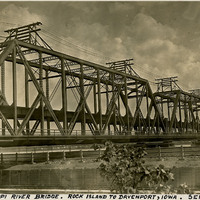
Caption: "Mississippi River Bridge. Rock Island to Davenport, Iowa. Sept. 25, 1934." View of the Government Bridge spanning the Mississippi River between Rock Island and Davenport, Iowa. Built in 1896 and designed by Ralph Modjeski, the bridge in this photograph was the fourth bridge constructed at the site, replacing earlier structures made obsolete by the increasing volume and changing character of traffic. This double-decker bridge connected the U.S. arsenal on Rock Island with Davenport, Iowa, and featured a double rail road track, a separate deck for automobiles, and a swing section. The bridge is still in use today.
Date: 9/25/1934
-
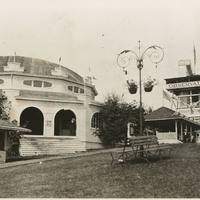
No Caption: See also 96-07-08-alb05-185, with caption: "Council Crest -- Portland," Buildings and benches in a park setting, with a tall observation tower, labeled the "Observatory," at the right side of the photograph. Council Crest Park in Portland, Oregon was the site of an amusement park between 1907 and 1929. The buildings in this photograph were part of that park. The Observatory, built in 1907, was demolished in 1941 to make room for a water tower. The area is still in use as a municipal park.
Date: 1909
-
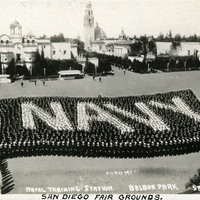
Caption: "San Diego Fair Grounds." and "39-6, 3,400 Men, Naval Training Station, Balboa Park, San Diego Cal.," c. 1917. With the advent of World War I, the U.S. Navy needed additional training grounds for sailors. In 1917, the City of San Diego offered to lease the Navy a portion of Balboa Park as a temporary training site until a new, more permanent facility could be constructed. This postcard shows 3,400 sailors lined up to form a Navy flag while at the temporary training ground.
Date: 1917
-
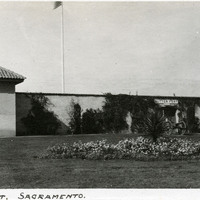
Caption: "Sutter [sic] Fort. Sacramento.," c. 1920. A gun tower at Sutter's Fort, and a gate bracketed by two cannons. John Sutter established the fort in 1839, calling it New Helvetia. After the discovery of gold at one of Sutter's mills (at Coloma, on the American River), almost all of the fort's inhabitants left for the gold fields in the foothills. The fort deteriorated until being restored from 1891-1893. The fort is now the site of a State Historic Park. See also 96-07-08-alb05-118.
Date: 1920