
Search All Items
- Filters:
- Language
- English 4964
- Spanish 26
- ENGLISH 2
- English 1
- census_013 1
- contra_costa_schedule_1_volume_1 1
- Type
- Image 3609
- Still Image 940
- Text 415
- Text 22
- Textual 2
- Image of the California Census from the records of the office of the California Secretary of State 1
Search Results 121 to 130 of 5047
-
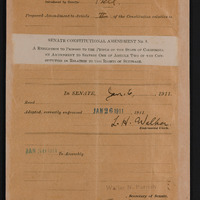
Absent of terms such as “women” or “sex”, the language for Senate Constitutional Amendment No. 8 appears intentionally neutral, labeled as “A Resolution to Propose to the People of the State of California an Amendment to Section One of Article Two of the Constitution in Relation to the Rights of Suffrage.” However, feelings about the amendment were decidedly strong. The arguments for and against Senate Constitutional Amendment No. 8 were closely watched by suffrage organizations, with crowds of onlookers filling the gallery and the lobby of the Capitol. Authored by Republican State Senator Charles W. Bell from Pasadena, Senate Constitutional Amendment No. 8 was passed by the Senate on February 2, 1911, receiving 66 ayes and 12 noes. Senate Constitutional Amendment No. 8 would be introduced to the public as Proposition 4 on the ballot for the special election scheduled for October 10, 1911, along with a variety of other reform amendments passed by the Senate.
Date: January 6, 1911
-
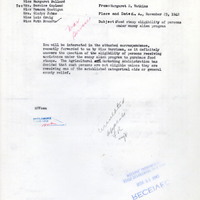
Office Memorandum from Margaret S. Watkins to Margaret Bullard, et al. regarding eligibility for food stamps
Date: November 23, 1942
-
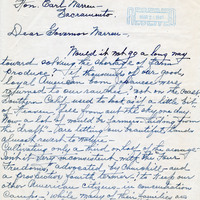
Correspondence from Helen M. Guenther (sp?) to Earl Warren regarding releasing Japanese to ranches for agricultural work
Date: March 18, 1943
-
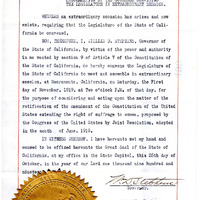
The 19th Amendment to the U.S. Constitution was passed by the U.S. House of Representatives on May 21, 1919 and the U.S. Senate on June 4, 1919 in a special congressional session. The amendment was then sent to the states for ratification. On October 25, 1919, Governor William D. Stephens issued a proclamation calling the California Legislature into a special session to consider ratification. When lawmakers convened on November 1, 1919, California ratified the amendment, becoming the 18th state to do so. The 19th Amendment received the required approval of 36 states on August 18, 1920, establishing that voting rights could not be denied on account of sex nationwide. Finally, on August 26, 1920, the 19th Amendment was added to the U.S. Constitution, granting women in the United States the right to vote on the federal level. This day is still commemorated and known today as Women’s Equality Day.
Date: October 25, 1919
-
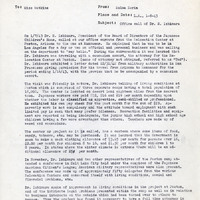
Correspondence from C. Rollin Zane to T. G. Ishimaru regarding conditions within the Children's Village
Date: February 15, 1943