Search All Items
- Filters:
- Type
- Image 3851
- Still Image 1032
- Text 431
- Text 19
- Language
- English 5293
- Spanish 43
- ENGLISH 2
- English 1
- census_013 1
Search Results 1391 to 1400 of 5390
-
Correspondence from Helen Wightman Simmons to Genevieve Murrican regarding interviews; Sections: Problems, Conference During the Day
Date: February 9, 1942
-
Correspondence from Archibald B. Young to Richard M. Neustadt regarding relocation into Tulare County
Date: May 2, 1942
-
Correspondence from Harry B. White to C. A. Herbage regarding materials associated with children at Manzanar
Date: February 4, 1944
-
Caption: "Old Landmark, Seaside, Or.," c. 1910. Shows a picket fence erected around what a sign calls "Remains of Cairn where Lewis & Clark made salt from the ocean water Jan. & Feb. 1806." When the famous expedition led by Merriweather Lewis and William Clark reached the Pacific Ocean in late 1805, their supplies had run dangerously low, including their salt supply. Salt, used not only to flavor meat but also to preserve it, was extremely important to the health of the expedition. Three of Lewis and Clark's men traveled to a site on the coast near present-day Seaside, Oregon to set up a small salt-works, boiling ocean water in a series of large kettles and then scraping the resulting salt crust off of the sides. In this manner, the men eventually collected about twenty gallons of salt before Lewis and Clark decided the supply was sufficient for the return journey. In 1910, the property containing the remains of the cairns was deeded to the Oregon Historical Society. In 1955, replica salt cairns were built at the site by the Lions Club to commemorate the expedition's activities.
Date: 1910
-
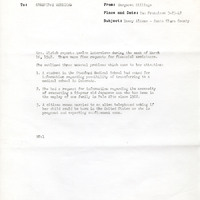
Office Memoranda from M. C. Ford to E. B. MacLatchie regarding assistance claims
Date: August 31, 1942