
Search All Items
- Filters:
- Language
- English 5312
- Spanish 43
- ENGLISH 2
- English 1
- census_013 1
- Type
- Image 3851
- Still Image 1035
- Text 445
- Text 22
- Textual 2
Search Results 1401 to 1410 of 5424
-
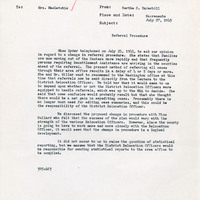
Office Memorandum from Bertha S. Underhill to Elizabeth B. MacLatchie regarding
Date: July 27, 1945
-
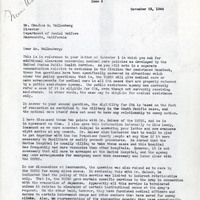
Correspondence from Azile H. Aaron to Charles M. Wollenberg regarding medical aid
Date: November 23, 1944
-
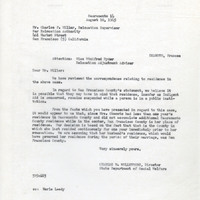
Correspondence from Charles M. Wollenberg to Charles F. Miller regarding residency of Frances Okamoto
Date: August 10, 1945
-
Office Memorandum from Bertha S. Underhill to Mary LeHane regarding new referral procedures
Date: August 17, 1945
-
Correspondence from Phoebe H. Bannister to Members of Public Assistance Staff Assigned to WCCA Local Office regarding statement by U.S. Public Health Service regarding medical care; see F3729_89_001b-F3729_89_001f for statement
Date: April 25, 1942
-
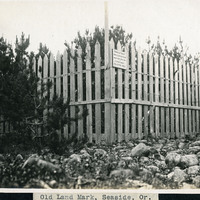
Caption: "Old Landmark, Seaside, Or.," c. 1910. Shows a picket fence erected around what a sign calls "Remains of Cairn where Lewis & Clark made salt from the ocean water Jan. & Feb. 1806." When the famous expedition led by Merriweather Lewis and William Clark reached the Pacific Ocean in late 1805, their supplies had run dangerously low, including their salt supply. Salt, used not only to flavor meat but also to preserve it, was extremely important to the health of the expedition. Three of Lewis and Clark's men traveled to a site on the coast near present-day Seaside, Oregon to set up a small salt-works, boiling ocean water in a series of large kettles and then scraping the resulting salt crust off of the sides. In this manner, the men eventually collected about twenty gallons of salt before Lewis and Clark decided the supply was sufficient for the return journey. In 1910, the property containing the remains of the cairns was deeded to the Oregon Historical Society. In 1955, replica salt cairns were built at the site by the Lions Club to commemorate the expedition's activities.
Date: 1910
-
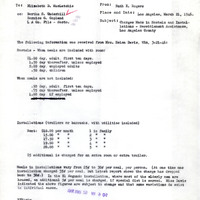
Office Memorandum from Ruth E. Rogers to Elizabeth B. MacLatchie regarding housing cost estimates
Date: March 21, 1946