Search All Items
- Filters:
- Language
- English 6853
- Spanish 18
- ENGLISH 3
- English 2
- census_013 1
- contra_costa_schedule_1_volume_1 1
- Type
- Image 3886
- Still Image 2484
- Text 441
- Text 54
- Textual 2
- Image of the California Census from the records of the office of the California Secretary of State 1
Search Results 1461 to 1470 of 6969
-
Correspondence from Charles M. Wollenberg (by Bertha S. Underhill) to Toyoji Inouye regarding public assistance
Date: July 12, 1945
-
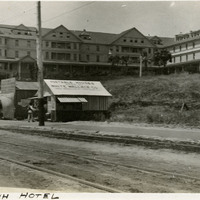
Caption: "Sea Beach Hotel," c. 1910. The Sea Beach Hotel, located on Beach Hill in Santa Cruz, was built in the 1870s by S.A. Hall. Originally called the Ocean View House, it was sold in the 1880s. Its new owner dubbed the building the Sea Beach Hotel. The resort hotel operated until burning down in 1912, never to be reconstructed.
Date: 1910
-
Caption: "City Hall - Healdsburg," c. 1910. The Healdsburg City Hall was built in 1886 and demolished in 1960.
Date: 1910
-
Caption: "American Eagle in Yellowstone Museum," c. 1923. A taxidermized bald eagle perched on a branch, one of the exhibits at a museum housed within the Yellowstone Information Office.
Date: 1923
-
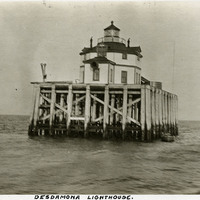
Caption: "Desdamona [sic] Lighthouse.," c. 1905-1909. View of the Desdemona Lighthouse, constructed in 1901 or 1902 on wood pilings over a group of shoals at the mouth of the Columbia River. The shoals carry the same name as the lighthouse, both of which are named for the boat Desdemona which ran aground and was destroyed by the shoals in 1857. The lighthouse was automated in 1934, and its light eventually removed in 1965.
Date: 1905
-
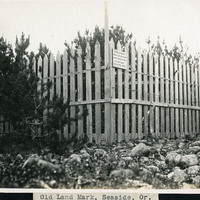
Caption: "Old Landmark, Seaside, Or.," c. 1910. Shows a picket fence erected around what a sign calls "Remains of Cairn where Lewis & Clark made salt from the ocean water Jan. & Feb. 1806." When the famous expedition led by Merriweather Lewis and William Clark reached the Pacific Ocean in late 1805, their supplies had run dangerously low, including their salt supply. Salt, used not only to flavor meat but also to preserve it, was extremely important to the health of the expedition. Three of Lewis and Clark's men traveled to a site on the coast near present-day Seaside, Oregon to set up a small salt-works, boiling ocean water in a series of large kettles and then scraping the resulting salt crust off of the sides. In this manner, the men eventually collected about twenty gallons of salt before Lewis and Clark decided the supply was sufficient for the return journey. In 1910, the property containing the remains of the cairns was deeded to the Oregon Historical Society. In 1955, replica salt cairns were built at the site by the Lions Club to commemorate the expedition's activities.
Date: 1910