
Search All Items
Search Results 1471 to 1480 of 6229
-
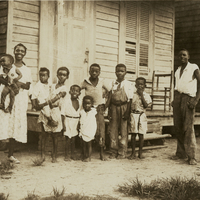
Unidentified African-American woman and several children posing on the porch of a wood-plank home. *Please Note:* Original caption removed due to sensitive content. To view the original photograph with caption, please contact the California State Archives Reference Desk.
Date: 6/17/1934
-
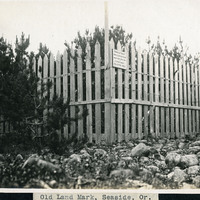
Caption: "Old Landmark, Seaside, Or.," c. 1910. Shows a picket fence erected around what a sign calls "Remains of Cairn where Lewis & Clark made salt from the ocean water Jan. & Feb. 1806." When the famous expedition led by Merriweather Lewis and William Clark reached the Pacific Ocean in late 1805, their supplies had run dangerously low, including their salt supply. Salt, used not only to flavor meat but also to preserve it, was extremely important to the health of the expedition. Three of Lewis and Clark's men traveled to a site on the coast near present-day Seaside, Oregon to set up a small salt-works, boiling ocean water in a series of large kettles and then scraping the resulting salt crust off of the sides. In this manner, the men eventually collected about twenty gallons of salt before Lewis and Clark decided the supply was sufficient for the return journey. In 1910, the property containing the remains of the cairns was deeded to the Oregon Historical Society. In 1955, replica salt cairns were built at the site by the Lions Club to commemorate the expedition's activities.
Date: 1910
-
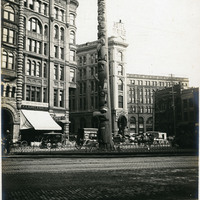
Caption: "Seattle totem pole.," c. 1905. View of the Tlingit totem pole in Seattle's Pioneer Square. The totem pole was stolen in 1899 by a group of businessmen, and erected in the square, then known as Pioneer Place. An arson destroyed this pole in 1938, but it was later replaced by another carved by the Tlingit tribe (who were also finally paid for the original pole).
Date: 1905
-
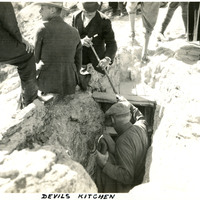
Caption: "Devil's Kitchen," c. 1923. This photograph shows several people descending into and standing around the entry to Devil's Kitchen, an extinct hot spring that left behind a cavern. Once a popular tourist attraction for its small opening that made visitors feel as if they were descending into the underworld, the site was closed in 1939 because the cavern periodically fills with dangerous levels of carbon dioxide.
Date: 1923
-
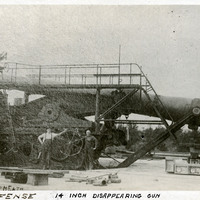
Caption: "Coast Defense: 14 Inch Disappearing Gun." Another copy of a C.D. Heath photograph, this image shows a heavy artillery gun, with two unidentified men standing next to it, at the Sandy Hook Proving Ground. Located at Sandy Hook, New Jersey, the Sandy Hook Proving Ground was used by the U.S. Army to test ordinance and materiel from 1874-1919. See also 96-07-08-alb05-101.
Date: 1910
-
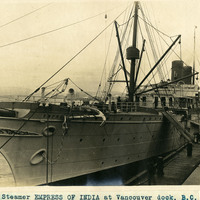
Caption: "Steamer EMPRESS OF INDIA at Vancouver dock, B.C.," c. 1908-1912. View of the Empress of India, built by England's Naval Construction & Armaments Co. in 1890 for the Canadian Pacific Steamships company. The Empress of India could accommodate up to 700 passengers, and was also used to carry mail between Hong Kong and Great Britain. She was sold in 1914 and refitted as a hospital ship for Indian soldiers. She was sold a final time in 1923, for scrap in Bombay.
Date: 1908
-
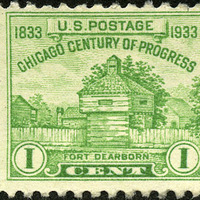
No caption. Commemorative U.S. postage stamp issued in 1933 for Chicago's Century of Progress Exposition, celebrating the one-hundred year anniversary of Chicago's incorporation. This stamp features Fort Dearborn, a fort built in 1803 in what is now Chicago proper. While the original fort was destroyed during the War of 1812, and the second fort which replaced it was destroyed by fires in 1857 and 1871, a replica was constructed for the Exposition.
Date: 1933
-
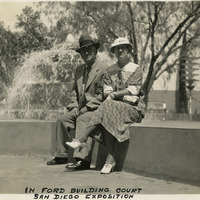
Caption: "In Ford Building Court, San Diego Exposition," 1935, shows William and Grace McCarthy sitting near a fountain in the Ford Building Court, at the California-Pacific International Exposition.
Date: 1935
-
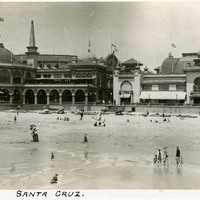
Caption: "Casino Santa Cruz.," c. 1910. View of beach and casino building in Santa Cruz. The casino, designed by William Weeks, was constructed in 1907, replacing a previous casino building that burned down in 1906.
Date: 1910
-
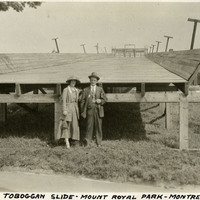
Caption: "Toboggan Slide - Mount Royal Park - Montreal," c. 1925. William and Grace McCarthy pose in front of a large toboggan slide, absent of snow, at Montreal's Mount Royal Park.
Date: 1925