
Search All Items
- Filters:
- Language
- English 4767
- Spanish 11
- ENGLISH 2
- English 1
- census_013 1
- contra_costa_schedule_1_volume_1 1
- Type
- Image 3783
- Still Image 592
- Text 377
- Text 22
- Textual 2
- Image of the California Census from the records of the office of the California Secretary of State 1
Search Results 1511 to 1520 of 4830
-
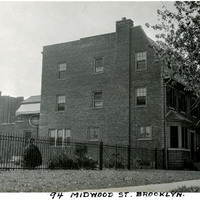
Caption: "94 Midwood St. Brooklyn." View of a three-story brick house or apartment building, with a park or empty lot on one side. See also 96-07-08-alb11-235, where the building is captioned as "The Walsh Home."
Date: 9/2/1934
-
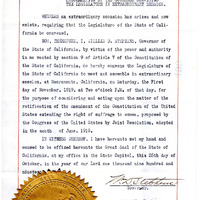
The 19th Amendment to the U.S. Constitution was passed by the U.S. House of Representatives on May 21, 1919 and the U.S. Senate on June 4, 1919 in a special congressional session. The amendment was then sent to the states for ratification. On October 25, 1919, Governor William D. Stephens issued a proclamation calling the California Legislature into a special session to consider ratification. When lawmakers convened on November 1, 1919, California ratified the amendment, becoming the 18th state to do so. The 19th Amendment received the required approval of 36 states on August 18, 1920, establishing that voting rights could not be denied on account of sex nationwide. Finally, on August 26, 1920, the 19th Amendment was added to the U.S. Constitution, granting women in the United States the right to vote on the federal level. This day is still commemorated and known today as Women’s Equality Day.
Date: October 25, 1919
-
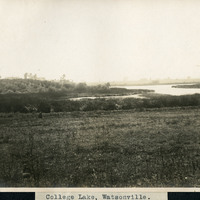
Caption: "College Lake, Watsonville," c. 1906, is an intermittent or seasonal lake, which was known at one time as Laguna Grande, and became known as College Lake sometime after 1869.
Date: 1906
-
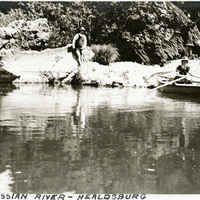
Caption: "Russian River -- Healdsburg." William and Grace McCarthy in swimsuits enjoying summer fun on the Russian River near Healdsburg. William stands on a rock along the bank, while Grace is sitting in a rowboat on the river.
Date: 1914-07
-
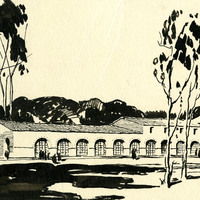
Ink drawing of Poultry Building, State Fair, Stockton Boulevard, Sacramento. Design and drawing by Alfred Eichler. Built. This is now the Art Building, 1963. Project for Department of Finance - Fairs and Expositions.
Date: 1931
-
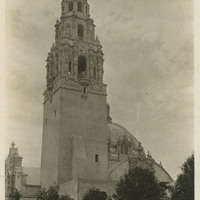
Caption: "California Building Tower - July 18, 15," (Bertrum Goodhue, architect), at the Panama-California Exposition in Balboa Park, San Diego, 1915. The exposition's Spanish Colonial Revival style architecture designed by Bertrum Goodhue is credited with giving the style national exposure.
Date: 1915
-
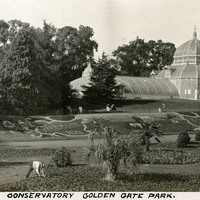
Caption: "Conservatory Golden Gate Park," c. 1910. Built in 1879, the Conservatory is the oldest building in Golden Gate Park, and the oldest municipal wooden conservatory in the country.
Date: 1910
-
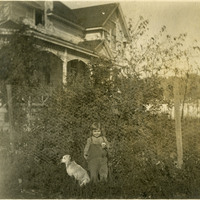
No Caption: See also 96-07-08-alb06-078 with caption: "Harrold and Buff," c. 1906. A young child with a dog is seen standing near a fence at the McCarthy home in Watsonville.
Date: 1906
-
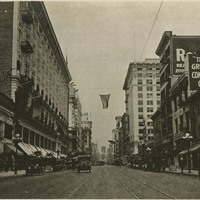
No Caption: c. 1915. Shows a view of Broadway in Los Angeles. On the right side of the street is Woodley Theatre, a vaudeville theater that opened in 1913.
Date: 1915
-
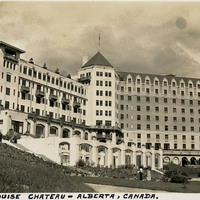
Caption: "Lake Louise Chateau - Alberta, Canada," c. 1935 shows the luxury hotel, originally built by the Canadian Pacific Railway as a base for outdoor enthusiasts in 1890. The hotel is located in Banff National Park.
Date: 1935