
Search All Items
Search Results 1541 to 1550 of 6229
-
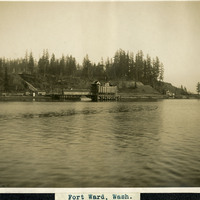
Caption: "Fort Ward, Wash.," c. 1908-1912. View from Puget Sound of a wharf and other buildings of Fort Ward. Originally known as Bean Point, Fort Ward was established by the U.S. Army Coastal Artillery Corps in 1890. Re-named Fort Ward in 1903, the facility included four coastal batteries designed to assist in protecting Puget Sound and the nearby Naval Shipyard from enemy attack. Fort Ward was placed on inactive status in the 1920s, but was revived by the U.S. Navy during World War II. The Navy discovered the fort's location was ideal for listening to radio communications from Japan, and it subsequently became a top secret listening post with a link directly to Washington, D.C. The Navy continued the fort's use as a listening post until 1956, when it was again taken over by the U.S. Army. The Army subsequently stopped all activity in 1958, ultimately selling portions of the fort to the Washington State Park System in 1960. It is now a state park.
Date: 1908
-
No Caption: This postcard shows a view of the Government Building and the Cascades (a terraced fountain leading up to the building), part of the Alaska-Yukon-Pacific Exposition. Held in Seattle to celebrate the development of the Pacific Northwest, the fair attracted 3.7 million visitors over the course of its run from June to October 1909. Although most of the fair's buildings have since been destroyed, several of them now serve as part of the University of Washington campus. See also 96-07-08-alb05-212.
Date: 1909
-
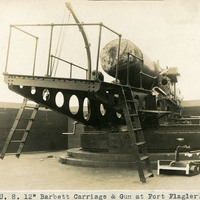
Caption: "U. S. 12" Barbett [sic] Carriage & Gun at Fort Flagler.," c. 1908-1912. View of a 12" disappearing gun installed at Fort Flagler. The coastal artillery fortification Fort Flagler was established in 1897 and activated in 1899. Most of the fort's buildings and batteries had been completed by 1907. Fort Flagler was part of the "triangle of fire," three coastal defense fortifications (Fort Casey, Fort Worden, and Fort Flagler) guarding the entrance to Puget Sound. Fort Flagler was decommissioned in 1953, and purchased by the State of Washington in 1955 for use as a state park.
Date: 1908
-
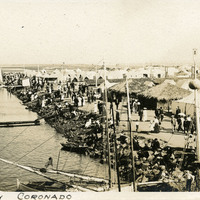
Caption: "Tent City Coronado," c. 1910-1913. View of rows of tents and sheds thatched in palm fronds along the coast near Coronado Hotel, with people strolling along the roadways. Established in 1900 for travelers who could not afford to stay in the resort hotel, the Coronado Tent City consisted of a grid of streets lined with furnished tents, near the sea shore. It also featured restaurants, a library, soda fountain, theater, bandstand, and other recreational facilities. See also 96-07-08-alb08-210, and 263.
Date: 1910
-
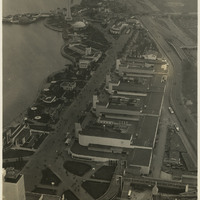
Caption: "Chicago Fair Grounds. View from Sky Ride Tower, Sept. 15, 34." Bird's eye view of the fair grounds where Chicago held its Century of Progress Exposition, a world fair celebrating the city's one-hundred year anniversary of incorporation. Originally planned to only run from May to November in 1933, it was such a success that its organizers decided to keep it running for a second season from May through October the following year. This photograph was taken from one of the two Sky Ride Towers, 628-foot structures that carried an aerial tram or gondola over the harbor in the center of the fair grounds. Over 4.5 million passengers enjoyed the views from the Sky Ride before it was demolished after the conclusion of the exposition in 1934.
Date: 9/15/1934
-
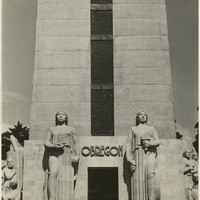
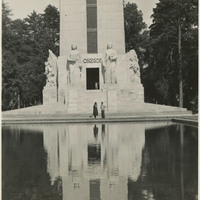
Caption: "Obregon's tomb, Mexico City." William and Grace McCarthy standing before the monument to General Alvaro Obregon (1880-1928), who was a leader of the Mexican Revolution (1920-1920). Obregon was elected President of post-Revolution Mexico, serving from 1920-1924. In 1928, he was again elected but was assassinated by Jose de Leon Toral, a Roman Catholic who opposed Obregon's policies on religious matters. The monument was completed in 1935 and stands in the San Angel region of Mexico City, in the same location where Obregon was assassinated.
Date: 1938
-
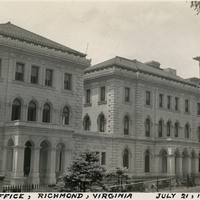
Caption: "Post Office, Richmond, Virginia, July 21, 1934." View of the Richmond Custom House and Post Office. The Custom House, the first federal building in Richmond, was designed by Ammi Burnham Young in 1858. The post office was located on the first floor (for easy access by citizens), the custom house occupied the second floor, and the third floor held a federal courtroom. The building was expanded between 1887 and 1889 to include two short wings on either side of the facade. A story was added to the building in 1910, and wings added in 1910 and 1930, so that now the building occupies the entire block.
Date: 7/21/1934
-
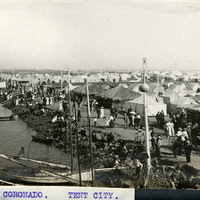
Caption: "CORONADO. TENT CITY.," c. 1910. View of rows of tents and sheds thatched in palm fronds along the coast near Coronado Hotel, with people strolling along the roadways. Established in 1900 for travelers who could not afford to stay in the resort hotel, the Coronado Tent City consisted of a grid of streets lined with furnished tents, near the sea shore. It also featured restaurants, a library, soda fountain, theater, bandstand, and other recreational facilities. See also 96-07-08-alb05-202 and 96-07-08-alb08-263.
Date: 1910
-
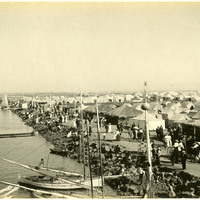
No Caption: c. 1910. View of rows of tents and sheds thatched in palm fronds along the coast near Coronado Hotel, with people strolling along the roadways. Established in 1900 for travelers who could not afford to stay in the resort hotel, the Coronado Tent City consisted of a grid of streets lined with furnished tents, near the sea shore. It also featured restaurants, a library, soda fountain, theater, bandstand, and other recreational facilities. See also 96-07-08-alb05-202 and 96-07-08-alb08-210.
Date: 1910
-
Caption: "Obregon's tomb, Mexico City." William and Grace McCarthy standing before the monument to General Alvaro Obregon (1880-1928), who was a leader of the Mexican Revolution (1920-1920). Obregon was elected President of post-Revolution Mexico, serving from 1920-1924. In 1928, he was again elected but was assassinated by Jose de Leon Toral, a Roman Catholic who opposed Obregon's policies on religious matters. The monument was completed in 1935 and stands in the San Angel region of Mexico City, in the same location where Obregon was assassinated.
Date: 1938