
Search All Items
- Filters:
- Language
- English 4767
- Spanish 11
- ENGLISH 2
- English 1
- census_013 1
- contra_costa_schedule_1_volume_1 1
- Type
- Image 3783
- Still Image 592
- Text 377
- Text 22
- Textual 2
- Image of the California Census from the records of the office of the California Secretary of State 1
Search Results 1541 to 1550 of 4830
-
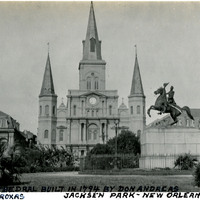
Caption: "St. Louis Cathedral Built in 1794 by Don Andreas Almonastry Roxas - Jacksen[sic] Park - New Orleans." St. Louis Cathedral anchors one end of Jackson Square in New Orleans' French Quarter. The structure of the cathedral largely dates to the 1850 restoration and expansion of an older cathedral built on the site in 1793. Very little of the older church survived, although the central bell tower (added on to the older church in 1819) was reused in the new structure and is still extant today. A statue of Andrew Jackson mounted on a rearing horse (Clark Mills, sculptor) stands in the square in front of the cathedral. The sculpture was erected in 1856. See also 96-07-08-alb11-052.
Date: 6/15/1934
-
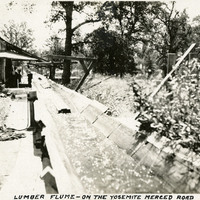
Caption: "Lumber Flume -- on the Yosemite Merced Road," c. 1920. Flume with boards being carried by running water, likely along what is now known as California State Route 140, connecting the town of Merced with the Yosemite Valley.
Date: 1920
-
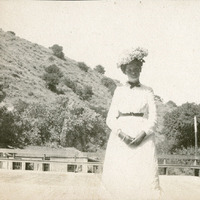
No caption. An unidentified woman poses for a photograph in white dress and flower adorned hat at what is likely the Alhambra Springs of Alhambra Creek in Contra Costa County, c. 1906.
Date: 1906
-
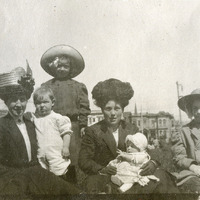
No caption, c. 1912-1915. Two unidentified women with four children, one of which (standing next to women at far left) is the same toddler who appears in 96-07-08-alb05-083 and 084.
Date: 1915
-
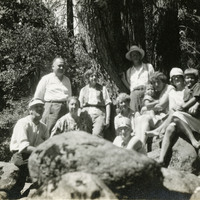
No caption, c. 1935. Group of unidentified people posing for a photograph, with rock formation in front and trees behind. Grace McCarthy is seated at the center of photograph, wearing a strand of pearls.
Date: 1935
-
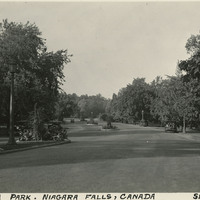
Caption: "Victoria Park. Niagara Falls, Canada, Sept. 10, 1934." Broad roadway flanked by manicured grounds and trees, running through Queen Victoria Park in Niagara Falls, Ontario, Canada. Opened in 1888, the park is operated today by the Niagara Parks Commission.
Date: 9/10/1934
-
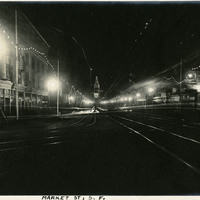
Caption: "Market St, S.F," c. 1908. A view of San Francisco's Market Street at night. Electric lights are strung along the length of the street, ending at the Ferry Building, which is also decorated with electric lights.
Date: 1908
-
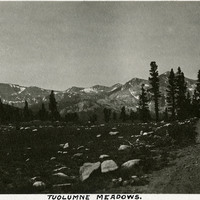
Caption: "Tuolumne Meadows." Meadow area along the Tuolumne River in the eastern portion of Yosemite National Park, with mountains in the background. Tuolumne Meadows is recognized as one of the largest alpine meadows of the Sierra Nevada Mountains.
Date: 1927
-
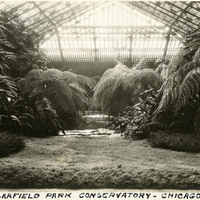
Caption: "Garfield Park Conservatory - Chicago," c. 1925. Construction began on the Garfield Park Conservatory in 1906. Opened to the public in 1908, the Conservatory is one of the largest greenhouse conservatories in the United States.
Date: 1925
-
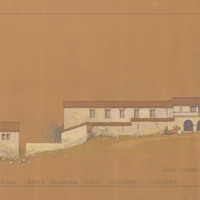
Alternate sketch of Main Entrance, Administration Building, Riviera Campus, Santa Barbara State College, by Alfred Eichler. Built, but not according to this design. Project for Department of Education. The image, eichler_f3274_191, is inset on the image, eichler_f3274_190.
Date: 1926