
Search All Items
Search Results 1561 to 1570 of 6229
-
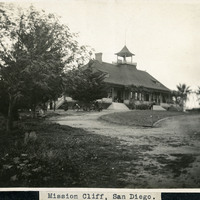
Caption: "Mission Cliff, San Diego.," c. 1905. View of the pavilion in San Diego's Mission Cliff Gardens. Originally opened in the 1880s as the "Bluffs" by the San Diego Cable Railway Company, the owners hoped to entice people to ride the cable cars by providing a recreational destination. The pavilion seen in the photograph was constructed in 1890. A few years later, the Citizens' Traction Company purchased the park and changed its name to Mission Cliff Park. In 1898, the property was sold yet again, this time to J.D. Spreckels and the San Diego Electric Railway Company. Spreckels hoped to transform the property into a quiet, restful, public botanical garden. The name changed again, to Mission Cliff Gardens, to reflect this change in direction for the park. The botanical gardens developed at the park became world-renowned before closing to the public in 1929. The property was subdivided in 1942, into residential lots.
Date: 1905
-
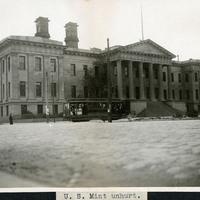
Caption: "U.S. Mint unhurt," c. 1906. Pictured is the U.S. Mint building in San Francisco, which opened in 1874, after the original 1854 building was outgrown, which had been established to serve the gold mines during the California Gold Rush. The building suffered little damage after the 1906 earthquake. The facility served as the San Francisco U.S. Mint until 1937, when workers moved to a larger and more modern building. In 1961, the old U.S. Mint, known as the "Granite Lady," was designated a National Historic Landmark.
Date: 1906
-
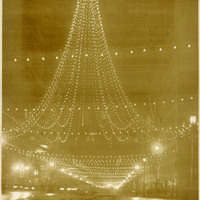
No Caption: The photograph has a hand-written inscription stating: "Portola Electric Bell Copyright 1909 Pillsbury Picture Co. No. 800." Installed on the intersection of Third and Market Streets in San Francisco, the Portola Electric Bell contained two thousand bulbs and rose 125 feet above the street. It was part of the Portola Festival of 1909, a grand celebration devised to commemorate the discovery of San Francisco Bay by Gaspar De Portola, and for the public to celebrate the future of the rebuilt city after the 1906 earthquake and fires.
Date: 1909
-
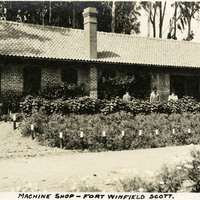
Caption: "Machine Shop -- Fort Winfield Scott," c. 1913. Low brick building with tile roof, with William McCarthy (far left) and two unidentified men standing in front. Fort Winfield Scott, formerly Fort Point, was part of an effort by the U.S. government to protect the Golden Gate, entrance to the San Francisco Bay. Built between 1853-1861, the fort included emplacements for 141 guns but never fired a weapon in defense of the Bay. Its name was officially changed in 1882 to Fort Winfield Scott. This only lasted four years, however, for in 1886 the fort was officially downgraded to a sub-post of the San Francisco Presidio and the name discontinued. It was resurrected in 1912, with the establishment of a coastal artillery fortification at the Presidio, called, once again, Fort Winfield Scott.
Date: 1913
-
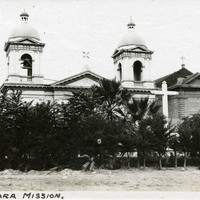
Caption: "Santa Clara Mission," c. 1910. Founded in 1777, Mission Santa Clara featured several different churches over the years. This photograph shows the mission church as it appeared from roughly 1861 to 1926. In the 1860s, Santa Clara College President Burchard Villager decided to rebuild many of the buildings on the campus. In the process, the mission church was renovated in the Italianate style, with a second bell tower. This Italianate-style church burned in 1926. The church was then rebuilt as a modern reconstruction of the fifth church on the site, the original of which was destroyed by fire in 1825.
Date: 1910
-
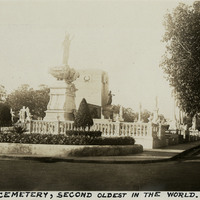
Caption: "Havana Cemetery, Second Oldest in the World. July 4, 34." Several memorials in Colon Cemetery can be seen in this photograph. Founded in 1876, Colon Cemetery replaced Havana's first cemetery, Espada Cemetery, after a cholera epidemic in 1868 revealed the need for a new, larger facility. Today, the Colon Cemetery holds more than 800,000 graves. It is not known where William McCarthy found reference to this being the "second oldest" cemetery in the world, as California State Archives staff could not verify that statistic.
Date: 7/4/1934
-
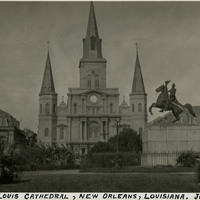
Caption: "Saint Louis Cathedral, New Orleans, Louisiana. June 16, 1934." St. Louis Cathedral anchors one end of Jackson Square in New Orleans' French Quarter. The structure of the cathedral largely dates to the 1850 restoration and expansion of an older cathedral built on the site in 1793. Very little of the older church survived, although the central bell tower (added on to the older church in 1819) was reused in the new structure and is still extant today. A statue of Andrew Jackson mounted on a rearing horse (Clark Mills, sculptor) stands in the square in front of the cathedral. The sculpture was erected in 1856. See also 96-07-08-alb09-231.
Date: 6/15/1934
-
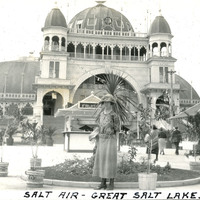
Caption: "Salt Air - Great Salt Lake," c.1923. Grace McCarthy poses in front of the Saltair resort complex on Utah's Great Salt Lake. Constructed in 1893 and designed by Richard K.A. Kletting, the Saltair set out to be the Western counterpart of Coney Island. The resort was a popular spot for Mormon families, only fifteen miles from Salt Lake City and overseen by Church leaders. The Church sold the building in 1906. It was later destroyed by fire in 1925, but a second pavilion was quickly built.
Date: 1923
-
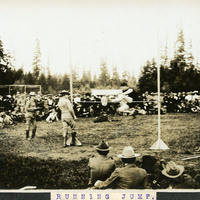
Caption: "R U N N I N G J U M P.," c. 1917. Image of an early high jumper in mid-leap, with men clad in military uniforms watching, as well as civilian men and women. In the high jump, athletes attempt to leap over a horizontal bar without the benefit of a pole (as in pole vaulting). The technique shown here is an early one with the jumper upright rather than in the "Fosbury Flop" position, developed later in the century. The uniforms and surrounding vegetation in the photograph suggest that that event may have taken place at Camp Lewis, Washington.
Date: 1917
-
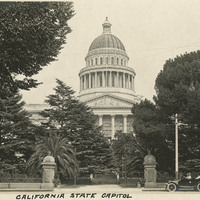
Caption: "California State Capitol." Shows the California State Capitol building and grounds. Located on the west end of Capitol Park, the neoclassical building's construction began in 1860 and was completed in 1874. It houses the state legislature and offices of the governor. The capitol and grounds were listed on the National Register of Historic Places in 1973, and as a California Historical Landmark in 1974. A parked automobile in the foreground has Grace McCarthy at the wheel, with William McCarthy sitting beside her, and two unidentified people in the backseat, Sacramento, c. 1915.
Date: 1915