
Search All Items
- Filters:
- Language
- English 4767
- Spanish 11
- ENGLISH 2
- English 1
- census_013 1
- contra_costa_schedule_1_volume_1 1
- Type
- Image 3783
- Still Image 592
- Text 377
- Text 22
- Textual 2
- Image of the California Census from the records of the office of the California Secretary of State 1
Search Results 1561 to 1570 of 4830
-
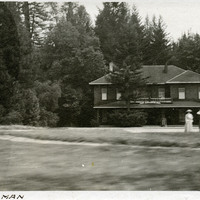
Caption: "Camp Herman," c. 1912-1915. View of the Zayante Inn at Mount Herman. Originally the site of Hotel Tuxedo, in 1906 a group later known as the Mount Herman Association, Inc. purchased the building and surrounding property, and renamed it the Zayante Inn. The inn became a Christian retreat center. Although this building was destroyed by fire in 1921, the retreat center was rebuilt as the Mount Herman Christian Conference Center, still operating today.
Date: 1915
-
Caption: "Ponciana [sic] and Whitehall Hotels. Ponciana {sic] is the Largest Frame Bldg. Hotel in the World. Palm Beach, Florida. July 8, 1934." Both the Royal Poinciana Hotel (center) and the Whitehall Hotel (far right) can be seen in this photograph, taken from across Lake Worth. The Royal Poinciana, built by Henry Flagler as a resort retreat for wealthy guests, opened in 1894. Renovations eventually enlarged the hotel to a length of 1,800 feet, with over three miles of corridors and hallways, and rooms for over 1,000 guests. At one point, it was reputed to be the largest wood structure in the world. Attendance declined in the 1920s, however, as tourists were attracted to more modern facilities. Damage by a hurricane and the Great Depression combined to close the hotel in 1934. The building was razed a year later. The Whitehall Hotel started its existence as a mansion, also built by Flagler, as a present for his wife. After Flagler's death in 1913, the home was sold to a group of investors who erected an eleven-story tower and converted the entire complex to use as a resort hotel. In 1959, the Henry Morrison Flagler Museum purchased the building. It now serves as a museum.
Date: 7/8/1934
-
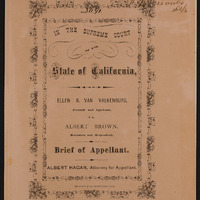
A Brief of Appellant is filed in the appellate court by the party who lost in the previous trial and argues in favor of appealing a lower court’s decision. Ellen Van Valkenburg began an important legal battle for women’s enfranchisement in California on July 21, 1871, when she requested that Santa Cruz County Clerk Albert Brown enter her name in the Great Register of voters. After Brown (a willing accomplice in helping her bring the case to court) refused to register her, Van Valkenburg and her lawyer, Santa Cruz Judge Albert Hagan, began legal proceedings by requesting a writ of mandamus, a judicial remedy used to compel agencies to perform ministerial acts, such as registering voters. Van Valkenburg and Hagan argued her case by citing the 14th Amendment of the U.S. Constitution. The new amendment, ratified 3 years earlier in 1868, defined all persons born or naturalized in the U.S. as citizens protected by civil rights. Van Valkenburg and Hagan asserted that American women were considered citizens under this amendment, and that citizenship automatically granted absolute rights, including the right to vote. The case first went to California’s Third District Court. Many of America’s most prominent suffragists, including Elizabeth Cady Stanton and Susan B. Anthony, were with Van Valkenburg in Santa Cruz when the lower court ruled against her on August 16, 1871. Van Valkenburg and Hagan swiftly appealed this decision through the Supreme Court of California. In the end, the Supreme Court of California upheld the lower court’s verdict under the reasoning that as a white American woman, Van Valkenburg already had citizenship and civil rights prior to the passage of the 14th amendment, and that the 14th amendment did not provide her with any additional political rights, such as the right to vote. While Van Valkenburg lost her case, and subsequent lawsuits failed to secure women's suffrage nationwide, the case stands as a critical early example of legal advocacy for women's political rights in California.
Date: September 29, 1871
-
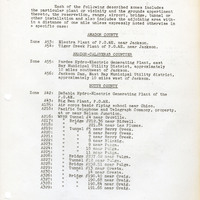
List of key locations in each prohibited zone by county
Date: April 6, 1942
-
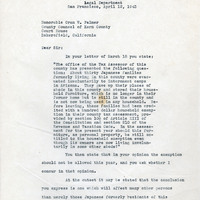
Correspondence from Robert W. Kenny (by H. H. Linney) to Oran W. Palmer regarding taxation of Japanese families during incarceration
Date: April 12, 1943
-
An explanation of the War Program; Sections: Enemy Alien and Japanese Evacuation; War Services Program; Defense Activities
Date: November 24, 1943
-
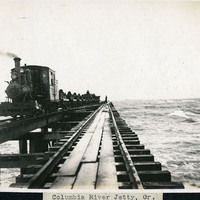
Caption: "Columbia River Jetty, Or.," c. 1910. View of a jetty built at the mouth of the Columbia River, carrying a railroad trestle. A train hauling cars loaded with large rocks is visible at the left side of the photograph. This is likely the so-called South Jetty, extending more than six miles into the ocean from Point Adams on the Oregon side of the river mouth. The jetty system at the mouth of the Columbia River was constructed between 1885 and 1917. Designed to funnel water from the Columbia River in a more concentrated fashion into the Pacific Ocean, the jetty system helped create a deeper, more stable shipping channel.
Date: 1910
-
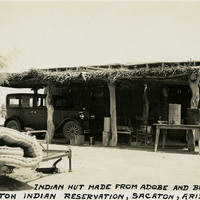
Caption: "Indian Hut Made From Adobe and Bush Branches, Sacaton Indian Reservation, Sacaton, Arizona, May, 24, 1934." View of a small adobe building with a porch area across the length of the façade. The porch is sheltered by a low roof supported by tree trunks or thick tree branches and thatched with grass or sticks. Located south of Phoenix and including the town of Sacaton, the Gila River Indian Reservation is home to members of the Akimel O’odham (Pima) and the Pee-Posh (Maricopa) tribes. The reservation was established in 1859. Eighty years later, in 1939, Congress provided for the self-governance of the reservation via the Gila River Indian Community.
Date: 5/24/1934
-
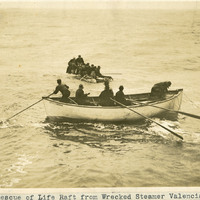
Caption: "Rescue of Life Raft from Wrecked Steamer Valencia." Photograph showing a boat crew about to rescue 18 people on a life raft. On Monday, January 22, 1906, the passenger liner Valencia ran aground on a reef during a storm off the southwestern coast of Vancouver Island (an area notorious for ship wrecks). Although the shore was only about fifty yards away, heavy seas and rock cliffs prevented the passengers and crew from making their way safely to land. Circumstances prevented rescue vessels from coming to the stricken ship's aid until Wednesday January 24th. The steamship City of Topeka rescued 18 men on a life raft, shown in this photograph. The official death toll was 136: seven officers, 33 crewmen, and 96 passengers (including seventeen women and eleven children -- all of the women and children on board perished). Only 37 people survived the wreck.
Date: 1/24/1906