
Search All Items
- Filters:
- Language
- English 4772
- Spanish 11
- ENGLISH 2
- English 1
- census_013 1
- contra_costa_schedule_1_volume_1 1
- Type
- Image 3784
- Still Image 595
- Text 378
- Text 22
- Textual 2
- Image of the California Census from the records of the office of the California Secretary of State 1
Search Results 1571 to 1580 of 4835
-
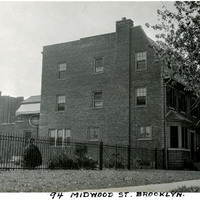
Caption: "94 Midwood St. Brooklyn." View of a three-story brick house or apartment building, with a park or empty lot on one side. See also 96-07-08-alb11-235, where the building is captioned as "The Walsh Home."
Date: 9/2/1934
-
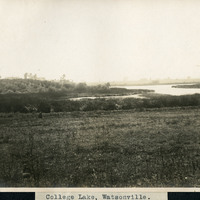
Caption: "College Lake, Watsonville," c. 1906, is an intermittent or seasonal lake, which was known at one time as Laguna Grande, and became known as College Lake sometime after 1869.
Date: 1906
-
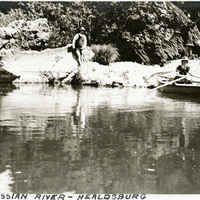
Caption: "Russian River -- Healdsburg." William and Grace McCarthy in swimsuits enjoying summer fun on the Russian River near Healdsburg. William stands on a rock along the bank, while Grace is sitting in a rowboat on the river.
Date: 1914-07
-
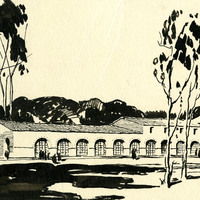
Ink drawing of Poultry Building, State Fair, Stockton Boulevard, Sacramento. Design and drawing by Alfred Eichler. Built. This is now the Art Building, 1963. Project for Department of Finance - Fairs and Expositions.
Date: 1931
-
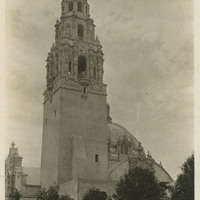
Caption: "California Building Tower - July 18, 15," (Bertrum Goodhue, architect), at the Panama-California Exposition in Balboa Park, San Diego, 1915. The exposition's Spanish Colonial Revival style architecture designed by Bertrum Goodhue is credited with giving the style national exposure.
Date: 1915
-
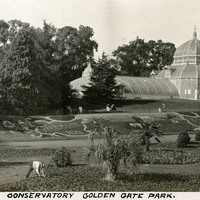
Caption: "Conservatory Golden Gate Park," c. 1910. Built in 1879, the Conservatory is the oldest building in Golden Gate Park, and the oldest municipal wooden conservatory in the country.
Date: 1910
-
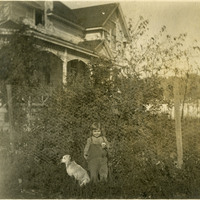
No Caption: See also 96-07-08-alb06-078 with caption: "Harrold and Buff," c. 1906. A young child with a dog is seen standing near a fence at the McCarthy home in Watsonville.
Date: 1906
-
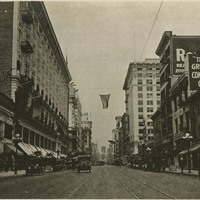
No Caption: c. 1915. Shows a view of Broadway in Los Angeles. On the right side of the street is Woodley Theatre, a vaudeville theater that opened in 1913.
Date: 1915
-
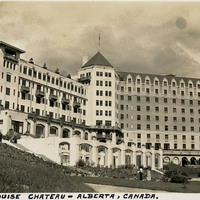
Caption: "Lake Louise Chateau - Alberta, Canada," c. 1935 shows the luxury hotel, originally built by the Canadian Pacific Railway as a base for outdoor enthusiasts in 1890. The hotel is located in Banff National Park.
Date: 1935
-
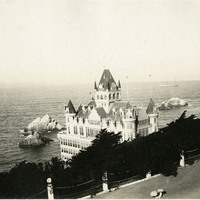
No Caption: The Cliff House, San Francisco, California, c. 1905. The Victorian structure shown here is the third iteration of the Cliff House, constructed in 1896. It was later destroyed by a fire, in 1907.
Date: 1905