Search All Items
- Filters:
- Language
- English 4770
- Spanish 11
- ENGLISH 2
- English 1
- census_013 1
- contra_costa_schedule_1_volume_1 1
- Type
- Image 3784
- Still Image 594
- Text 377
- Text 22
- Textual 2
- Image of the California Census from the records of the office of the California Secretary of State 1
Search Results 1581 to 1590 of 4833
-
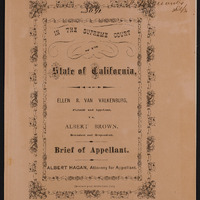
A Brief of Appellant is filed in the appellate court by the party who lost in the previous trial and argues in favor of appealing a lower court’s decision. Ellen Van Valkenburg began an important legal battle for women’s enfranchisement in California on July 21, 1871, when she requested that Santa Cruz County Clerk Albert Brown enter her name in the Great Register of voters. After Brown (a willing accomplice in helping her bring the case to court) refused to register her, Van Valkenburg and her lawyer, Santa Cruz Judge Albert Hagan, began legal proceedings by requesting a writ of mandamus, a judicial remedy used to compel agencies to perform ministerial acts, such as registering voters. Van Valkenburg and Hagan argued her case by citing the 14th Amendment of the U.S. Constitution. The new amendment, ratified 3 years earlier in 1868, defined all persons born or naturalized in the U.S. as citizens protected by civil rights. Van Valkenburg and Hagan asserted that American women were considered citizens under this amendment, and that citizenship automatically granted absolute rights, including the right to vote. The case first went to California’s Third District Court. Many of America’s most prominent suffragists, including Elizabeth Cady Stanton and Susan B. Anthony, were with Van Valkenburg in Santa Cruz when the lower court ruled against her on August 16, 1871. Van Valkenburg and Hagan swiftly appealed this decision through the Supreme Court of California. In the end, the Supreme Court of California upheld the lower court’s verdict under the reasoning that as a white American woman, Van Valkenburg already had citizenship and civil rights prior to the passage of the 14th amendment, and that the 14th amendment did not provide her with any additional political rights, such as the right to vote. While Van Valkenburg lost her case, and subsequent lawsuits failed to secure women's suffrage nationwide, the case stands as a critical early example of legal advocacy for women's political rights in California.
Date: September 29, 1871
-
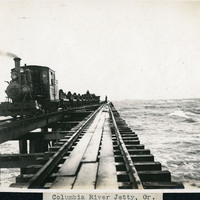
Caption: "Columbia River Jetty, Or.," c. 1910. View of a jetty built at the mouth of the Columbia River, carrying a railroad trestle. A train hauling cars loaded with large rocks is visible at the left side of the photograph. This is likely the so-called South Jetty, extending more than six miles into the ocean from Point Adams on the Oregon side of the river mouth. The jetty system at the mouth of the Columbia River was constructed between 1885 and 1917. Designed to funnel water from the Columbia River in a more concentrated fashion into the Pacific Ocean, the jetty system helped create a deeper, more stable shipping channel.
Date: 1910
-
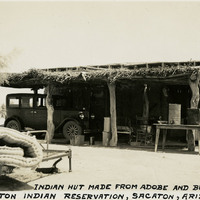
Caption: "Indian Hut Made From Adobe and Bush Branches, Sacaton Indian Reservation, Sacaton, Arizona, May, 24, 1934." View of a small adobe building with a porch area across the length of the façade. The porch is sheltered by a low roof supported by tree trunks or thick tree branches and thatched with grass or sticks. Located south of Phoenix and including the town of Sacaton, the Gila River Indian Reservation is home to members of the Akimel O’odham (Pima) and the Pee-Posh (Maricopa) tribes. The reservation was established in 1859. Eighty years later, in 1939, Congress provided for the self-governance of the reservation via the Gila River Indian Community.
Date: 5/24/1934
-
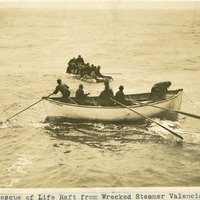
Caption: "Rescue of Life Raft from Wrecked Steamer Valencia." Photograph showing a boat crew about to rescue 18 people on a life raft. On Monday, January 22, 1906, the passenger liner Valencia ran aground on a reef during a storm off the southwestern coast of Vancouver Island (an area notorious for ship wrecks). Although the shore was only about fifty yards away, heavy seas and rock cliffs prevented the passengers and crew from making their way safely to land. Circumstances prevented rescue vessels from coming to the stricken ship's aid until Wednesday January 24th. The steamship City of Topeka rescued 18 men on a life raft, shown in this photograph. The official death toll was 136: seven officers, 33 crewmen, and 96 passengers (including seventeen women and eleven children -- all of the women and children on board perished). Only 37 people survived the wreck.
Date: 1/24/1906
-
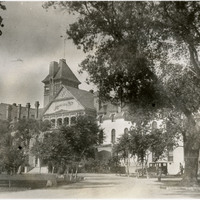
No caption, c. 1920. View of the Hotel el Paso de Robles. This resort hotel opened in 1891, featuring a variety of amenities including a mineral hot springs "plunge" bath. The hotel burned down in 1940, and was replaced by the building that is still in operation today as the Paso Robles Inn.
Date: 1920
-
Caption: "Crater Lake - Arrow indicates Watchman Point," c. 1935. Located in the Crater Lake National Park, Crater Lake is a caldera lake formed about 7,700 years ago by the collapse of the volcano, Mount Mazama. Its 1,949 foot depth makes it the deepest lake in the United States.
Date: 1935
-
Caption: "Nudist Colony - San Diego Exposition," c. 1935. The Zoro Garden Nudist Colony, named for the Persian mystic, Zoroaster, was an unusual and controversial attraction that featured partially nude men and women performing as nudists. Exposition visitors were charged twenty-five cents to watch the "nudists" perform ceremonies and other activities. Today, the sunken Zoro Garden in Balboa Park is a butterfly garden.
Date: 1935
-
Caption: "Republic Statue Jackson Park Chicago," c. 1925. Designed by Chester French (sculptor), this version of the Statue of the Republic has stood in Chicago's Jackson Park since its construction in 1918. It is a one-third replica of a statue at the World's Columbian Exposition, held at Chicago in 1893.
Date: 1925
-
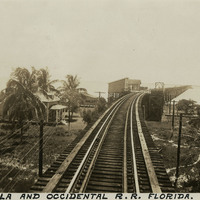
Caption: "Peninsula and Occidental R.R. Florida. July 2, 34." View of railroad tracks carried over water into the distance on a wood trestle. This is likely part of the Overseas Railroad, an extension of the Florida East Coast Railway, built to connect Key West with the Florida mainland.
Date: 7/2/1934
-
Caption: "Lower Market St. San Francisco, Calif., May 14, 1934." Bird's eye view of a street scene along San Francisco's Market Street. The Ferry Building is visible in the upper right-hand corner of the photograph, while the Flatiron Building appears in the photograph's center.
Date: 5/14/1934