
Search All Items
- Filters:
- Language
- English 4767
- Spanish 11
- ENGLISH 2
- English 1
- census_013 1
- contra_costa_schedule_1_volume_1 1
- Type
- Image 3783
- Still Image 592
- Text 377
- Text 22
- Textual 2
- Image of the California Census from the records of the office of the California Secretary of State 1
Search Results 1611 to 1620 of 4830
-
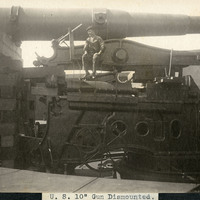
Caption: "U.S. 10" Gun Dismounted.," c. 1905. View from the side of a 10" disappearing gun, a heavy coastal artillery weapon. It has been dismounted from its carriage, with one end held up by timbers. An unidentified man is seated near the barrel of the gun.
Date: 1905
-
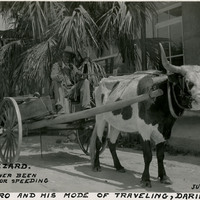
Caption: "York Hazzard. He has Never Been Arrested for Speeding. Old Negro and His Mode of Traveling, Darien, Ga. July 13, 1934." York Hazzard, an elderly man of African-American ethnicity, seated in a small wooden cart drawn by a cow or steer. An automobile is parked on the street behind the cart.
Date: 7/13/1934
-
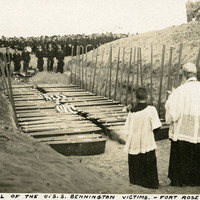
Caption: "Buriel [sic] of the U.S.S. Bennington Victims. -- Fort Rosecrans." Shows a grave site with dozens of caskets ready for burial. A priest and two altar boys stand at one side of the caskets, while a large group of U.S. Navy sailors looks on from the other side. While sailing from port in San Diego on the morning of July 21, 1905, the boiler of the USS Bennington exploded, killing sixty-six of her crew. The victims were laid to rest in the cemetery at Fort Rosecrans. See also 96-07-08-alb08-217.
Date: 1905-07-23
-
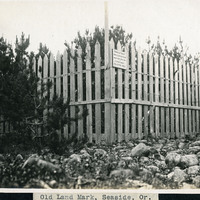
Caption: "Old Landmark, Seaside, Or.," c. 1910. Shows a picket fence erected around what a sign calls "Remains of Cairn where Lewis & Clark made salt from the ocean water Jan. & Feb. 1806." When the famous expedition led by Merriweather Lewis and William Clark reached the Pacific Ocean in late 1805, their supplies had run dangerously low, including their salt supply. Salt, used not only to flavor meat but also to preserve it, was extremely important to the health of the expedition. Three of Lewis and Clark's men traveled to a site on the coast near present-day Seaside, Oregon to set up a small salt-works, boiling ocean water in a series of large kettles and then scraping the resulting salt crust off of the sides. In this manner, the men eventually collected about twenty gallons of salt before Lewis and Clark decided the supply was sufficient for the return journey. In 1910, the property containing the remains of the cairns was deeded to the Oregon Historical Society. In 1955, replica salt cairns were built at the site by the Lions Club to commemorate the expedition's activities.
Date: 1910
-
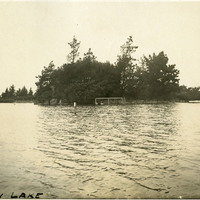
Caption: "Stow Lake," in Golden Gate Park, San Francisco, c. 1910. Stow lake is a manmade lake in Golden Gate Park dating back to 1893. Visitors still enjoy Stow Lake today, engaging in activities such as boating and picnicking by the lake.
Date: 1910
-
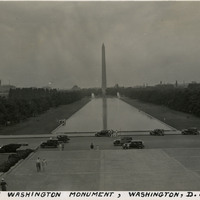
Caption: "George Washington Monument, Washington, D.C. July 29, 1934." The obelisk of the Washington Monument rises above the Reflecting Pool on National Mall in Washington, D.C. Built between 1848 and 1888 to commemorate George Washington (former Commander-in-Chief of the Continental Army and first President of the United States), the obelisk is the world's tallest stone structure at a height of 555 feet.
Date: 7/29/1934
-
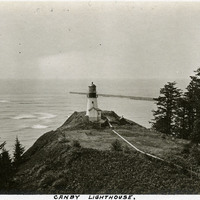
Caption: "Canby Lighthouse.," c. 1905-1909. The Cape Disappointment Lighthouse sits on a rocky point overlooking the mouth of the Columbia River. Built in the 1850s, the lighthouse was electrified in 1934 and automated in 1973. The lighthouse is now part of the Cape Disappointment State Park (formerly Fort Canby State Park).
Date: 1905
-
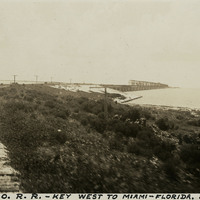
Caption: "P. and O. R.R. -- Key West to Miami -- Florida. July 2, 1934." View of railroad tracks carried on a berm in the foreground and on a trestle over water in the distance. This is likely part of the Overseas Railroad, an extension of the Florida East Coast Railway, built to connect Key West with the Florida mainland.
Date: 7/2/1934
-
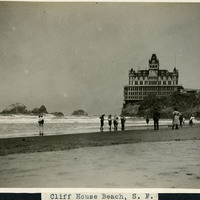
Caption: "Cliff House Beach, S.F.," c. 1906. Unidentified people enjoying the surf and beach at Ocean Beach, overlooked by the iconic San Francisco Cliff House. The Victorian structure shown here is the third iteration of the Cliff House, constructed in 1896. It was later destroyed by a fire, in 1907.
Date: 1906