
Search All Items
- Filters:
- Language
- English 4786
- Spanish 11
- ENGLISH 2
- English 1
- census_013 1
- contra_costa_schedule_1_volume_1 1
- Type
- Image 3785
- Still Image 609
- Text 377
- Text 22
- Textual 2
- Image of the California Census from the records of the office of the California Secretary of State 1
Search Results 1651 to 1660 of 4849
-
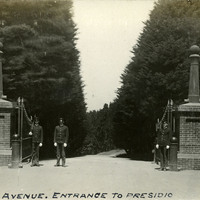
Caption: "Presidio Avenue. Entrance to Presidio," c. 1906. Gateway into the Presidio of San Francisco, bracketed by brick podiums topped by ornamental pinnacles. Three soldiers stand guard at the gate. Established in 1776 by Spanish explorers, the Presidio is a fortified location overlooking the Golden Gate, the entrance into San Francisco Bay. It was closed as a military structure in 1995, and is now a park within the Golden Gate National Recreation Area.
Date: 1906
-
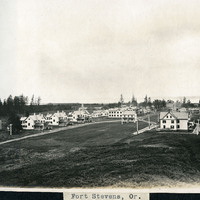
Caption: "Fort Stevens, Or.," c. 1910. View of buildings at Fort Stevens, part of the Three Fort Harbor Defense System protecting the mouth of the Columbia River from enemy incursion or attack (the other forts being Fort Columbia and Fort Canby, both in Washington). Built during the Civil War, the fort remained active until after World War II. In June 1942, Fort Stevens gained the dubious distinction of being the only military installation in the continental United States to come under enemy fire when a Japanese submarine surfaced off the coast and fired seventeen missiles at the fort. The missiles destroyed the backstop to the fort's baseball field, but otherwise did little harm. Fort Stevens was decommissioned in 1947. It was later turned over to the Oregon Parks and Recreation Department, and currently is the site of an Oregon State Park.
Date: 1910
-
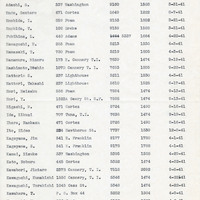
List of Japanese holders of commercial fishing licences, arranged alphabetically by last name
Date: 1941-1942
-
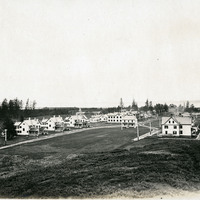
No Caption: See also 96-07-08-alb08-139 with caption: "Fort Stevens, Or," c. 1910. A view of buildings at Fort Stevens, part of the Three Fort Harbor Defense System protecting the mouth of the Columbia River from enemy incursion or attack (the other forts being Fort Columbia and Fort Canby, both in Washington). Built during the Civil War, the fort remained active until after World War II. In June 1942, Fort Stevens gained the dubious distinction of being the only military installation in the continental United States to come under enemy fire when a Japanese submarine surfaced off the coast and fired seventeen missiles at the fort. The missiles destroyed the backstop to the fort's baseball field, but otherwise did little harm. Fort Stevens was decommissioned in 1947. It was later turned over to the Oregon Parks and Recreation Department, and currently is the site of an Oregon State Park.
Date: 1910
-
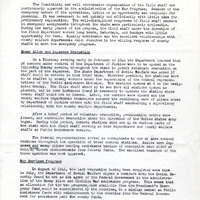
Summary of the War Program; Sections: Enemy Alien and Japanese Evacuation; War Services Program; Defense Activities; See Memo on Report on Field Staff Operations (F3729_129_002a)
Date: October 25, 1943
-
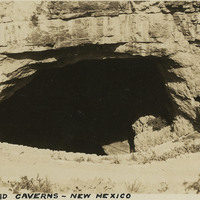
Caption: "Carlsbad Caverns -- New Mexico, May 30, 34." View looking into dark cave mouth of Carlsbad Cavern, a series of natural underground chambers including the "Big Room," the fifth-largest such chamber in North America with a length of 1,000 feet, a width of 625 feet, and a maximum height of 255 feet. The site was named Carlsbad Cave National Monument in 1923, and declared Carlsbad Caverns National Park in 1930.
Date: 5/30/1934
-
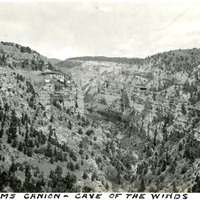
Caption: "Williams Canion [sic] - Cave of the Winds," c. 1923. View of a rugged canyon with a small building perched on one wall featuring a sign reading "CAVE." In 1880, two brothers, George and John Pickett, discovered the entrance to a large cave system in Williams Canyon. Further exploration resulted in opening more caverns within the system. The site became a tourist attraction called "Cave of the Winds," with guided tours having been on offer since 1881.
Date: 1923
-
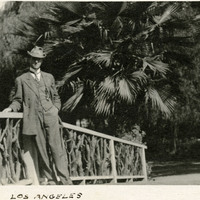
Caption: "Echo Park [sic] Los Angeles," c. 1906. Unidentified man leaning on a railing made of tree branches, with palm trees and other vegetation in the background. Echo Lake Park opened in 1895. The lake was originally created in 1868 to support the operations of a mill. The mill, however, closed seven years later. The site was later selected for conversion to a city park.
Date: 1906
-
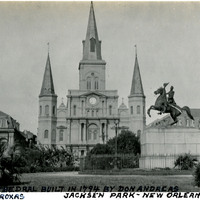
Caption: "St. Louis Cathedral Built in 1794 by Don Andreas Almonastry Roxas - Jacksen[sic] Park - New Orleans." St. Louis Cathedral anchors one end of Jackson Square in New Orleans' French Quarter. The structure of the cathedral largely dates to the 1850 restoration and expansion of an older cathedral built on the site in 1793. Very little of the older church survived, although the central bell tower (added on to the older church in 1819) was reused in the new structure and is still extant today. A statue of Andrew Jackson mounted on a rearing horse (Clark Mills, sculptor) stands in the square in front of the cathedral. The sculpture was erected in 1856. See also 96-07-08-alb11-052.
Date: 6/15/1934
-
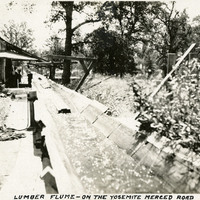
Caption: "Lumber Flume -- on the Yosemite Merced Road," c. 1920. Flume with boards being carried by running water, likely along what is now known as California State Route 140, connecting the town of Merced with the Yosemite Valley.
Date: 1920