
Search All Items
- Filters:
- Language
- English 1638
- Spanish 154
- ENGLISH 2
- English 1
- census_013 1
- Type
- Image 1312
- Still Image 275
- Text 183
- Text 22
Search Results 1701 to 1710 of 1819
-
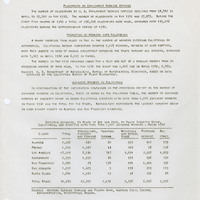
Excerpt from report by the State and County Coordinating Committee on Remployment; Data on number of Japanese workers employed in March 1940 by county, distributed by industry
Date: July 6, 1942; Date taken from first page of report
-
Office Memoranda from Beryl E. Cox to Bertha S. Underhill regarding the War Services Program; Sections: Total Plan; Civilian War Assistance; Resettlement Program
Date: June 6, 1945
-
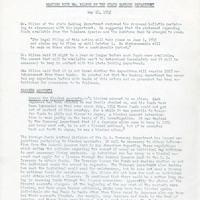
Summary of discussion with State Banking Department on Japanese banks; Section on blocked accounts
Date: May 24, 1945
-
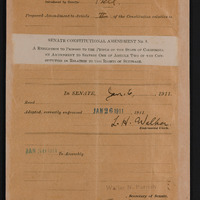
Absent of terms such as “women” or “sex”, the language for Senate Constitutional Amendment No. 8 appears intentionally neutral, labeled as “A Resolution to Propose to the People of the State of California an Amendment to Section One of Article Two of the Constitution in Relation to the Rights of Suffrage.” However, feelings about the amendment were decidedly strong. The arguments for and against Senate Constitutional Amendment No. 8 were closely watched by suffrage organizations, with crowds of onlookers filling the gallery and the lobby of the Capitol. Authored by Republican State Senator Charles W. Bell from Pasadena, Senate Constitutional Amendment No. 8 was passed by the Senate on February 2, 1911, receiving 66 ayes and 12 noes. Senate Constitutional Amendment No. 8 would be introduced to the public as Proposition 4 on the ballot for the special election scheduled for October 10, 1911, along with a variety of other reform amendments passed by the Senate.
Date: January 6, 1911