
Search All Items
- Filters:
- Type
- Image 3871
- Still Image 1541
- Text 433
- Text 19
- Image of the California Census from the records of the office of the California Secretary of State 1
- Language
- English 5808
- Spanish 62
- ENGLISH 2
- English 1
- census_013 1
- contra_costa_schedule_1_volume_1 1
Search Results 1731 to 1740 of 5932
-
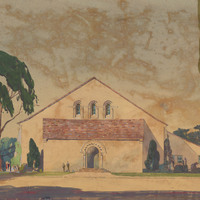
Design and color drawing by Alfred Eichler of Gymnasium, Fred C. Nelles School for Boys, Whittier. Built. Project for California Youth Authority - Institutions.
Date: 1933
-
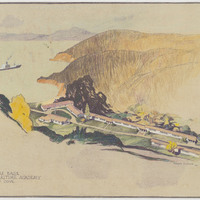
Color drawing by Alfred Eichler of California Maritime Academy shore base, Morrow Cove; design for wartime development. Built. Project for Department of Education.
Date: 1942
-
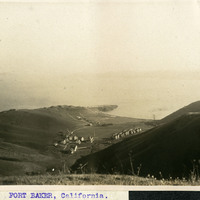
Caption: "Fort Baker, California," c. 1910. Fort Baker was constructed between 1901 and 1910 to provide permanent housing for the new seacoast fortifications that were built between 1897 and 1905. The men stationed at Fort Baker were members of the Coast Artillery Corps, officially created in 1907 by the U.S. Army to protect and defend the nation's harbors.
Date: 1910
-
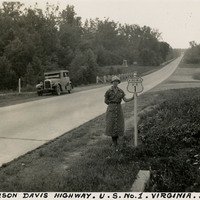
Caption: "Jefferson Davis Highway. U.S. No. 1. Virginia. July 20, 34." Grace McCarthy is standing next to a U.S. Route 1 sign along a highway in Virginia. The Jefferson Davis Highway project was begun by the United Daughters of the Confederacy (UDC). As auto tourism increased across the U.S., so to did the need for roads on which to drive. Private interests such as the UDC began to develop routes across the country, but with no central administrating organization the routes were haphazard and confusing. The UDC planned a route that was to stretch from Virginia across the southern U.S. to San Diego, but the entire route never materialized. The federal government stepped in to impose a numbering system on various routes across the nation. That portion of the planned Jefferson Davis Highway through Virginia was numbered as U.S. Route 1.
Date: 7/20/1934
-
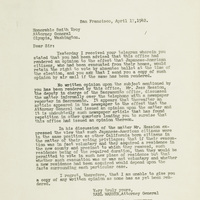
Correspondence from Earl Warren (by Robert W. Harrison) to Smith Troy regarding written opinion on voting rights of incarcerated Japanese
Date: April 17, 1942
-
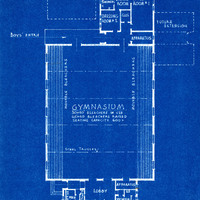
Caption: "Floor Plan. Gymnasium, Whittier State School." Blueprint, Fred C. Nelles School for Boys; design and drawing by Alfred Eichler. Project for California Youth Authority - Institutions.
Date: 1934
-
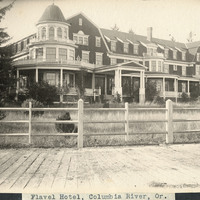
Caption: "Flavel Hotel, Columbia River, Or.," c. 1909. Built at the turn of the century, the Flavel Hotel housed passengers waiting to board steamships of the Great Northern Pacific Steamship Company bound for San Francisco and other ports. The Flavel family constructed the hotel as part of an effort to establish the town of Flavel on Tansy Point along the Columbia River. The town failed to attract sufficient residents, however, and was annexed into Warrenton by 1918. By the time this photograph was taken, the hotel appears to have been abandoned.
Date: 1909
-
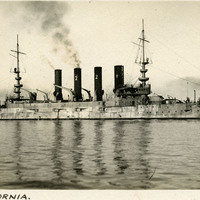
Caption: "U.S.S. California," c. 1906. This photograph shows the second U.S. Navy ship to bear the Golden State's name. Launched in 1904 and commissioned in 1907, this Pennsylvania-class armored cruiser served in the Pacific fleet. Her name was changed in 1914 to the USS San Diego, in order to free up the name for a new, Tennessee-class battleship. The USS San Diego went on to serve in both the Pacific and Atlantic fleets during World War I, until being sunk off the coast of New York by a German mine in 1918, with a loss of six lives.
Date: 1906
-
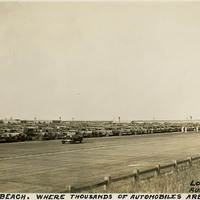
Caption: "Jones's [sic] Beach. Where Thousands of Automobiles are Parked. Long Island, N.Y. Aug. 17, 1934." Photograph of a large parking area full of automobiles on Jones Beach Island. The Long Island State Park Commission began to develop the area for a park in the 1920s, dredging enough sand to connect several of the barrier islands south of Long Island and raising the elevation of the islands by fourteen feet to create one large park. It opened to the public in 1929. It is now a state park, with an estimated six million visitors each year.
Date: 8/17/1934