
Search All Items
- Filters:
- Language
- English 6853
- Spanish 18
- ENGLISH 3
- English 2
- census_013 1
- contra_costa_schedule_1_volume_1 1
- Type
- Image 3886
- Still Image 2484
- Text 441
- Text 54
- Textual 2
- Image of the California Census from the records of the office of the California Secretary of State 1
Search Results 1741 to 1750 of 6969
-
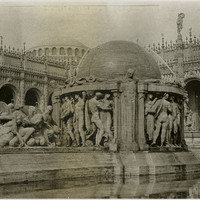
No Caption: Fountain of the Earth, (Robert I. Aitken, sculptor), at the Panama-Pacific International Exposition. See also 96-07-08-alb01-064.
Date: 1915
-
No Caption: See also 96-07-08-alb01-066, with caption: "Fountain of the Earth Views," (Robert I. Aitken, sculptor), at the Panama-Pacific International Exposition.
Date: 1915
-
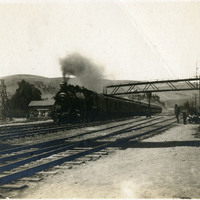
No caption, undated. A locomotive steams through the center of this photograph, in an unidentified location. This photograph was loose in the box with Album 11.
Date: Undated
-
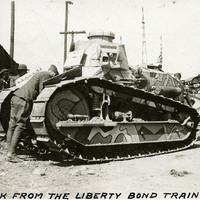
Caption: "A Tank from the Liberty Bond Train." Shows a Renault FT Tank, a small French tank with caterpillar-style propulsion used during World War I. This tank was displayed as part of the fifth Liberty Bond Drive, held in 1919. During World War I, the U.S. government raised funds for the war by issuing "liberty bonds." Liberty Bond Trains crisscrossed the country to encourage purchase of the bonds. Citizens who purchased the bonds could later redeem them for the purchase price plus interest.
Date: 1919
-
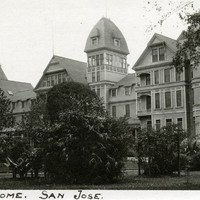
Caption: "Hotel Vendome. San Jose.," c. 1910. View of the Hotel Vendome, a resort hotel built in San Jose in 1889. The hotel was demolished in 1930, the land subdivided and sold as residential lots.
Date: 1910
-
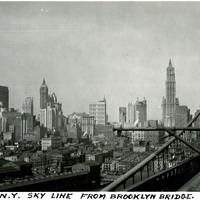
Caption: "N.Y. Sky Line From Brooklyn Bridge." View of New York City's skyline, as seen from the Brooklyn Bridge. A portion of the bridge (designed by architect John Augustus Roebling and completed in 1883) can be seen in the right hand side of the photograph. See also 96-07-08-alb09-165.
Date: 8/7/1934