
Search All Items
- Filters:
- Language
- English 5312
- Spanish 43
- ENGLISH 2
- English 1
- census_013 1
- Type
- Image 3851
- Still Image 1035
- Text 445
- Text 22
- Textual 2
Search Results 1771 to 1780 of 5424
-
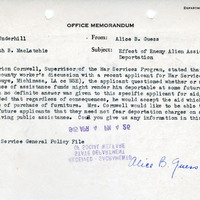
Office Memorandum from Alice B. Guess to Bertha S. Underhill regarding assistance and deportation; for response, see Correspondence on Fear of Deportation (F3729_109_001a)
Date: March 30, 1945
-
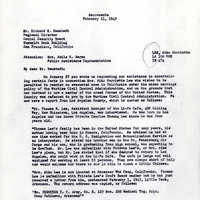
Correspondence from Martha A. Chickering to Richard H. Neustadt regarding exemption from incarceration in mixed marriage cases; See F3729_86_002 and F3729_86_003
Date: February 11, 1943
-
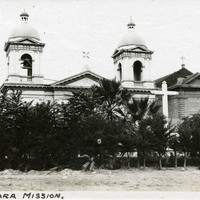
Caption: "Santa Clara Mission," c. 1910. Founded in 1777, Mission Santa Clara featured several different churches over the years. This photograph shows the mission church as it appeared from roughly 1861 to 1926. In the 1860s, Santa Clara College President Burchard Villager decided to rebuild many of the buildings on the campus. In the process, the mission church was renovated in the Italianate style, with a second bell tower. This Italianate-style church burned in 1926. The church was then rebuilt as a modern reconstruction of the fifth church on the site, the original of which was destroyed by fire in 1825.
Date: 1910
-
Summarized review of case records and interviews with several agencies
Date: February 25, 1946
-
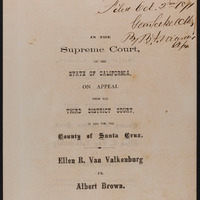
A Brief of Respondent is filed in the appellate court by the party who won in the previous trial and defends the lower court’s original decision. Ellen Van Valkenburg began an important legal battle for women’s enfranchisement in California on July 21, 1871, when she requested that Santa Cruz County Clerk Albert Brown enter her name in the Great Register of voters. After Brown (a willing accomplice in helping her bring the case to court) refused to register her, Van Valkenburg and her lawyer, Santa Cruz Judge Albert Hagan, began legal proceedings by requesting a writ of mandamus, a judicial remedy used to compel agencies to perform ministerial acts, such as registering voters. Van Valkenburg and Hagan argued her case by citing the 14th Amendment of the U.S. Constitution. The new amendment, ratified 3 years earlier in 1868, defined all persons born or naturalized in the U.S. as citizens protected by civil rights. Van Valkenburg and Hagan asserted that American women were considered citizens under this amendment, and that citizenship automatically granted absolute rights, including the right to vote. The case first went to California’s Third District Court. Many of America’s most prominent suffragists, including Elizabeth Cady Stanton and Susan B. Anthony, were with Van Valkenburg in Santa Cruz when the lower court ruled against her on August 16, 1871. Van Valkenburg and Hagan swiftly appealed this decision through the Supreme Court of California. In the end, the Supreme Court of California upheld the lower court’s verdict under the reasoning that as a white American woman, Van Valkenburg already had citizenship and civil rights prior to the passage of the 14th amendment, and that the 14th amendment did not provide her with any additional political rights, such as the right to vote. While Van Valkenburg lost her case, and subsequent lawsuits failed to secure women's suffrage nationwide, the case stands as a critical early example of legal advocacy for women's political rights in California.
Date: October 2, 1871
-
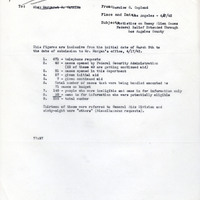
Office Memorandum from Bernice G. Copland to Margaret S. Watkins and Lois Craig regarding report on operations in Los Angeles County
Date: April 27, 1942
-
This item has no description.
Date: 1957
-
Caption: "Old Cathedral, St. Augustine." View of the tower, columned entryway, and bells of Cathedral Basilica of St. Augustine. The oldest church in Florida, the first building on the site was established in 1565. The cathedral seen in this photograph (which exists today) was constructed between 1793 and 1797. The cathedral was designated a National Historic Landmark in 1970.
Date: 7/10/1934