
Search All Items
- Filters:
- Language
- English 4971
- Spanish 26
- ENGLISH 2
- English 1
- census_013 1
- contra_costa_schedule_1_volume_1 1
- Type
- Image 3611
- Still Image 945
- Text 415
- Text 22
- Textual 2
- Image of the California Census from the records of the office of the California Secretary of State 1
Search Results 1821 to 1830 of 5054
-
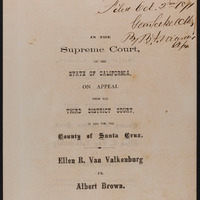
A Brief of Respondent is filed in the appellate court by the party who won in the previous trial and defends the lower court’s original decision. Ellen Van Valkenburg began an important legal battle for women’s enfranchisement in California on July 21, 1871, when she requested that Santa Cruz County Clerk Albert Brown enter her name in the Great Register of voters. After Brown (a willing accomplice in helping her bring the case to court) refused to register her, Van Valkenburg and her lawyer, Santa Cruz Judge Albert Hagan, began legal proceedings by requesting a writ of mandamus, a judicial remedy used to compel agencies to perform ministerial acts, such as registering voters. Van Valkenburg and Hagan argued her case by citing the 14th Amendment of the U.S. Constitution. The new amendment, ratified 3 years earlier in 1868, defined all persons born or naturalized in the U.S. as citizens protected by civil rights. Van Valkenburg and Hagan asserted that American women were considered citizens under this amendment, and that citizenship automatically granted absolute rights, including the right to vote. The case first went to California’s Third District Court. Many of America’s most prominent suffragists, including Elizabeth Cady Stanton and Susan B. Anthony, were with Van Valkenburg in Santa Cruz when the lower court ruled against her on August 16, 1871. Van Valkenburg and Hagan swiftly appealed this decision through the Supreme Court of California. In the end, the Supreme Court of California upheld the lower court’s verdict under the reasoning that as a white American woman, Van Valkenburg already had citizenship and civil rights prior to the passage of the 14th amendment, and that the 14th amendment did not provide her with any additional political rights, such as the right to vote. While Van Valkenburg lost her case, and subsequent lawsuits failed to secure women's suffrage nationwide, the case stands as a critical early example of legal advocacy for women's political rights in California.
Date: October 2, 1871
-
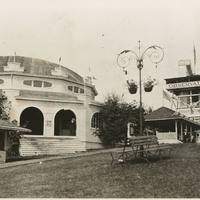
No Caption: See also 96-07-08-alb05-185, with caption: "Council Crest -- Portland," Buildings and benches in a park setting, with a tall observation tower, labeled the "Observatory," at the right side of the photograph. Council Crest Park in Portland, Oregon was the site of an amusement park between 1907 and 1929. The buildings in this photograph were part of that park. The Observatory, built in 1907, was demolished in 1941 to make room for a water tower. The area is still in use as a municipal park.
Date: 1909
-
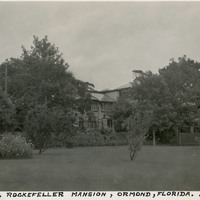
Caption: "John D. Rockefeller Mansion, Ormond [sic], Florida. July 10, 1934." A large mansion can be glimpsed through surrounding trees and other vegetation in this photograph. The mansion is known as the Casements, for the numerous casement windows incorporated into its structure. Built in 1914 in Ormond Beach, John D. Rockefeller purchased the home in 1918 for use as a winter residence. After Rockefeller died in 1937, the property was sold several times, until the City of Ormond Beach bought it in 1973. The city renovated it for use as a cultural and community center, a purpose which it still serves.
Date: 7/10/1934
-
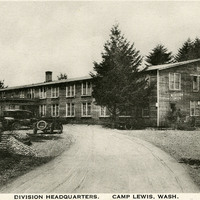
Caption: "Division Headquarters. Camp Lewis, Wash.," c. 1918. Shows the two-story building that served as Division Headquarters for Camp Lewis in Washington. The Camp was established by the U.S. Army in 1917, as part of the U.S.'s preparations for eventual entry into World War I. Rapid construction had the camp ready to house 60,000 men within a few months. The site is still in use as a military facility, under the name Fort Lewis.
Date: 1918
-
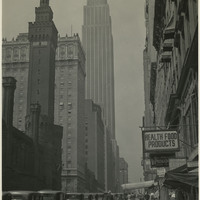
Caption: "Empire State Bldg. in the Distance. Height 1250 Feet, 102 Stories. 34th St. New York. Aug. 16, 1934." Street scene dominated by the Empire State Building rising a few blocks away. Construction began on this iconic 102-story building, designed by William F. Lamb, in 1930. Completed by early 1931, it held the title of world's tallest building for almost 40 years, until being surpassed in 1970 by the construction of the World Trade Center's North Tower. It is now the fifth-tallest building in the U.S., and the 28th-tallest in the world.
Date: 8/16/1934
-
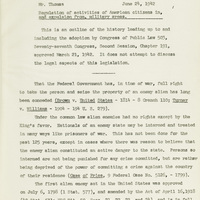
Narrative by J. M. Thomas to Mr. Wenig regarding the history leading up to and including the adoption of Public Law 503, 77th Congress
Date: June 24, 1942
-
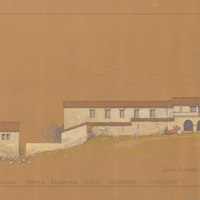
Caption: "Administration Building Santa Barbara State Teachers College." Riviera Campus. Design and drawing by Alfred Eichler. Built. Project for Department of Education. The image, eichler_f3274_191, is inset on the image, eichler_f3274_190.
Date: 1925
-
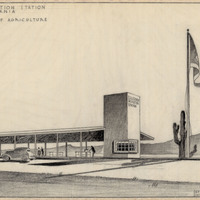
Caption: "Quarantine Inspection Station, Blythe, California, State Department of Agriculture. Department of Public Works, Division of Architecture-Sacramento." Design and drawing by Alfred Eichler. Built in 1939. Situated in desert country. Project for Department of Agriculture.
Date: 1939
-
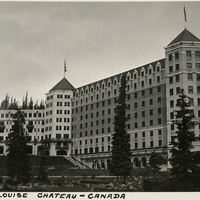
Caption: "Lake Louise Chateau - Canada," c. 1935 shows the luxury hotel, originally built by the Canadian Pacific Railway as a base for outdoor enthusiasts in 1890. The hotel is located in Banff National Park.
Date: 1935
-
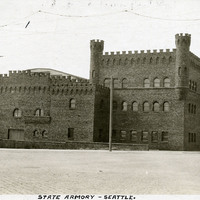
Caption: "State Armory -- Seattle.," c. 1910. View of castle-like armory building for the Washington National Guard, built in 1909 near Seattle's Pike Place Market. It was demolished in 1968.
Date: 1910