Search All Items
- Filters:
- Language
- English 6853
- Spanish 18
- ENGLISH 3
- English 2
- census_013 1
- contra_costa_schedule_1_volume_1 1
- Type
- Image 3886
- Still Image 2484
- Text 441
- Text 54
- Textual 2
- Image of the California Census from the records of the office of the California Secretary of State 1
Search Results 1841 to 1850 of 6969
-
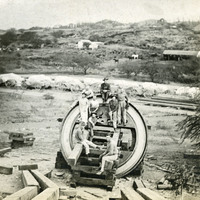
No caption, c. 1909-1915. Group of unidentified men gathered around a part of what appears to be a 12-inch mortar at Fort Ruger, Hawaii. Farm buildings and rolling hills appear in the distance. Fort Ruger was established on the Island of O'ahu by the U.S. in 1906 as the Diamond Head Reservation. Its name was changed to Fort Ruger in 1909. See also 96-07-08-alb05-098 and 099.
Date: 1915
-
Caption: "City Hall San Jose," c. 1905 (Theodore Lenzen, Architect), served as the San Jose City Hall from 1889 until it was demolished and replaced in 1958.
Date: 1905
-
Caption: "Court House, Port Townsend, Washington," c. 1935. The Jefferson County Courthouse in Port Townsend, Washington, was built in 1891 (W.A. Ritchie, architect) in Romanesque architectural style.
Date: 1935
-
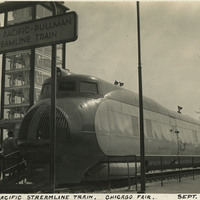
Caption: "Union Pacific Streamline Train. Chicago Fair. Sept. 22, 1934." View of the engine on the Union Pacific's new M-10000, on exhibit at Chicago's Century of Progress Exposition. The M-10000 was the first lightweight express passenger train powered by an internal combustion engine in the U.S. The train went on an exhibition tour of the US in 1934, which included a stop at the Exposition. The Exposition, a world fair attended by thirty-nine million people, celebrated Chicago's one-hundred year anniversary of incorporation. Originally planned to only run from May to November in 1933, it was such a success that its organizers decided to keep it running for a second season from May through October the following year. The central theme of the Exposition was technological innovation, with a motto of "Science Finds, Industry Applies, Man Conforms."
Date: 9/22/1934
-
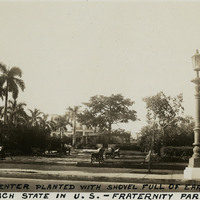
Caption: "Tree in Center Planted with Shovel Full of Earth From Each State in U.S. -- Fraternity Park -- Havana, July 4, 34." This photograph captures a view of Havana's Fraternity Park. The area originally served the city as a military parade and training ground (called Campo de Marte). In 1928, the park was renovated and a ceiba (or kapok) tree was planted in one of the central parcels. This tree, seen in the center of this photograph, was planted as the Tree of American Fraternity. When Havana hosted the sixth International American Conference later in 1928 (also known as one of the Pan-American Conferences), each of the twenty-one visiting dignitaries brought earth from their native counties in which to plant the tree (William McCarthy mistakenly identified the earth as coming from each state in the U.S.).
Date: 7/4/1934
-
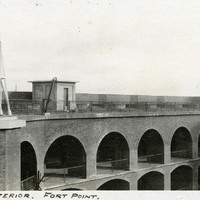
Caption: "Portion of Interior. Fort Point.," c. 1906. View of arched colonnades on ground and middle floors of Fort Point, and an upper tier with barbettes for the future installation of heavy artillery coastal defense weapons. The facilities at Fort Point were part of an effort by the U.S. government to protect the Golden Gate, entrance to the San Francisco Bay. Built between 1853-1861, the fort included emplacements for 141 guns but never fired a weapon in defense of the Bay. Its name was officially changed in 1882 to Fort Winfield Scott, but in 1886 the fort was officially downgraded to a sub-post of the San Francisco Presidio and the name discontinued. It was resurrected in 1912, with the establishment of a coastal artillery fortification at the Presidio, called, once again, Fort Winfield Scott.
Date: 1906