
Search All Items
- Filters:
- Language
- English 4330
- Spanish 107
- ENGLISH 1
- census_013 1
- Type
- Image 3891
- Still Image 286
- Text 236
- Text 19
- Textual 2
Search Results 1891 to 1900 of 4452
-
The Census of 1852 collection includes enumerations of California's 32 counties, arranged into 126 volumes. Schedule I enumerated the county's inhabitants, while schedule II enurmerated economic production. Many pages of this volume are damaged.
Date: 1852
-
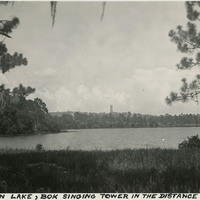
Caption: "Mountain Lake, Bok Singing Tower in the Distance -- Florida, June 26, 1934." Lake scene, with lush vegetation and the Singing Tower of Bok Tower Gardens visible in the center of the photograph. Mountain Lake, named for the lake near which it was established, was founded by Frederick S. Ruth in 1916.
Date: 6/26/1934
-
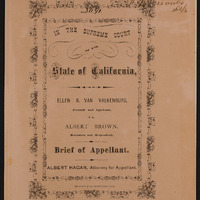
A Brief of Appellant is filed in the appellate court by the party who lost in the previous trial and argues in favor of appealing a lower court’s decision. Ellen Van Valkenburg began an important legal battle for women’s enfranchisement in California on July 21, 1871, when she requested that Santa Cruz County Clerk Albert Brown enter her name in the Great Register of voters. After Brown (a willing accomplice in helping her bring the case to court) refused to register her, Van Valkenburg and her lawyer, Santa Cruz Judge Albert Hagan, began legal proceedings by requesting a writ of mandamus, a judicial remedy used to compel agencies to perform ministerial acts, such as registering voters. Van Valkenburg and Hagan argued her case by citing the 14th Amendment of the U.S. Constitution. The new amendment, ratified 3 years earlier in 1868, defined all persons born or naturalized in the U.S. as citizens protected by civil rights. Van Valkenburg and Hagan asserted that American women were considered citizens under this amendment, and that citizenship automatically granted absolute rights, including the right to vote. The case first went to California’s Third District Court. Many of America’s most prominent suffragists, including Elizabeth Cady Stanton and Susan B. Anthony, were with Van Valkenburg in Santa Cruz when the lower court ruled against her on August 16, 1871. Van Valkenburg and Hagan swiftly appealed this decision through the Supreme Court of California. In the end, the Supreme Court of California upheld the lower court’s verdict under the reasoning that as a white American woman, Van Valkenburg already had citizenship and civil rights prior to the passage of the 14th amendment, and that the 14th amendment did not provide her with any additional political rights, such as the right to vote. While Van Valkenburg lost her case, and subsequent lawsuits failed to secure women's suffrage nationwide, the case stands as a critical early example of legal advocacy for women's political rights in California.
Date: September 29, 1871
-
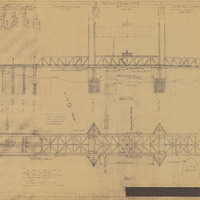
Caption: "Bridge Across Sacramento River at Sacramento … General Plan," c. 1934. Engineering drawing of Tower Bridge concrete towers. Working drawing. Project for Department of Public Works - Highways - Bridge Department.
Date: 1934
-
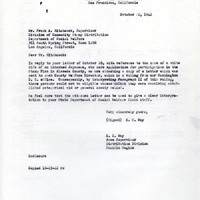
Correspondence from K. C. May to Frank A. Hitchcock regarding food stamps; Attachment: Correspondence on Food Stamps (F3729_66_006)
Date: October 22, 1942
-
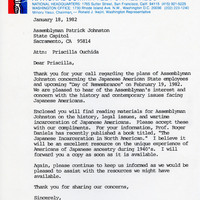
Correspondence from Carole Hayashino of the National Committee of Redress to Patrick Johnston, attention to Priscilla Ouchida regarding background material for AB2710
Date: January 18, 1982
-
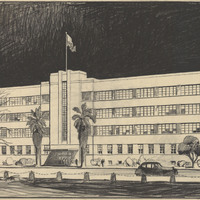
Drawing of Headquarters Office Building, Department of Motor Vehicles, Sacramento, by Alfred Eichler; drawing is in black pencil and pen and ink. Building is on N Street between 12th and 13th Streets. Design by H. S. Hazen and W. K. Bartges (interior). Built. Project for Department of Motor Vehicles.
Date: 1936
-
Caption: "Sign for California State Parks." Drawing by Alfred Eichler of sign for hacienda of Governor Pio Pico, California State Parks, after design Colonel Wing, Chief Division of Parks. Project for Department of Natural Resources - Beaches and Parks.
Date: 1929
-
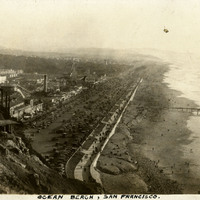
Caption: "Ocean Beach, San Francisco," c. 1925. Panorama of Ocean Beach, showing crowds not only at the beach but also at San Francisco's Playland, a series of seaside attractions and rides including a carousel, Fun House, and the Big Dipper rollercoaster. Entrepreneurs began erecting concessions and "thrill" rides at the location in the late nineteenth century. By 1913 the area was known as Chutes at the Beach. In 1923, brothers George and Leo Whitney began to purchase the attractions, eventually coming to own the entirety of what became known as Playland. The amusement park was torn down in 1972.
Date: 1925
-
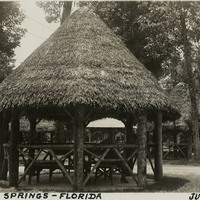
Caption: "Silver Springs -- Florida, June 24, 1934." Grace McCarthy seated in a gazebo with a conical roof sheathed in grass or brush. Silver Springs, a series of artesian springs in Marion County, was Florida's first tourist attraction. The area began to attract visitors after the Civil War, in the late 1860s. In the late 1870s, entrepreneurs started offering glass-bottom boat tours of the springs. The locale became popular in the 1930s with film producers: several of the original Tarzan movies were filmed here, as was the Creature from the Black Lagoon (1954).
Date: 6/24/1934