
Search All Items
- Filters:
- Language
- English 4971
- Spanish 26
- ENGLISH 2
- English 1
- census_013 1
- contra_costa_schedule_1_volume_1 1
- Type
- Image 3611
- Still Image 945
- Text 415
- Text 22
- Textual 2
- Image of the California Census from the records of the office of the California Secretary of State 1
Search Results 1921 to 1930 of 5054
-
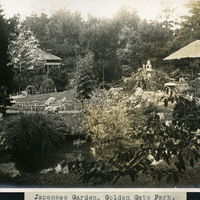
Caption: "Japanese Garden. Golden Gate Park," c. 1910. Originally created as a "Japanese Village" exhibit for the 1894 California Midwinter International Exposition, the still existing Japanese Tea Garden is now the oldest public Japanese garden in the United States.
Date: 1910
-
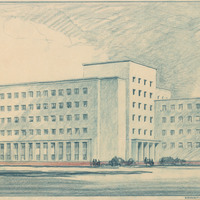
Caption: "Education Building - The Mall - Sacramento, Calif." Alfred Eichler, supervising architect of design; from working drawings by Harry Devine, Architect. Built in 1950. Project for Department of Finance - Buildings and Grounds - Office Buildings.
Date: 1949
-
Caption: "Camp Life -- Chino Calif." William and Grace McCarthy laughing as they remove their shoes in preparation for getting into a bed situated under a tree in a yard or garden.
Date: 1915
-
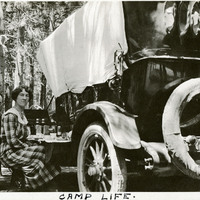
Caption: "Camp Life.," c. 1915-1920. William and Grace McCarthy seated next to automobile at an unidentified campground for a meal. See also 96-07-08-alb04-175, 179, 180, 181, and 182.
Date: 1920
-
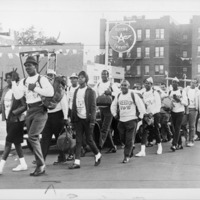
This item has no description.
Date: 1963
-
Caption: "State Teachers College - San Diego, California." Pencil sketch by Alfred Eichler, c. 1930. Includes hand-written annotation naming H. S. Hazen as designer. Project for Department of Education.
Date: 1930
-
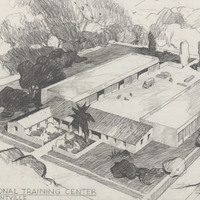
Caption: "Industrial Vocational Training Center, Veterans Home Yountville." Design and rendering by Alfred Eichler, c. 1948. Built in 1948; not built like this. Project for Department of Veterans Affairs.
Date: 1948
-
Caption: "State College San Francisco Market & Laguna Sts." Drawing of Training School and Auditorium, San Francisco State College. Design and drawing by Alfred Eichler. Not built like this. Became University of California extension. Project for Department of Education.
Date: 1928
-
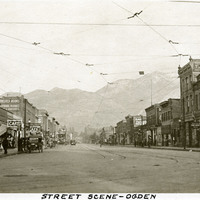
Caption: "Street Scene -- Ogden," c. 1916. Street scene in Ogden, Utah, with mountains in the background. Tracks and lines for electric trolleys or streetcars can be seen, as well as automobiles and several local businesses.
Date: 1916
-
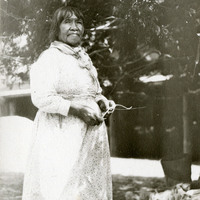
No caption, c. 1935. Lucy Parker Telles, a Mono Lake Paiute, lived in the Yosemite Valley. She was part of a group of Native American women who became well-known for their intricate basket weaving.
Date: 1935