
Search All Items
- Filters:
- Language
- English 5004
- Spanish 26
- ENGLISH 2
- English 1
- census_013 1
- contra_costa_schedule_1_volume_1 1
- Type
- Image 3651
- Still Image 938
- Text 415
- Text 22
- Textual 2
- Image of the California Census from the records of the office of the California Secretary of State 1
Search Results 1981 to 1990 of 5087
-
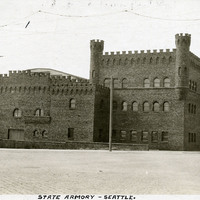
Caption: "State Armory -- Seattle.," c. 1910. View of castle-like armory building for the Washington National Guard, built in 1909 near Seattle's Pike Place Market. It was demolished in 1968.
Date: 1910
-
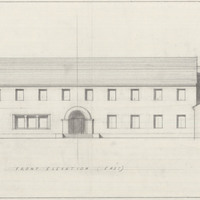
Caption: "Front Elevation (East). Female Acute Dist. Stockton." Design and drawing of Acute Disturbed Ward, Stockton State Hospital, by Alfred Eichler. Built. Project for Department of Mental Hygiene - Hospitals.
Date: 1937
-
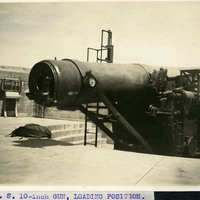
Caption: "U.S. 10-inch Gun, Loading Position." A close-up view of a large gun in a loading position at what appears to be a battery for coastal defense.
Date: Undated
-
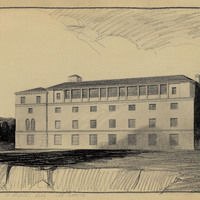
Caption: "Scheme No. 1. Addition to Hospital Bldg. San Quentin." Preliminary design of addition of 4th floor to hospital building, San Quentin State Prison, c. 1934. Project for Department of Corrections.
Date: 1934
-
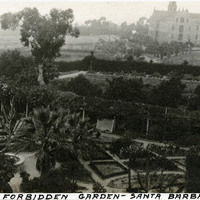
Caption: "Forbidden Garden -- Santa Barbara Mission," c. 1910. View of the gardens associated with Santa Barbara Mission. The gardens initially served as the location for instructing neophytes (Native American converts living at the mission) in trades and skills deemed necessary to life in European civilization. Later, the garden was used for meditation. The garden was often dubbed "forbidden" because it was closed to female visitors, as were many enclosures in active missions.
Date: 1910
-
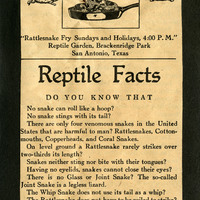
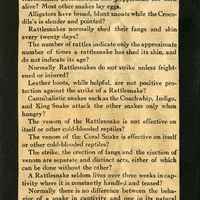
One side of a flier handed out by the San Antonio Reptile Garden in the mid-1930s entitled "Reptile Facts." The Reptile Garden opened in the 1930s as a fundraising facility for the Witte Museum. The Garden featured turtle races, snake handling demonstrations, fried rattlesnake meat, and rattlesnake dinner fund raisers. It also became a research center for the use of antivenom. The Garden closed in the early 1940s, its live snakes donated to the San Antonio Zoo.
Date: 1934
-
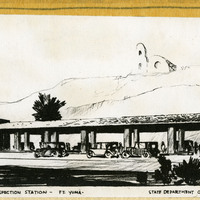
Caption: "Department of Agriculture - Plant Quarantine Inspection Station - Ft. Yuma. State Department of Public Works, Division of Architecture." Design and drawing by Alfred Eichler. Built in 1930. This was one of the first border stations and was situated in desert country; its purpose was to provide a stopping place for inspection of motor traffic coming into California in order to enforce quarantine against insect infestation of California agricultural products. Project for Department of Agriculture.
Date: 1930
-
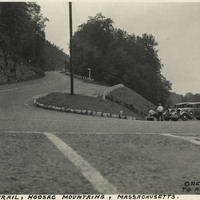
Caption: "Mohawk Trail, Hoosac Mountains, Massachusetts. Greenfield Mass to Albany New York, Sept 7, 1934." Hairpin turn on the Mohawk Trail, a scenic highway in Massachusetts. The Trail, originally a trade route for Native American tribes, was adopted as the route for the first scenic road constructed in the state. A gravel road was built along the route between 1912 and 1914, and later expanded as automobile traffic increased nation-wide. It is now part of Massachusetts Route 2.
Date: 9/7/1934
-
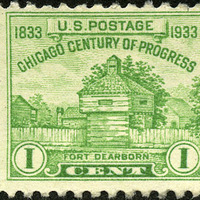
No caption. Commemorative U.S. postage stamp issued in 1933 for Chicago's Century of Progress Exposition, celebrating the one-hundred year anniversary of Chicago's incorporation. This stamp features Fort Dearborn, a fort built in 1803 in what is now Chicago proper. While the original fort was destroyed during the War of 1812, and the second fort which replaced it was destroyed by fires in 1857 and 1871, a replica was constructed for the Exposition.
Date: 1933
-
One side of a flier handed out by the San Antonio Reptile Garden in the mid-1930s entitled "Reptile Facts." The Reptile Garden opened in the 1930s as a fundraising facility for the Witte Museum. The Garden featured turtle races, snake handling demonstrations, fried rattlesnake meat, and rattlesnake dinner fund raisers. It also became a research center for the use of antivenom. The Garden closed in the early 1940s, its live snakes donated to the San Antonio Zoo.
Date: 1934