
Search All Items
- Filters:
- Language
- English 5312
- Spanish 43
- ENGLISH 2
- English 1
- census_013 1
- Type
- Image 3851
- Still Image 1035
- Text 445
- Text 22
- Textual 2
Search Results 1981 to 1990 of 5424
-
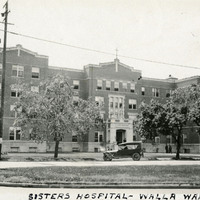
Caption: "Sisters Hospital -- Walla Walla.," ca. 1920. Five-story brick and stone building. This building is the second hospital built on the site. The first, built in the 1880s by the Sisters of Providence, burned in a 1915 fire. This second building (seen here), constructed in 1916, served as the main hospital building until a new facility was constructed in 1976. The resulting new complex of buildings is now called the Providence St. Mary Medical Center.
Date: 1920
-
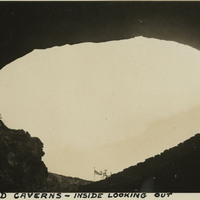
Caption: "Carlsbad Caverns -- Inside Looking Out, May, 30, 34." View looking out of the mouth of Carlsbad Cavern, a series of natural underground chambers including the "Big Room," the fifth-largest such chamber in North America with a length of 1,000 feet, a width of 625 feet, and a maximum height of 255 feet. The site was named Carlsbad Cave National Monument in 1923, and declared Carlsbad Caverns National Park in 1930.
Date: 5/30/1934
-
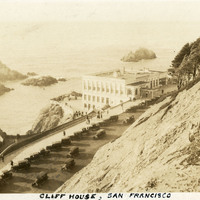
Caption: "Cliff House, San Francisco," c. 1920. The building shown here is the fourth iteration of the Cliff House, a neo-classical design built after a fire destroyed the Victorian structure previously at the site in 1907. Reconstruction of the iconic restaurant began in 1908, and a new Cliff House opened in 1909 (the building in this photograph). The building was extensively remodeled in the 1930s.
Date: 1920
-
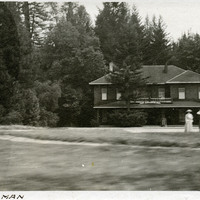
Caption: "Camp Herman," c. 1912-1915. View of the Zayante Inn at Mount Herman. Originally the site of Hotel Tuxedo, in 1906 a group later known as the Mount Herman Association, Inc. purchased the building and surrounding property, and renamed it the Zayante Inn. The inn became a Christian retreat center. Although this building was destroyed by fire in 1921, the retreat center was rebuilt as the Mount Herman Christian Conference Center, still operating today.
Date: 1915
-
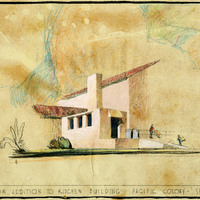
Caption: "Garbage Room Addition to Kitchen Building, Pacific Colony - Spadra." Design and drawing of Pacific State Hospital by Alfred Eichler. Built. Project for Department of Mental Hygiene - Hospitals. The hospital was initially named Pacific Colony (1927-1953), followed by Pacific State Hospital (1953-1979); Frank D. Lanterman State Hospital and Developmental Center; and finally Lanterman Developmental Center, which closed in 2015.
Date: 1933
-
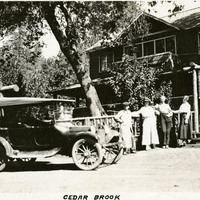
Caption: "Cedar Brook," c. 1920. William and Grace McCarthy (at left) standing with two unidentified people, with house in background and automobile next to them.
Date: 1920
-
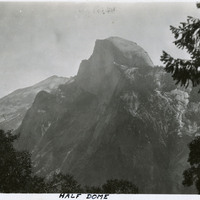
Caption: "Half Dome," c. 1917. The iconic granite Half Dome rises above the Yosemite Valley. This photograph appears to have been taken from across the Valley.
Date: 1917
-
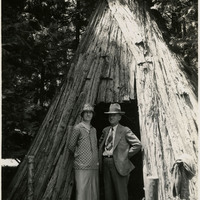
Caption: "Indian Wigwam, Yosemite National Park," c. 1935, shows Grace and William McCarthy standing at the entrance to an Indian abode covered in tree bark.
Date: 1935
-
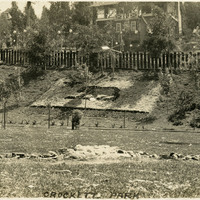
Caption: "Crockett Park," c. 1905-1906. Scene in a park in Crockett, California, showing a landscaped hill with flowers or rocks arranged to depict the California State Flag.
Date: 1906