
Search All Items
- Filters:
- Language
- English 5004
- Spanish 26
- ENGLISH 2
- English 1
- census_013 1
- contra_costa_schedule_1_volume_1 1
- Type
- Image 3651
- Still Image 938
- Text 415
- Text 22
- Textual 2
- Image of the California Census from the records of the office of the California Secretary of State 1
Search Results 1991 to 2000 of 5087
-
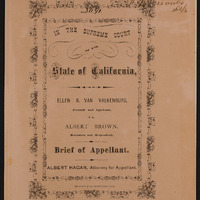
A Brief of Appellant is filed in the appellate court by the party who lost in the previous trial and argues in favor of appealing a lower court’s decision. Ellen Van Valkenburg began an important legal battle for women’s enfranchisement in California on July 21, 1871, when she requested that Santa Cruz County Clerk Albert Brown enter her name in the Great Register of voters. After Brown (a willing accomplice in helping her bring the case to court) refused to register her, Van Valkenburg and her lawyer, Santa Cruz Judge Albert Hagan, began legal proceedings by requesting a writ of mandamus, a judicial remedy used to compel agencies to perform ministerial acts, such as registering voters. Van Valkenburg and Hagan argued her case by citing the 14th Amendment of the U.S. Constitution. The new amendment, ratified 3 years earlier in 1868, defined all persons born or naturalized in the U.S. as citizens protected by civil rights. Van Valkenburg and Hagan asserted that American women were considered citizens under this amendment, and that citizenship automatically granted absolute rights, including the right to vote. The case first went to California’s Third District Court. Many of America’s most prominent suffragists, including Elizabeth Cady Stanton and Susan B. Anthony, were with Van Valkenburg in Santa Cruz when the lower court ruled against her on August 16, 1871. Van Valkenburg and Hagan swiftly appealed this decision through the Supreme Court of California. In the end, the Supreme Court of California upheld the lower court’s verdict under the reasoning that as a white American woman, Van Valkenburg already had citizenship and civil rights prior to the passage of the 14th amendment, and that the 14th amendment did not provide her with any additional political rights, such as the right to vote. While Van Valkenburg lost her case, and subsequent lawsuits failed to secure women's suffrage nationwide, the case stands as a critical early example of legal advocacy for women's political rights in California.
Date: September 29, 1871
-
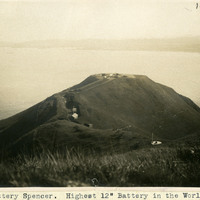
Caption: "Battery Spencer. Highest 12" Battery in the World." With construction begun in 1893, Battery Spencer, located at Fort Baker in Marin County on the north side of the Golden Gate Bridge, was one of the main protection points for the San Francisco harbor from 1897 until it was deactivated in 1942. It was named for Major General Joseph Spencer of the Continental Army during the Revolutionary War.
Date: 1908
-
No caption. Obverse of a souvenir ticket for the "Official Pedestrian Day" on May 27, 1937, held as part of the Golden Gate Bridge Fiesta celebrating the opening of the now-iconic bridge. The celebrations occupied an entire week, kicked off by Pedestrian Day, when more 200,000 people were allowed to walk across the Golden Gate Bridge on foot or on roller skates, the day before the bridge opened for vehicular traffic.
Date: 5/27/1937
-
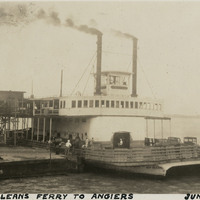
Caption: "New Orleans Ferry to Angiers [sic] June 15, 34." Ferry New Orleans getting ready for a trip to Algiers, on the west bank of the Mississippi River (now one of the oldest neighborhoods in New Orleans). Ferries were critical to the movement of people and freight between the east and west banks of the Mississippi River for more than a century. There are still several that serve the New Orleans area.
Date: 6/15/1934
-
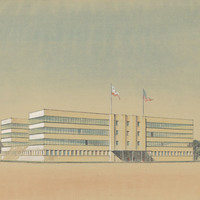
Preliminary design and drawing of state office building on N Street, Sacramento, by Alfred Eichler. Built to later design. Project for Department of Finance - Buildings and Grounds - Office Buildings.
Date: 1937
-
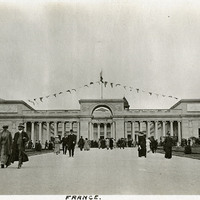
Caption: "France" French Pavilion at the Panama-Pacific International Exposition. The French Pavilion, an homage to the Palais de Legion d'Honneur in Paris, provided the inspiration for the Legion of Honor Museum in San Francisco.
Date: 1915
-
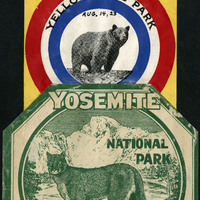
Caption: "Tours to the East." Two National Park decals for Yellowstone Park (with handwritten date of Aug. 14, 23, featuring a bear) and Yosemite National Park in 1920 (with handwritten date of July 4, featuring a mountain lion).
Date: 1920
-
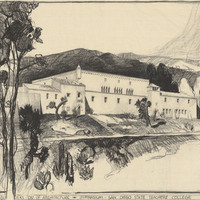
Caption: "State Dept. of Public Works Div. of Architecture - Gymnasium - San Diego State Teachers College." Drawing of Women's Gymnasium by Alfred Eichler. Design by H. S. Hazen, 1932. Built. Project for Department of Education.
Date: 1932
-
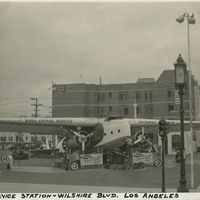
Caption: "Bobs Service Station - Wilshire Blvd. Los Angeles," c. 1935, shows Bob Spencer's Mobil gas service station, which was built around a grounded Fokker F32, whose wings served as a canopy for the fueling stations.
Date: 1935
-
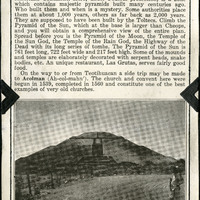
No Caption: A section from an informational tourist brochure describing Teotihuacan, an area northeast of Mexico City and famous for some of the most important archaeological discoveries on the North American Continent.
Date: 1938