
Search All Items
- Filters:
- Language
- English 2011
- Spanish 54
- ENGLISH 2
- English 1
- census_013 1
- Type
- Image 1725
- Still Image 163
- Text 153
- Text 22
- Textual 2
Search Results 2001 to 2010 of 2088
-
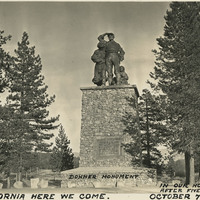
Caption: "California Here We Come. Donner Monument. In Our Home State Again After Five Months Tour. October 7, 1934." William and Grace McCarthy took this photograph of the Pioneer Monument when they arrived back in California after a five month road trip to the East Coast. The Pioneer Monument, featuring a pair of pioneers with their two children looking west, was first dedicated on June 6, 1918 to commemorate those who emigrated to California in the mid 1800s. Today, the monument and surrounding area is known as Donner Memorial State Park. The park was established in memory of the ill-fated Donner Party, a group of emigrants whose wagon train was caught in the Sierra Nevada Mountains during the winter of 1846-47. The Pioneer Monument's stone pedestal stands twenty-two feet high, the height of the snow that the party had to contend with. Of the eighty-seven people in the wagon train, only forty-eight survived to be rescued the following spring. Some of the survivors are said to have resorted to cannibalism in order to survive.
Date: 10/7/1934
-
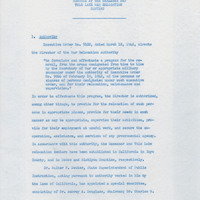
Memorandum regarding planning for the education of incarcerated students
Date: Undated
-
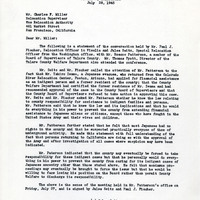
Correspondence from Jules Seitz to Charles F. Miller regarding opposition to resettlement of Japanese in Solano County, including statement of Board of Supervisors of Tulare County regarding aid to Japanese
Date: July 28, 1945
-
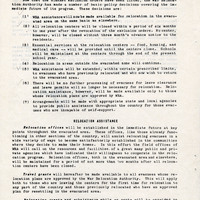
Summarization of policies; Sections: Relocation Assistance, Property Assistance, Welfare Assistance to Relocatees, Center Operations, Miscellaneous Information; Attached to: "Message for the Director of the War Relocation Authority," (F3729_119_002a-F3729_119_002e)
Date: Undated
-
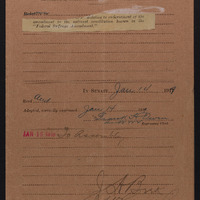
In addition to granting women the right to vote, the 1911 women’s suffrage amendment also paved the way for women to hold political office in California. In 1918, Esto B. Broughton, Elizabeth Hughes, Anna L. Saylor, and Grace S. Dorris became the first four women elected to the California State Assembly. Though fifteen states had already granted women full voting rights, a federal amendment was required to secure nationwide suffrage. To push for this national change, two almost identical resolutions were introduced on January 9, 1919 to urge the U.S. Congress to move forward with “the amendment to the National Constitution known as ‘The Federal Suffrage Amendment.’". On just her third day in office, newly elected Assemblywoman Grace S. Dorris introduced Assembly Joint Resolution No. 1. Simultaneously, Senate Joint Resolution No. 3 was introduced by Senator Burnett, a male colleague in the State Senate. While Dorris's historic Assembly bill ultimately died in committee, its twin Senate resolution successfully advanced, passing both chambers on January 17, 1919.
Date: January 1919