
Search All Items
- Filters:
- Language
- English 5312
- Spanish 43
- ENGLISH 2
- English 1
- census_013 1
- Type
- Image 3851
- Still Image 1035
- Text 445
- Text 22
- Textual 2
Search Results 2041 to 2050 of 5424
-
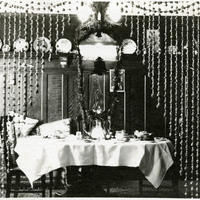
No caption, c. 1910. Image of parlor or dining room decorated for a celebration. Strings of beads or bells hang around the entry to the room.
Date: 1910
-
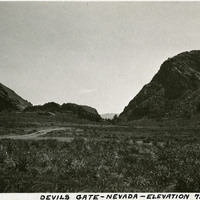
Caption: "Devils Gate -- Nevada -- Elevation 7540 Feet." Devil's Gate is a rock formation near Silver City, Nevada. In the nineteenth century a portion of the formation was blasted away to create enough space for a wagon road, which became a toll road serving as an entryway to the Nevada silver fields.
Date: 1927
-
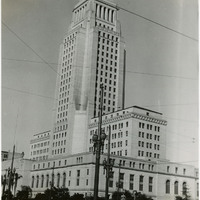
Caption: "City Hall, Los Angeles, Population of Los Angeles 1, 360,000," The iconic Los Angeles City Hall building, completed in 1928, still houses the offices of the mayor and city council. Defined as "Modern American" by one of the architects who worked on the original building, the landmark was restored to its original grandeur and seismically stabilized in 2001. See also 96-07-08-alb11-005, dated May 18, 1934.
Date: 1934
-
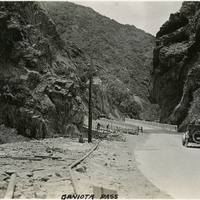
Caption: "Gaviota Pass," c. 1915-1916. Shows concrete bridge over Gaviota Creek at Gaviota Pass, a pass in the Santa Ynez mountains just north of Santa Barbara. The pass allows U.S. Route 101 to pass through the coastal mountains to the interior.
Date: 1915
-
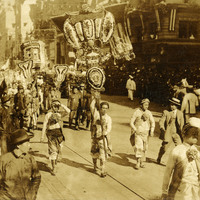
No Caption: A scene from the 1909 Portola Festival, a grand celebration devised to commemorate the discovery of San Francisco Bay by Gaspar De Portola, and for the public to celebrate the future of the rebuilt city after the 1906 earthquake and fires.
Date: 1909
-
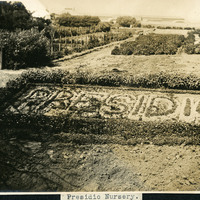
Caption: "Presidio Nursery." Image of flower and plant beds at San Francisco's Presidio. One of the beds uses plants and flowers to spell out the word "Presidio."
Date: Undated
-
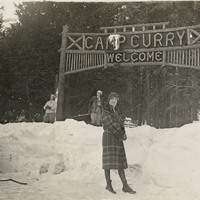
No Caption: Grace McCarthy standing in the snow at the entrance to Camp Curry campground in Yosemite National Park, c. 1932.
Date: 1932
-
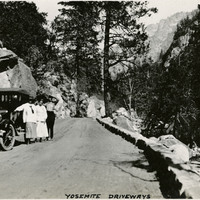
Caption: "Yosemite Driveways," c. 1917. Grace McCarthy and two unidentified people pose next to a vehicle on a dirt road in Yosemite National Park.
Date: 1917
-
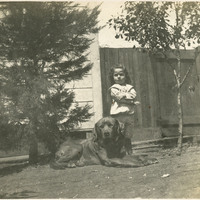
No caption. An unidentified young child is seen standing next to a large dog, in a yard at an unidentified location, c. 1906.
Date: 1906
-
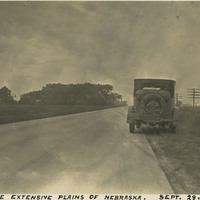
Caption: "On the Extensive Plains of Nebraska. Sept. 28, 1934." Automobile parked on the side of a highway stretching in to the distance, flanked by fields.
Date: 9/27/1934