
Search All Items
- Filters:
- Language
- English 6853
- Spanish 18
- ENGLISH 3
- English 2
- census_013 1
- contra_costa_schedule_1_volume_1 1
- Type
- Image 3886
- Still Image 2484
- Text 441
- Text 54
- Textual 2
- Image of the California Census from the records of the office of the California Secretary of State 1
Search Results 2071 to 2080 of 6969
-
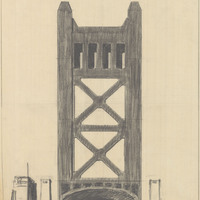
Design drawing of M Street Bridge tower by Alfred Eichler, April 18, 1934. The Tower Bridge replaced the M Street Bridge, which was removed in 1935. Project for Department of Public Works - Highways - Bridge Department.
Date: 1934
-
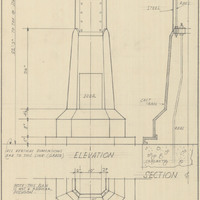
Design drawing of M Street Bridge by Alfred Eichler depicting lower part of lamp standard, April 3, 1934. The Tower Bridge replaced the M Street Bridge, which was removed in 1935. Project for Department of Public Works - Highways - Bridge Department.
Date: 1934
-
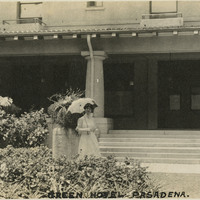
Caption: "Green Hotel Pasadena," c. 1915, shows Grace McCarthy standing before the Hotel Green in Pasadena, built by George Gill Green in 1893, and expanded by him in 1898 and 1903 with two additional structures. The hotel complex was sold to private investors and by 1924, the 1898 Central Annex structure (Frederick L. Roehrig, architect) was turned into apartments and renamed the Castle Green. It is listed on the National Register of Historic Places, the California Register of Historic Places, and the City of Pasadena's list of historic places. See also 96-07-08-alb07-212.
Date: 1915
-
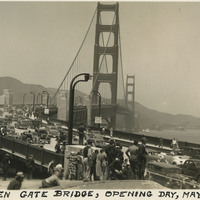
Caption: "Golden Gate Bridge, Opening Day, May 28, 1937." Dozens of automobiles are visible crossing the Golden Gate Bridge in this photograph, taken on the bridge's Opening Day, the first day that vehicular traffic was allowed over the bridge. Completed in 1937, the Golden Gate Bridge spans the mouth of San Francisco Bay (called the Golden Gate), connecting San Francisco with Marin County to the north. It is one of the most recognizable bridges in the world, and was named in 1994 as one of the Modern Wonders of the World by the American Society of Civil Engineers.
Date: 5/28/1937
-
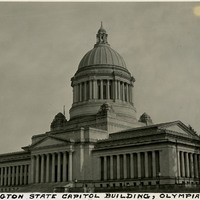
Caption: "Washington State Capitol Building, Olympia, Wash." c. 1935. The Neo-classical style building (Walter R. Wilder and Harry K. White, architects) opened in 1928, and was listed on the National Register of Historic Places in 1979.
Date: 1935