
Search All Items
Search Results 191 to 200 of 5365
-
The Progressive Movement transformed California politics in the early twentieth century by promoting government reform, greater public participation, and limits on the influence of powerful corporations and political machines. Women’s suffrage became part of this broader reform agenda. Governor Hiram Johnson (1866–1945) served as California’s 23rd governor from 1911 to 1917 and was a leading figure in the Progressive Movement. Johnson became tied to the suffrage cause through the 1910 California Republican platform, which endorsed women’s right to vote as part of a larger slate of progressive reforms. Motivated by Johnson’s promise to support their political rights, women in California quickly mobilized for him in his bid for governor, organizing grassroots efforts in support of his campaign in multiple counties. As the new governor, he insisted that the Legislature honor his pledge by submitting a women’s suffrage amendment before the Senate on January 6, 1911, only 3 days after he took office.
Date: 1912
-
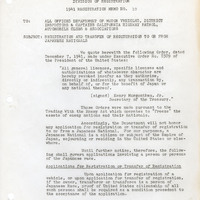
Bulletin from Howard E. Deems regarding registration for any person of Japanese descent
Date: December 10, 1941
-
Ahead of the second California Constitutional Convention held in Sacramento from September 28, 1878 to March 3, 1879, petitions were circulated around California in support of amending Article II of the 1849 constitution. The petitions included over 2,500 signatures and asserted that “no citizen of the State shall be disenfranchised on the account of sex.” The petition shown here from October 10, 1878 contains hundreds of signatures and measures over seven feet long. However, the many signatures indicating support for the amendment were not enough to sway the all-male delegation at the 1878-1879 Constitutional Convention. Several delegates expressed fears about the impact of enfranchising women as well as concerns that the inclusion of women’s suffrage in the new 1879 constitution would threaten its ratification. After several days of debate, the amendment did not move forward.
Date: October 10, 1878
-
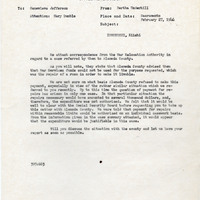
Office Memorandum from Bertha S. Underhill to Genevieve Jefferson regarding payment for repairs to home
Date: February 27, 1946
-
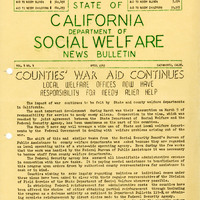
Bulletin to counties from the Department of Social Welfare regarding counties' responsibility to aid relocated Japanese
Date: April 1942
-
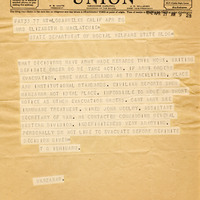
Telegram from T. G. Ishimaru to Elizabeth B. MacLatchie regarding evacuation of children's institutions to Manzanar
Date: April 20, 1942
-
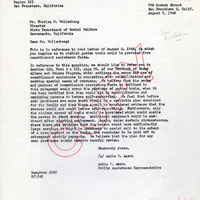
Correspondence from Azile H. Aaron to Charles M. Wollenberg regarding using resettlement assistance funds to purchase garden tools
Date: August 8, 1945