
Search All Items
- Filters:
- Language
- English 5312
- Spanish 43
- ENGLISH 2
- English 1
- census_013 1
- Type
- Image 3851
- Still Image 1035
- Text 445
- Text 22
- Textual 2
Search Results 2101 to 2110 of 5424
-
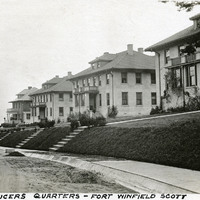
Caption: "Officers Quarters -- Fort Winfield Scott," c. 1912. Shows a row of multi-story homes along a landscaped street. Fort Winfield Scott was a coastal artillery post at the San Francisco Presidio. Originally named Fort Point, it was part of an effort by the U.S. government to protect the Golden Gate, entrance to the San Francisco Bay. Built between 1853-1861, the fort included emplacements for 141 guns but never fired a weapon in defense of the Bay. Its name was officially changed in 1882 to Fort Winfield Scott. This only lasted four years, until 1886 when the fort was officially downgraded to a sub-post of the San Francisco Presidio and the name discontinued. It was resurrected in 1912, with the establishment of a coastal artillery fortification at the Presidio, called, once again, Fort Winfield Scott.
Date: 1912
-
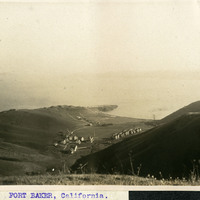
Caption: "Fort Baker, California," c. 1910. Fort Baker was constructed between 1901 and 1910 to provide permanent housing for the new seacoast fortifications that were built between 1897 and 1905. The men stationed at Fort Baker were members of the Coast Artillery Corps, officially created in 1907 by the U.S. Army to protect and defend the nation's harbors.
Date: 1910
-
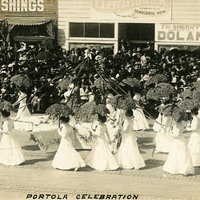
Caption: "Portola Celebration." 1909. The Portola Festival was a grand celebration devised to commemorate the discovery of San Francisco Bay by Gaspar De Portola, and for the public to celebrate the future of the rebuilt city after the 1906 earthquake and fires.
Date: 1909
-
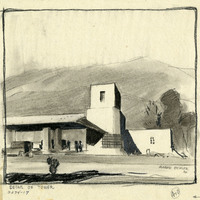
Caption: "Detail of Tower." Design and drawing by Alfred Eichler. Built in 1930. This was one of the first border stations and was situated in desert country; its purpose was to provide a stopping place for inspection of motor traffic coming into California in order to enforce quarantine against insect infestation of California agricultural products. Project for Department of Agriculture.
Date: 1930
-
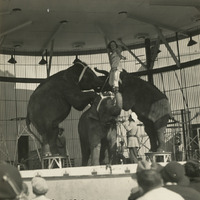
Caption: "Chicago Fair, Sept. 23, 1934." Three elephants performing in a circus ring at Chicago's Century of Progress Exposition. The Exposition, a world fair attended by thirty-nine million people, celebrated Chicago's one-hundred year anniversary of incorporation. Originally planned to only run from May to November in 1933, it was such a success that its organizers decided to keep it running for a second season from May through October the following year. The central theme of the Exposition was technological innovation, with a motto of "Science Finds, Industry Applies, Man Conforms."
Date: 9/23/1934
-
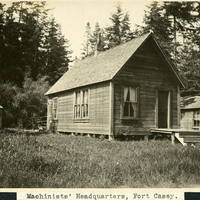
Caption: "Machinists' Headquarters, Fort Casey.," c. 1908-1912. View of building with gabled roof and sides sheathed in wood planks, with a small shed to the left and another small building to the right. Fort Casey was part of the "triangle of fire," three coastal defense fortifications (Fort Casey, Fort Worden, and Fort Flagler) guarding the entrance to Puget Sound. Construction began on the fort in 1897, and the U.S. Army used the facility until the 1950s, when the fort was decommissioned. The area is now a state park.
Date: 1908
-
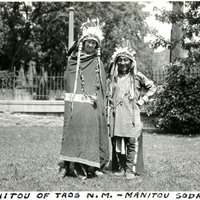
Caption: "Chief Manitou of Taos N. M. - Manitou Soda Springs," c. 1923. Grace McCarthy, wearing a Native American headdress and beaded blanket, stands next to a smiling Pedro Cajete in traditional dress. Mr. Cajete, better known to many as Chief Manitou, was a Native American of the Tewa tribe near Santa Fe, New Mexico, who was hired to promote tourism in the Manitou Springs/Colorado Springs area of Colorado. He often sold trinkets and posed for photographs with tourists near the mouth of Manitou Cave, resulting in his moniker Chief Manitou.
Date: 1923
-
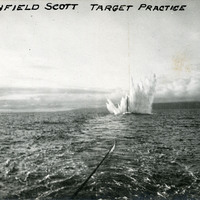
Caption: "Fort Winfield Scott Target Practice." This postcard shows a plume of seawater thrown up by a mortar shell during target practice at Fort Point. Fort Point was part of an effort by the U.S. government to protect the Golden Gate, entrance to the San Francisco Bay. Built between 1853-1861, the fort included emplacements for 141 guns but never fired a weapon in defense of the Bay. Its name was officially changed in 1882 to Fort Winfield Scott. This only lasted four years, however, for in 1886 the fort was officially downgraded to a sub-post of the San Francisco Presidio and the name discontinued. It was resurrected in 1912, with the establishment of a coastal artillery fortification at the Presidio, called, once again, Fort Winfield Scott. See also 96-07-08-alb08-029.
Date: 1909-10-25
-
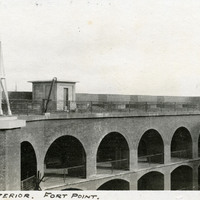
Caption: "Portion of Interior. Fort Point.," c. 1906. View of arched colonnades on ground and middle floors of Fort Point, and an upper tier with barbettes for the future installation of heavy artillery coastal defense weapons. The facilities at Fort Point were part of an effort by the U.S. government to protect the Golden Gate, entrance to the San Francisco Bay. Built between 1853-1861, the fort included emplacements for 141 guns but never fired a weapon in defense of the Bay. Its name was officially changed in 1882 to Fort Winfield Scott, but in 1886 the fort was officially downgraded to a sub-post of the San Francisco Presidio and the name discontinued. It was resurrected in 1912, with the establishment of a coastal artillery fortification at the Presidio, called, once again, Fort Winfield Scott.
Date: 1906