
Search All Items
- Filters:
- Language
- English 5312
- Spanish 43
- ENGLISH 2
- English 1
- census_013 1
- Type
- Image 3851
- Still Image 1035
- Text 445
- Text 22
- Textual 2
Search Results 2111 to 2120 of 5424
-
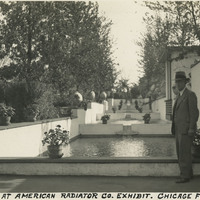
Caption: "Garden at American Radiator Co. Exhibit. Chicago [sic] Fair. Sept. 18, 1934." William McCarthy stands in front of a series of pools cascading into one another, surrounded by manicured plants at the Century of Progress Exposition. The Exposition, a world fair attended by thirty-nine million people, celebrated Chicago's one-hundred year anniversary of incorporation. Originally planned to only run from May to November in 1933, it was such a success that its organizers decided to keep it running for a second season from May through October the following year. The central theme of the Exposition was technological innovation, with a motto of "Science Finds, Industry Applies, Man Conforms."
Date: 9/18/1934
-
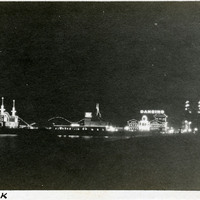
Caption: "Ocean Park," c. 1910. Night view of amusement zone at what became Venice, California. In 1905, Abbot Kinney built a series of canals as part of a development project along Santa Monica Beach, hoping to recreate the look and feel of Italy's iconic "Floating City" in southern California. Called Ocean Park at first, in 1911, the name officially changed to Venice. By 1929, however, many of the canals had been filled in to create roadways, and those that remained fell into disrepair. A revitalization movement in the early 1990s has restored some of the canals, and made the area a desirable residential neighborhood.
Date: 1910
-
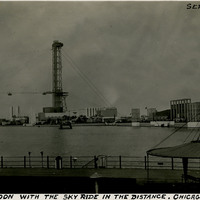
Caption: "The Lagoon with the Sky Ride in the distance. Chicago Fair. Sept. 18, 1934." Dominating this photograph is one of the 628-foot towers making up the Sky Ride, an aerial tramway which carried fair goers in small gondolas or trams (visible just to the left of the tower) over the harbor around which the Century of Progress Exposition was held. Over 4.5 million passengers enjoyed the views from the Sky Ride before it was demolished after the conclusion of the exposition in 1934. The Exposition, a world fair attended by thirty-nine million people, celebrated Chicago's one-hundred year anniversary of incorporation. Originally planned to only run from May to November in 1933, it was such a success that its organizers decided to keep it running for a second season from May through October the following year. The central theme of the Exposition was technological innovation, with a motto of "Science Finds, Industry Applies, Man Conforms."
Date: 9/18/1934
-
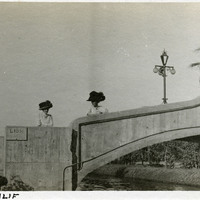
Caption: "Venice, Calif," c. 1911. Grace McCarthy and an unidentified woman standing on a bridge over Lion Canal in Venice, California. In 1905, Abbot Kinney built a series of canals as part of a development project along Santa Monica Beach, hoping to recreate the look and feel of Italy's iconic "Floating City" in southern California. Called Ocean Park at first, gondoliers sailed boats under elegant bridges such as the one shown in this photograph, in an effort to attract businesses, residents, and investors. In 1911, the name officially changed to Venice. By 1929, however, many of the canals had been filled in to create roadways, and those canals that remained fell into disrepair. A revitalization movement in the early 1990s has restored some of the canals, and made the area a desirable residential neighborhood.
Date: 1911
-
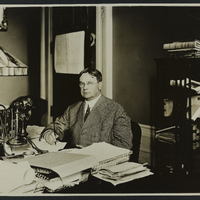
The Progressive Movement transformed California politics in the early twentieth century by promoting government reform, greater public participation, and limits on the influence of powerful corporations and political machines. Women’s suffrage became part of this broader reform agenda. Governor Hiram Johnson (1866–1945) served as California’s 23rd governor from 1911 to 1917 and was a leading figure in the Progressive Movement. Johnson became tied to the suffrage cause through the 1910 California Republican platform, which endorsed women’s right to vote as part of a larger slate of progressive reforms. Motivated by Johnson’s promise to support their political rights, women in California quickly mobilized for him in his bid for governor, organizing grassroots efforts in support of his campaign in multiple counties. As the new governor, he insisted that the Legislature honor his pledge by submitting a women’s suffrage amendment before the Senate on January 6, 1911, only 3 days after he took office.
Date: 1911/1917
-
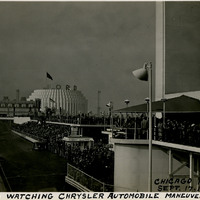
Caption: "Crowd Watching Chrysler Automobile Maneuvers. Chicago Fair. Sept. 17, 1934." Fairgoers pack the stands at a demonstration of the capabilities of Chrysler automobiles on a track created as part of the Chrysler complex built for the Exposition. The Exposition, a world fair attended by thirty-nine million people, celebrated Chicago's one-hundred year anniversary of incorporation. Originally planned to only run from May to November in 1933, it was such a success that its organizers decided to keep it running for a second season from May through October the following year. The central theme of the Exposition was technological innovation, with a motto of "Science Finds, Industry Applies, Man Conforms."
Date: 9/17/1934
-
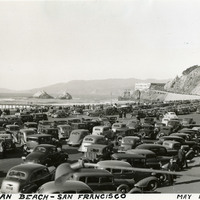
Caption: "Ocean Beach -- San Francisco, May 14, 1934." View of San Francisco's Ocean Beach, with a crowded parking lot in the foreground and the Cliff House (the fourth iteration of this San Francisco landmark) visible just to the right of the photograph's center. The date on this photograph may not be accurate, as several of the vehicles shown appear to date from later in the 1930s.
Date: 5/14/1934
-
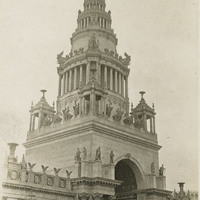
Caption: "Tower of Jewels," at the Panama-Pacific International Exposition. The Panama Pacific International Exposition was held to celebrate the completion of the Panama Canal, as well as inventive technologies and new industries from around the world. It was also a chance for San Francisco to show the world how the great city had rebuilt and thrived after the devastation of the 1906 earthquake and fire.
Date: 1915
-
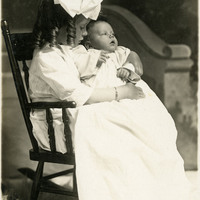
No caption, c. 1905. Unidentified young girl holding baby in long gown, seated in front of what appears to be a photography studio backdrop.
Date: 1905
-
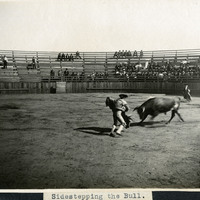
Caption: "Sidestepping the Bull." In this photograph, a bull attempts to gore a matador holding a cape, observed by dozens of people in the surrounding stands.
Date: 1905