
Search All Items
- Filters:
- Type
- Image 3639
- Still Image 937
- Text 401
- Text 19
- Image of the California Census from the records of the office of the California Secretary of State 1
- Language
- English 4975
- Spanish 26
- ENGLISH 2
- English 1
- census_013 1
- contra_costa_schedule_1_volume_1 1
Search Results 2141 to 2150 of 5047
-
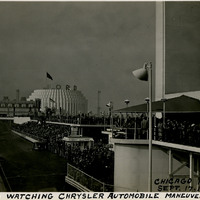
Caption: "Crowd Watching Chrysler Automobile Maneuvers. Chicago Fair. Sept. 17, 1934." Fairgoers pack the stands at a demonstration of the capabilities of Chrysler automobiles on a track created as part of the Chrysler complex built for the Exposition. The Exposition, a world fair attended by thirty-nine million people, celebrated Chicago's one-hundred year anniversary of incorporation. Originally planned to only run from May to November in 1933, it was such a success that its organizers decided to keep it running for a second season from May through October the following year. The central theme of the Exposition was technological innovation, with a motto of "Science Finds, Industry Applies, Man Conforms."
Date: 9/17/1934
-
Caption: "U.S. Battle Ship California. May 28, 1937." The USS California, a Tennessee-class dreadnaught battleship, was the fifth U.S. ship named after the Golden State. Launched in 1915, the California served as the Pacific Fleet's flagship for twenty years. The California was docked at Pearl Harbor when the Japanese attacked in 1941. Two bombs struck and eventually sunk her, killing ninety-eight of her crew and wounding sixty-one more. The California was subsequently refloated, with repairs done first at Pearl Harbor and then at Puget Sound Navy Yard. She then sailed to assist numerous campaigns in the Pacific Theater of the war, earning seven battle stars for this service. The California was decommissioned in 1947, and sold for scrapping in 1959.
Date: 5/28/1937
-
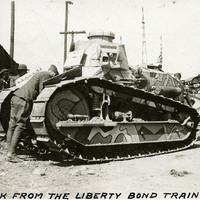
Caption: "A Tank from the Liberty Bond Train." Shows a Renault FT Tank, a small French tank with caterpillar-style propulsion used during World War I. This tank was displayed as part of the fifth Liberty Bond Drive, held in 1919. During World War I, the U.S. government raised funds for the war by issuing "liberty bonds." Liberty Bond Trains crisscrossed the country to encourage purchase of the bonds. Citizens who purchased the bonds could later redeem them for the purchase price plus interest.
Date: 1919
-
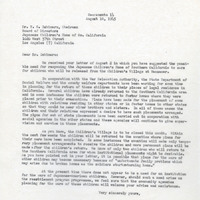
Correspondence from Charles M. Wollenberg to T. G. Ishimaru regarding possible reopening of the Japanese Children's Home of Southern California after the closure of the Children's Village at Manzanar
Date: August 10, 1945
-
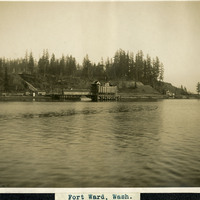
Caption: "Fort Ward, Wash.," c. 1908-1912. View from Puget Sound of a wharf and other buildings of Fort Ward. Originally known as Bean Point, Fort Ward was established by the U.S. Army Coastal Artillery Corps in 1890. Re-named Fort Ward in 1903, the facility included four coastal batteries designed to assist in protecting Puget Sound and the nearby Naval Shipyard from enemy attack. Fort Ward was placed on inactive status in the 1920s, but was revived by the U.S. Navy during World War II. The Navy discovered the fort's location was ideal for listening to radio communications from Japan, and it subsequently became a top secret listening post with a link directly to Washington, D.C. The Navy continued the fort's use as a listening post until 1956, when it was again taken over by the U.S. Army. The Army subsequently stopped all activity in 1958, ultimately selling portions of the fort to the Washington State Park System in 1960. It is now a state park.
Date: 1908
-
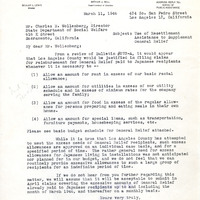
Correspondence from Beulah L. Lewis to Charles M. Wollenberg regarding resettlement assistance; Attachment: General Relief Basic Budget Table No. 33
Date: March 11, 1946