
Search All Items
- Filters:
- Language
- English 5312
- Spanish 43
- ENGLISH 2
- English 1
- census_013 1
- Type
- Image 3851
- Still Image 1035
- Text 445
- Text 22
- Textual 2
Search Results 2141 to 2150 of 5424
-
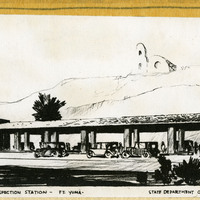
Caption: "Department of Agriculture - Plant Quarantine Inspection Station - Ft. Yuma. State Department of Public Works, Division of Architecture." Design and drawing by Alfred Eichler. Built in 1930. This was one of the first border stations and was situated in desert country; its purpose was to provide a stopping place for inspection of motor traffic coming into California in order to enforce quarantine against insect infestation of California agricultural products. Project for Department of Agriculture.
Date: 1930
-
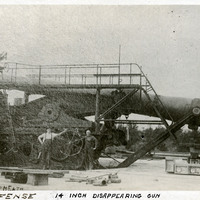
Caption: "Coast Defense: 14 Inch Disappearing Gun." Another copy of a C.D. Heath photograph, this image shows a heavy artillery gun, with two unidentified men standing next to it, at the Sandy Hook Proving Ground. Located at Sandy Hook, New Jersey, the Sandy Hook Proving Ground was used by the U.S. Army to test ordinance and materiel from 1874-1919. See also 96-07-08-alb05-101.
Date: 1910
-
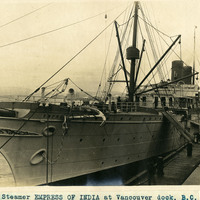
Caption: "Steamer EMPRESS OF INDIA at Vancouver dock, B.C.," c. 1908-1912. View of the Empress of India, built by England's Naval Construction & Armaments Co. in 1890 for the Canadian Pacific Steamships company. The Empress of India could accommodate up to 700 passengers, and was also used to carry mail between Hong Kong and Great Britain. She was sold in 1914 and refitted as a hospital ship for Indian soldiers. She was sold a final time in 1923, for scrap in Bombay.
Date: 1908
-
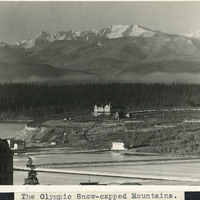
Caption: "The Olympic Snow-capped Mountains.," c. 1908-1912. Vista of the Olympic Mountains in the distance. In the middle distance to the right can be seen the Eisenbeis Castle (now known as the Manresa Castle Restaurant and Lounge), built in 1892 by Charles Eisenbeis, a businessman and Port Townsend's first mayor. The photograph is centered around what appears to be a resort hotel situated a short distance from the Eisenbeis Castle. See also 96-07-08-alb02-058.
Date: 1908
-
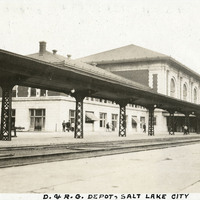
Caption: "D. & R. G. Depot, Salt Lake City," c. 1923. Constructed in 1910 by the Denver and Rio Grande Western Railroad (D&RGW), this depot operated under the auspices of that railroad company until the 1970s. It served as a passenger depot for Amtrak from 1986 to 1999. The building is currently home to the Division of Utah State History and the Utah Department of Heritage & Arts.
Date: 1923
-
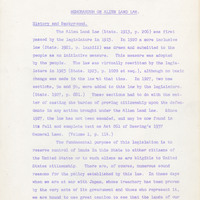
Summary of the history of the Alien Land Laws including deciding court cases; Sections: History and Background, Provisions of Existing Law; Persons Affected by this Law, Property Affected by the Law
Date: Undated
-
No Caption: This postcard shows a view of the Government Building and the Cascades (a terraced fountain leading up to the building), part of the Alaska-Yukon-Pacific Exposition. Held in Seattle to celebrate the development of the Pacific Northwest, the fair attracted 3.7 million visitors over the course of its run from June to October 1909. Although most of the fair's buildings have since been destroyed, several of them now serve as part of the University of Washington campus. See also 96-07-08-alb05-212.
Date: 1909
-
Caption: "Seminole Indian Women Washing Clothes -- Everglades -- Fla. June 30, 1934." Two unidentified women and a small child washing clothing. Several articles of clothing are spread out to dry on a canoe lifted off the ground by sawhorses made of logs. They are likely Seminoles, a Native American tribe in Florida, although most of the tribe had been forcibly relocated from Florida to Oklahoma by 1842. Fewer than 200 remained in Florida after the Third Seminole War ended in 1858, but a resurgence of the tribe occurred in the early to mid twentieth century. The Florida Seminole tribe received federal recognition in 1957.
Date: 6/30/1934
-
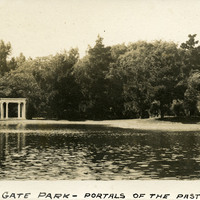
Caption: "Golden Gate Park -- Portals of the Past," c. 1910. A monument in Golden Gate Park in San Francisco, on the shores of Lloyd Lake, consisting of a white marble archway and columns. The archway was originally part of the Nob Hill mansion belonging to railroad tycoon Alban Towne. The mansion was destroyed in the 1906 San Francisco earthquake and fire, but the entryway still stood. It was moved to the shore of Lloyd Lake in 1909, as a memorial to the pre-1906 city.
Date: 1910
-
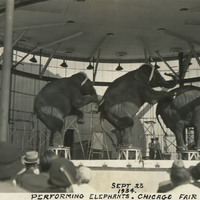
Caption: "Performing Elephants. Chicago Fair. Sept 23 1934." Three elephants performing in a circus ring at Chicago's Century of Progress Exposition. The Exposition, a world fair attended by thirty-nine million people, celebrated Chicago's one-hundred year anniversary of incorporation. Originally planned to only run from May to November in 1933, it was such a success that its organizers decided to keep it running for a second season from May through October the following year. The central theme of the Exposition was technological innovation, with a motto of "Science Finds, Industry Applies, Man Conforms."
Date: 9/23/1934