
Search All Items
- Filters:
- Language
- English 5312
- Spanish 43
- ENGLISH 2
- English 1
- census_013 1
- Type
- Image 3851
- Still Image 1035
- Text 445
- Text 22
- Textual 2
Search Results 2151 to 2160 of 5424
-
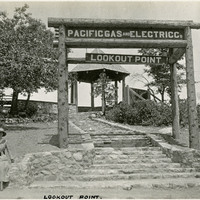
Caption: "Lookout Point." Shows Grace McCarthy seated near steps and archway leading to Pacific Gas and Electric Co.'s "Lookout Point" in the Sierra Nevada Mountains, along the Lincoln Highway (now Interstate 80).
Date: 1927
-
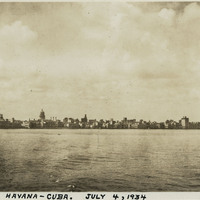
Caption: "City of Havana -- Cuba. July 4, 1934." View of Havana taken from across a harbor, or other stretch of ocean. The dome of El Capitolio (then Cuba's Capitol) can be seen just to the left of the photograph's center.
Date: 7/4/1934
-
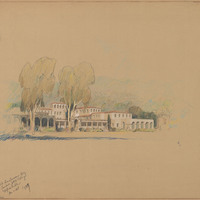
Caption: "Early sketch for Home Economics Bldg., Santa Barbara State College." Sketch by Alfred Eichler of Home Economics Building, Riviera Campus, Santa Barbara State College. Built to a later design. Project for Department of Education.
Date: 1927
-
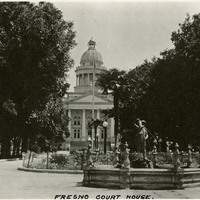
Caption: "Fresno Court House.," c. 1920. Shows the historic Fresno County Courthouse, built in 1875, as well as a small fountain. This courthouse was torn down in 1966 to make way for a more modern facility.
Date: 1920
-
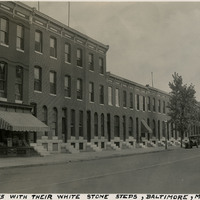
Caption: "Apartments with their White Stone Steps, Baltimore, Maryland. July 30, 1934." View of several apartment buildings, almost identical, sheathed in brick with stone steps leading to the front doors.
Date: 7/30/1934
-
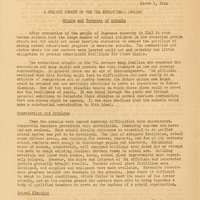
Summarative report on the WRA Educational Program including scope, employees, cost, and future goals
Date: March 1, 1944
-
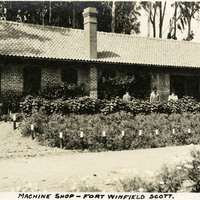
Caption: "Machine Shop -- Fort Winfield Scott," c. 1913. Low brick building with tile roof, with William McCarthy (far left) and two unidentified men standing in front. Fort Winfield Scott, formerly Fort Point, was part of an effort by the U.S. government to protect the Golden Gate, entrance to the San Francisco Bay. Built between 1853-1861, the fort included emplacements for 141 guns but never fired a weapon in defense of the Bay. Its name was officially changed in 1882 to Fort Winfield Scott. This only lasted four years, however, for in 1886 the fort was officially downgraded to a sub-post of the San Francisco Presidio and the name discontinued. It was resurrected in 1912, with the establishment of a coastal artillery fortification at the Presidio, called, once again, Fort Winfield Scott.
Date: 1913
-
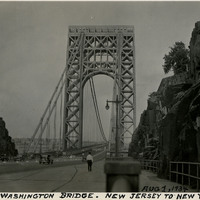
Caption: "George Washington Bridge. New Jersey to New York. Aug 1, 1934." This suspension bridge, designed by Othmar Ammann, spans the Hudson River between Manhattan in New York City, and Fort Lee, New Jersey. Constructed between 1927 and 1931, the bridge included the longest main span in the world at the time, a record it held until construction of the Golden Gate Bridge was completed in 1937. It was originally built with only one deck, but a second deck opened in 1962. Still in active use today, it carried over 51 million vehicles in 2016.
Date: 8/1/1934
-
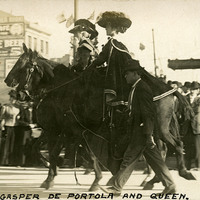
Caption: "Don Gasper [sic] de Portola and Queen," 1909. Participants at the Portola Festival on horseback and dressed in period costume as Don Gaspar De Portola and Queen. The Portola Festival was a grand celebration devised to commemorate the discovery of San Francisco Bay by Gaspar De Portola, and for the public to celebrate the future of the rebuilt city after the 1906 earthquake and fires.
Date: 1909
-
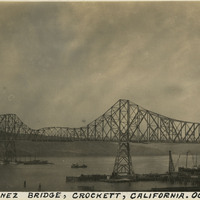
Caption: "Carquinez Bridge, Crockett, California. Oct. 9, 1934." This photograph shows the original Carquinez Bridge, built to span the Carquinez Strait and thereby contribute to a direct route between Sacramento and San Francisco. The steel cantilevered bridge, designed by Robinson & Steinman, was constructed in 1927. It is no longer extant, having been replaced by two parallel bridges constructed in 1958 and 2003. The structure of the original bridge was removed in 2007. See also 96-07-08-alb04-004.
Date: 10/9/1934