
Search All Items
- Filters:
- Language
- English 5312
- Spanish 43
- ENGLISH 2
- English 1
- census_013 1
- Type
- Image 3851
- Still Image 1035
- Text 445
- Text 22
- Textual 2
Search Results 2171 to 2180 of 5424
-
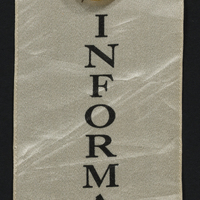
In the years following the passage of the 1911 state suffrage amendment, supporters continued to advocate for the federal enfranchisement of women across the country. Suffragists created and distributed ephemera to publicize their cause and gain support for the movement, including literature, pennants, posters, shopping bags, playing cards, postcards, and pin-back buttons, such as this ribbon with a “Votes for Women” pin from 1912.
Date: 1912?
-
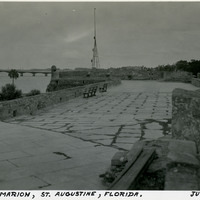
Caption: "Fort Marion, St. Augustine, Florida. July 10, 1934." Walkway atop what appears to be the ramparts of the Castillo de San Marcos (Castle of Saint Mark). The core structures of this coastal defense fort were completed by Spanish forces in 1695. Numerous additions, renovations, and repairs have occurred since that time. When Spain ceded Florida to the U.S. in 1821, the Castillo was designated a U.S. Army base and renamed Fort Marion, in honor of Frances Marion (also known as the Swamp Fox, Marion was an American Revolutionary War hero known for his guerilla war tactics). The fort was deactivated in 1933, and turned over to the National Park Service.
Date: 7/10/1934
-
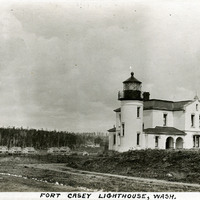
Caption: "Fort Casey Lighthouse, Wash.," c. 1909. View of the lighthouse with fort buildings in the background. Located on Whidbey Island in Puget Sound, the Admiralty Head Lighthouse was built overlooking Admiralty Inlet in 1903. It replaced an earlier structure that had to be moved in 1890 to accommodate the construction of Fort Casey. The second lighthouse, shown here, was built with thick walls in order to withstand earthquakes and the concussion of guns at Fort Casey. Deactivated in 1922, the lighthouse has since been restored by Washington State Parks, and is part of the Fort Casey State Park.
Date: 1909
-
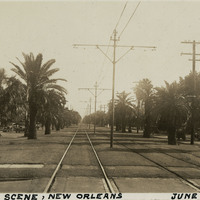
Caption: "Street Scene -- New Orleans, June 15, 34." Street scene with two lines of railroad tracks in the center of the photograph, running into the distance. Automobile traffic can be seen on the roads to either side of the tracks.
Date: 6/15/1934
-
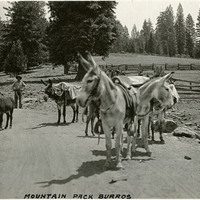
Caption: "Mountain Pack Burros," c. 1920. String of burros loaded with packs, with fields and trees in background. One young, unburdened burro stands off to the left of the main group.
Date: 1920
-
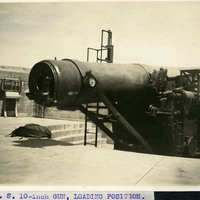
Caption: "U.S. 10-inch Gun, Loading Position." A close-up view of a large gun in a loading position at what appears to be a battery for coastal defense.
Date: Undated
-
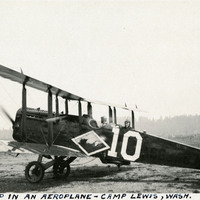
Caption: "My Trip in an Aeroplane -- Camp Lewis, Wash.," c. 1917-1920. William McCarthy in the rear seat of a biplane, either getting ready to take off or having just landed.
Date: 1917
-
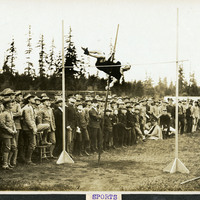
Caption: "SPORTS," c. 1917. Image of a pole vaulter attempting to clear a jump, with rows of men clad in military uniforms observing. The uniforms and the surrounding vegetation suggest that this may have taken place at Camp Lewis, Washington.
Date: 1917
-
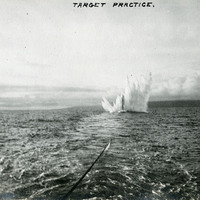
Caption: "Target Practice," c. 1908. This postcard shows a plume of seawater thrown up by a mortar shell during target practice at Fort Point. The facilities at Fort Point were part of an effort by the U.S. government to protect the Golden Gate, entrance to the San Francisco Bay. Built between 1853-1861, the fort included emplacements for 141 guns but never fired a weapon in defense of the Bay. Its name was officially changed in 1882 to Fort Winfield Scott, but in 1886 the fort was officially downgraded to a sub-post of the San Francisco Presidio and the name discontinued. It was resurrected in 1912, with the establishment of a coastal artillery fortification at the Presidio, called, once again, Fort Winfield Scott. See also 96-07-08-alb05-322.
Date: 1908
-
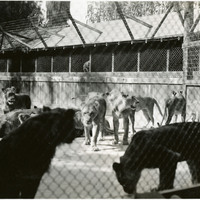
No Caption: Shows a group of adult African lions in a enclosed area of Gay's Lion Farm in El Monte, Los Angeles. Charles and Muriel Gay opened the farm in 1925 and operated it until 1942 as a popular tourist attraction where lions were selectively bred and trained for the Hollywood film industry. It was closed during WWII due to wartime meat shortages, and the lions were loaned to zoos around the country, c. 1935.
Date: 1935