
Search All Items
- Filters:
- Language
- English 5312
- Spanish 43
- ENGLISH 2
- English 1
- census_013 1
- Type
- Image 3851
- Still Image 1035
- Text 445
- Text 22
- Textual 2
Search Results 2221 to 2230 of 5424
-
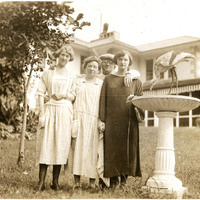
No caption. William and Grace McCarthy and two unidentified women pose next to a bird bath in front of the John Shields residence, in the Daybreak Estate area of Long Island.
Date: 1934
-
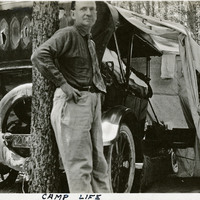
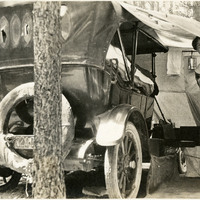
Caption: "Camp Life.," c. 1915-1920. William and Grace McCarthy standing next to automobile at an unidentified campground. See also 96-07-08-alb04-175, 180, 181, and 182.
Date: 1920
-
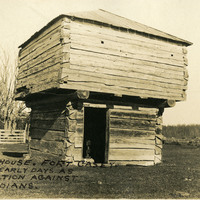
Caption: " Block House, Fort Casey. Used in Early Days as Protection Against the Indians." Washington, c. 1909. View of a blockhouse, a timber structure built by European settlers to guard against attack during the Indian Wars of 1855-1857.
Date: 1909
-
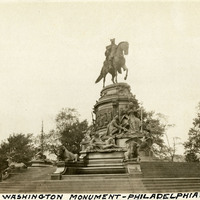
Caption: "Washington Monument -- Philadelphia." c. 1920. Philadelphia's Washington Monument Fountain (Rudolf Siemering, sculptor) features a bronze and granite statute of George Washington on horseback. Dedicated at Fairmount Park in 1897, it was moved to Philadelphia's Eakins Oval in 1928.
Date: 1920
-
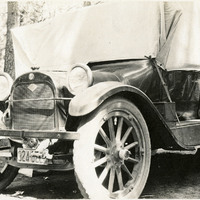
No caption, c. 1915-1920. William and Grace McCarthy standing in campground next to automobile fitted with mattress and curtains for privacy while sleeping. See also 96-07-08-alb04-175, 179, 180, and 181.
Date: 1920
-
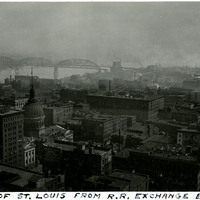
Caption: "View of St. Louis from R.R. Exchange Bldg," c. 1923. Merchant's Bridge and the Old Courthouse (domed building just to left of center) can be seen in this bird's eye view of St. Louis.
Date: 1923
-
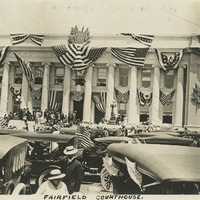
Caption: "Fairfield Courthouse," c. 1918, shows the Solano County Courthouse in Fairfield, built in 1911 and festooned with United States flags, possibly for an event to welcome home WWI troops from overseas.
Date: 1918
-
No caption, c. 1920. William McCarthy in camp ground standing beside automobile converted to "bedroom," with a tarp around the windows for privacy. See also 96-07-08-alb04-176, 179, 180, 181, and 182.
Date: 1920
-
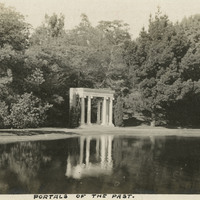
Caption: "Portals of the Past," c. 1915, on the shore of Lake Lloyd in Golden Gate Park, was originally the entranceway to the Nob Hill mansion of railroad tycoon, A.N. Towne. The entranceway was the only part of the home that was not destroyed by the 1906 earthquake and was moved to Golden Gate Park in 1909 as a reminder of much that was lost. See also 96-07-08-alb05-065.
Date: 1915
-
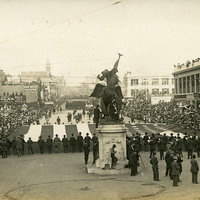
No Caption: A view of the large crowds surrounding an enormous United States flag and the Spanish-American War Memorial (Douglas Tildon, sculptor) at the Portola Festival of 1909. The Portola Festival was a grand celebration devised to commemorate the discovery of San Francisco Bay by Gaspar De Portola, and for the public to celebrate the future of the rebuilt city after the 1906 earthquake and fires.
Date: 1909