
Search All Items
- Filters:
- Language
- English 2268
- Spanish 15
- ENGLISH 2
- English 1
- census_013 1
- Type
- Image 1908
- Text 191
- Still Image 161
- Text 22
- Textual 2
Search Results 2231 to 2240 of 2304
-
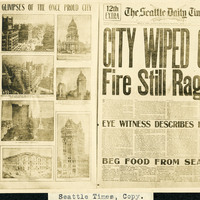
Caption: "Seattle Times, Copy." Photograph of the front page and an additional page from the Seattle Daily Times, April 20, 1906, in regard to the earthquake and fire that destroyed much of San Francisco on April 18, 1906. The primary headline reads "CITY WIPED OUT! Fire Still Raging!" See also 96-07-08-alb05-020 and 021.
Date: 4/20/1906
-
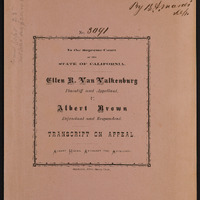
A Transcript of Appeal is the official written record of a trial, used by a higher court to review the lower court's proceedings. Ellen Van Valkenburg began an important legal battle for women’s enfranchisement in California on July 21, 1871, when she requested that Santa Cruz County Clerk Albert Brown enter her name in the Great Register of voters. After Brown (a willing accomplice in helping her bring the case to court) refused to register her, Van Valkenburg and her lawyer, Santa Cruz Judge Albert Hagan, began legal proceedings by requesting a writ of mandamus, a judicial remedy used to compel agencies to perform ministerial acts, such as registering voters. Van Valkenburg and Hagan argued her case by citing the 14th Amendment of the U.S. Constitution. The new amendment, ratified 3 years earlier in 1868, defined all persons born or naturalized in the U.S. as citizens protected by civil rights. Van Valkenburg and Hagan asserted that American women were considered citizens under this amendment, and that citizenship automatically granted absolute rights, including the right to vote. The case first went to California’s Third District Court. Many of America’s most prominent suffragists, including Elizabeth Cady Stanton and Susan B. Anthony, were with Van Valkenburg in Santa Cruz when the lower court ruled against her on August 16, 1871. Van Valkenburg and Hagan swiftly appealed this decision through the Supreme Court of California. In the end, the Supreme Court of California upheld the lower court’s verdict under the reasoning that as a white American woman, Van Valkenburg already had citizenship and civil rights prior to the passage of the 14th amendment, and that the 14th amendment did not provide her with any additional political rights, such as the right to vote. While Van Valkenburg lost her case, and subsequent lawsuits failed to secure women's suffrage nationwide, the case stands as a critical early example of legal advocacy for women's political rights in California.
Date: September 23, 1871
-
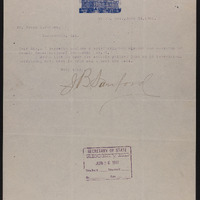
J. B. Sanford was a California State Senator representing the 4th Senate District and served as Chairman of the Democratic Caucus during the 1911 legislative session. He was one of the most prominent legislative opponents of women's suffrage in California. Sanford authored the official ballot argument against Senate Constitutional Amendment No. 8 (Proposition 4). In it, Sanford argues that women should not be granted the right to vote because suffrage is a privilege rather than an inherent right. He asserts that political involvement would distract women from their primary domestic duties, disrupt traditional gender roles, and ultimately harm the family structure. Furthermore, he claims that men already adequately protected women's interests in government and that granting women the vote would lead to increased social instability.
Date: June 24, 1911