Search All Items
- Filters:
- Language
- English 6020
- Spanish 194
- ENGLISH 2
- English 1
- census_013 1
- Type
- Image 3854
- Still Image 1909
- Text 426
- Text 22
- Textual 2
Search Results 2251 to 2260 of 6281
-
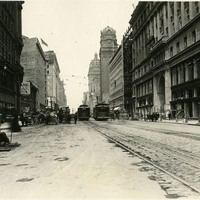
No Caption: A view of the reconstruction on Market Street after the 1906 earthquake and fires, c. 1907.
Date: 1907
-
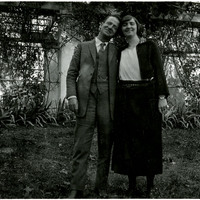
No caption. William McCarthy and an unidentified woman pose in front of a landscaped area with an arbor, c. 1925.
Date: 1925
-
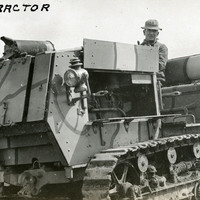
Caption: "5 Ton Tractor," c. 1906. William McCarthy is seen sitting on a military artillery tractor at an unidentified location.
Date: 1906
-
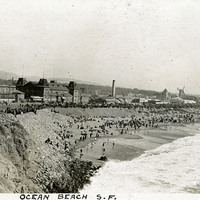
Caption: "Ocean Beach S.F.," c. 1910. View of a crowded Ocean Beach, near San Francisco's Cliff House.
Date: 1910
-
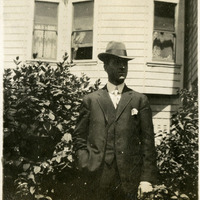
No Caption: An unidentified man standing in front of a house at an unidentified location, c. 1906.
Date: 1906
-
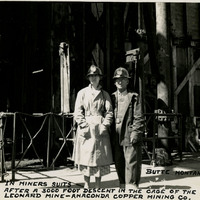
Caption: "Butte, Montana. In miner's suits after a 3,000 foot descent in the cage of Leonard Mine - Anaconda Copper Mining Co.," c. 1935, shows William and Grace McCarthy in miner's suits and helmets.
Date: 1935
-
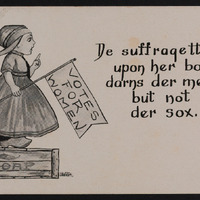
Those opposing women's suffrage created their own ephemera to spread their message, like this postcard from 1913 depicting a woman standing on a soap box declaring, “De suffragette upon her box darns der men, but not der sox.” This postcard evidenced that although women may have won the vote in California, there were still strong anti-suffragette sentiments circulating in the United States in the years following 1911.
Date: 1913
-
Caption: "Ponciana [sic] and Whitehall Hotels. Ponciana {sic] is the Largest Frame Bldg. Hotel in the World. Palm Beach, Florida. July 8, 1934." Both the Royal Poinciana Hotel (center) and the Whitehall Hotel (far right) can be seen in this photograph, taken from across Lake Worth. The Royal Poinciana, built by Henry Flagler as a resort retreat for wealthy guests, opened in 1894. Renovations eventually enlarged the hotel to a length of 1,800 feet, with over three miles of corridors and hallways, and rooms for over 1,000 guests. At one point, it was reputed to be the largest wood structure in the world. Attendance declined in the 1920s, however, as tourists were attracted to more modern facilities. Damage by a hurricane and the Great Depression combined to close the hotel in 1934. The building was razed a year later. The Whitehall Hotel started its existence as a mansion, also built by Flagler, as a present for his wife. After Flagler's death in 1913, the home was sold to a group of investors who erected an eleven-story tower and converted the entire complex to use as a resort hotel. In 1959, the Henry Morrison Flagler Museum purchased the building. It now serves as a museum.
Date: 7/8/1934
-
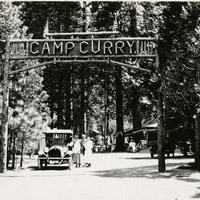
No caption c. 1917. Grace McCarthy and two unidentified people pose under a log sign reading "Camp Curry." Yosemite's Half Dome Village, established by David and Jennie Curry in 1899, was originally called Camp Curry, and later Curry Village. It was designed to provide cheaper accommodations for Yosemite tourists than the resort hotels. The couple set up furnished tents and provided amenities such as a dining tent. The entrance sign seen in this photograph was erected in 1914. As a result of a legal dispute over trademarked names in the park, Curry Village changed its name to Half Dome Village in 2016.
Date: 1917