Search All Items
- Filters:
- Language
- English 6020
- Spanish 194
- ENGLISH 2
- English 1
- census_013 1
- Type
- Image 3854
- Still Image 1909
- Text 426
- Text 22
- Textual 2
Search Results 2271 to 2280 of 6281
-
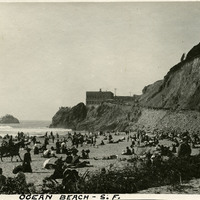
Caption: "Ocean Beach - S.F," c. 1910, shows a large group of sunbathers on San Francisco's Ocean Beach.
Date: 1910
-
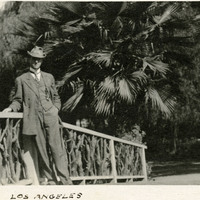
Caption: "Echo Park [sic] Los Angeles," c. 1906. Unidentified man leaning on a railing made of tree branches, with palm trees and other vegetation in the background. Echo Lake Park opened in 1895. The lake was originally created in 1868 to support the operations of a mill. The mill, however, closed seven years later. The site was later selected for conversion to a city park.
Date: 1906
-
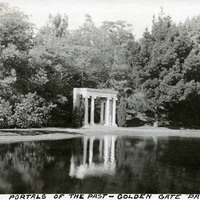
Caption: "Portals of the Past," c. 1915. A monument in Golden Gate Park in San Francisco, on the shores of Lloyd Lake, consisting of a white marble archway and columns. The archway was originally part of the Nob Hill mansion belonging to railroad tycoon Alban Towne. The mansion was destroyed in the 1906 San Francisco earthquake and fire, but the entryway still stood. It was moved to the shore of Lloyd Lake in 1909, as a memorial to the pre-1906 city.
Date: 1915
-
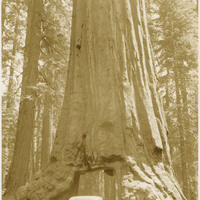
No Caption: c. 1935. Pictured are vehicles driving through the famous Wawona Tunnel Tree, a giant sequoia that stood in Mariposa Grove of Yosemite National Park. The tree's tunnel was cut in 1881 as a tourist attraction. In 1969, the tree fell during a severe winter storm. Before it fell, the ancient tree measured 234 ft. high, twenty-six ft. in diameter, and was approximately 2,100 years old.
Date: 1935
-
Caption: "Bird's Eye View. Camp Lewis, Wash.," c. 1918. This postcard shows a bird's eye view of buildings at Camp Lewis. The Camp was established by the U.S. Army in 1917, as part of the U.S.'s preparations for eventual entry into World War I. Rapid construction had the camp ready to house 60,000 men within a few months. The site is still in use as a military facility, under the name Fort Lewis.
Date: 1918
-
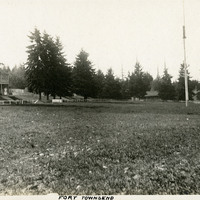
Caption: "Fort Townsend," c. 1906. Park-like scene, with buildings in the distance and a flag pole at the right. The U.S. Army established Fort Townsend in 1856. Abandoned after a fire destroyed the barracks buildings in 1895, it was reactivated during World War II to serve as a munitions defusing station. It was turned over to the State of Washington in 1953, and is now in use as Fort Townsend State Park.
Date: 1906
-
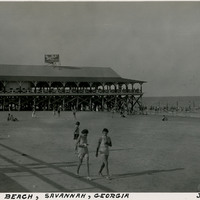
Caption: "Tybee Beach, Savannah, Georgia, July 14, 1934." Beach scene with a small crowd of unidentified people enjoying the ocean waves and strolling in the sand. The large Tybrisa Pavilion, set on a wood pier, extends into the water. Tybee Beach is one of several beaches in Tybee Island, a town on an island of the same name located across the river from Savannah. The island became a popular tourist spot between the Civil War and the mid-twentieth century, particularly after the Central of Georgia Railway constructed a line to the island. To encourage tourists, the railroad built Tybrisa Pavilion in 1891. It featured a large dance floor that became popular on the Big Band circuit, but was destroyed by fire in 1967.
Date: 7/14/1934
-
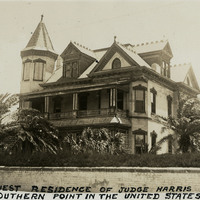
Caption: "Key West Residence of Judge Harris, Most Southern Point in the United States July 2, 1934." View of the Queen Anne-style Victorian mansion constructed in Key West by Judge Vinning Harris in 1897. The home was originally touted as occupying the southernmost point in the U.S., resulting in the colloquial name "Southernmost House." During the Prohibition years (1920-1933) the house operated as a speakeasy, with a restaurant and casino. In 1939, it was converted to use as a nightclub. Today, it has been renovated for use as a bed-and-breakfast.
Date: 7/2/1934
-
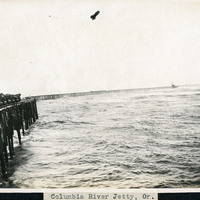
Caption: "Columbia River Jetty, Or.," c. 1910. View of a jetty built at the mouth of the Columbia River, carrying a railroad trestle. Train cars loaded with large rocks are visible at the left side of the photograph. This is likely the so-called South Jetty, extending more than six miles into the ocean from Point Adams on the Oregon side of the river mouth. The jetty system at the mouth of the Columbia River was constructed between 1885 and 1917. Designed to funnel water from the Columbia River in a more concentrated fashion into the Pacific Ocean, the jetty system helped create a deeper, more stable shipping channel.
Date: 1910
-
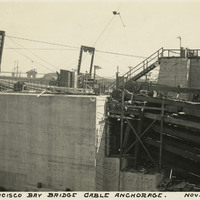
Caption: "San Francisco Bay Bridge Cable Anchorage. Nov. 1, 1935." View of a cable anchorage at one terminus of the San Francisco-Oakland Bay Bridge. The Bay Bridge's design combined three different types of bridge-building technology over the five miles it covers between San Francisco and Oakland: a suspension span, a cantilevered span, and a tunnel. At the time of its completion in 1936 the bridge was the longest steel structure on the globe. It also featured the deepest bridge pier ever built, and the world's largest bore tunnel.
Date: 11/1/1935