
Search All Items
- Filters:
- Language
- English 5312
- Spanish 43
- ENGLISH 2
- English 1
- census_013 1
- Type
- Image 3851
- Still Image 1035
- Text 445
- Text 22
- Textual 2
Search Results 2291 to 2300 of 5424
-
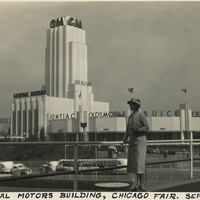
Caption: "General Motors Building, Chicago Fair. Sept. 17, 1934." Grace McCarthy stands at a railing with the General Motors Building in the background. The building was part of the Century of Progress Exposition, a world fair attended by thirty-nine million people, celebrated Chicago's one-hundred year anniversary of incorporation. Originally planned to only run from May to November in 1933, it was such a success that its organizers decided to keep it running for a second season from May through October the following year. The central theme of the Exposition was technological innovation, with a motto of "Science Finds, Industry Applies, Man Conforms." None of the buildings constructed for the fair are still extant today, having been built as temporary facilities.
Date: 9/17/1934
-
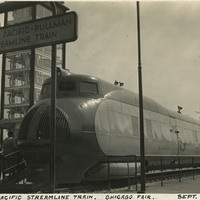
Caption: "Union Pacific Streamline Train. Chicago Fair. Sept. 22, 1934." View of the engine on the Union Pacific's new M-10000, on exhibit at Chicago's Century of Progress Exposition. The M-10000 was the first lightweight express passenger train powered by an internal combustion engine in the U.S. The train went on an exhibition tour of the US in 1934, which included a stop at the Exposition. The Exposition, a world fair attended by thirty-nine million people, celebrated Chicago's one-hundred year anniversary of incorporation. Originally planned to only run from May to November in 1933, it was such a success that its organizers decided to keep it running for a second season from May through October the following year. The central theme of the Exposition was technological innovation, with a motto of "Science Finds, Industry Applies, Man Conforms."
Date: 9/22/1934
-
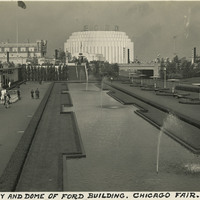
Caption: "Parkway and Dome of Ford Building. Chicago Fair. Sept. 17, 34." Several pedestrians wander along a parkway with a small lagoon and fountains, flanked by benches and manicured hedges. The Ford Building rises in the distance. The Exposition, a world fair attended by thirty-nine million people, celebrated Chicago's one-hundred year anniversary of incorporation. Originally planned to only run from May to November in 1933, it was such a success that its organizers decided to keep it running for a second season from May through October the following year. The central theme of the Exposition was technological innovation, with a motto of "Science Finds, Industry Applies, Man Conforms." None of the buildings constructed for the fair are still extant today, having been built as temporary facilities.
Date: 9/17/1934
-
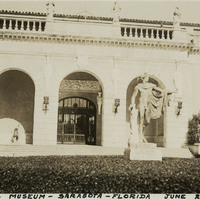
Caption: "Ringling Museum -- Sarasota -- Florida, June 28 1934." Entrance to the John and Mable Ringling Museum of Art, Florida's state art museum established by John and Mable Ringling in 1927. John was a promoter and part-owner of the famous Ringling Brothers Circus, along with four of his brothers. When John and Mable built a winter home in Sarasota in 1926, they also explored the possibility of establishing an art gallery on the same property. Architect John H. Phillips designed the building, which opened to the public in 1931. John Ringling willed the facility and the art collection to the state of Florida upon his death in 1936. The museum, now known simply as "The Ringling," is under the jurisdiction of the University of Florida.
Date: 6/28/1934
-
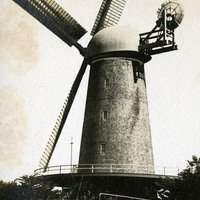
Caption: "MC. Foto" and "Dutch Windmill," c. 1905. This postcard shows the Dutch Windmill in Golden Gate Park, built in 1903 to pump ground water within the park for irrigation purposes.
Date: 1905
-
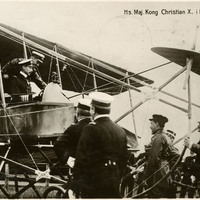
Caption: "Hs. Maj. Kong Christian X. i Flyvemaskine" and "100 Kobenhavn." This postcard shows Denmark's King Christian X in an early biplane. It was sent to William and Grace McCarthy on December 29, 1915.
Date: 1915
-
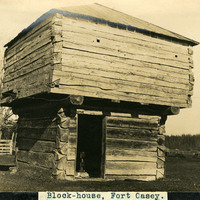
Caption: "Block-house, Fort Casey.," c. 1908-1912. View of a blockhouse, a timber structure built by European settlers to guard against attack during the Indian Wars of 1855-1857. See also 96-07-08-alb08-019.
Date: 1908
-
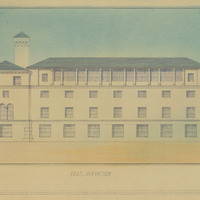
Caption: "East Elevation." Rendered elevation of Scheme No. 1, addition of 4th floor to hospital building, San Quentin State Prison. Sketch in colored pencil by Alfred Eichler. Project for Department of Corrections.
Date: 1934
-
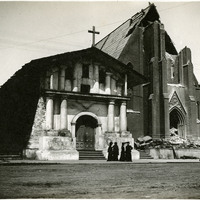
No Caption: Mission Delores, the oldest intact building still standing in San Francisco today, suffered little damage from the 1906 earthquake. The parish church next to it was greatly damaged and rebuilt as the Mission Dolores Basilica, opened in 1918.
Date: 1906
-
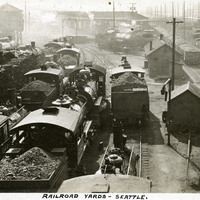
Caption: "Railroad Yards -- Seattle.," c. 1905-1909. View of busy rail yard in Seattle, with a series of trains loaded with what appears to be gravel or rubble, as well as sheds, a water tower, and several other outbuildings.
Date: 1905